The Bottom Line First
If you're buying hearing protection for a noisy workplace and you want the short answer: the 3M Peltor X5A has the highest NRR in the Peltor lineup at 31 dB, and for genuinely brutal noise—105 dB and up, the kind of environment where you feel your chest vibrate—it's the right call. But if your people need to hear radio calls, alarms, or each other, the Peltor Bluetooth hearing protection models are the better buy. You give up a few dB of NRR. You gain the ability to stay protected and still communicate. That trade is almost always worth it.
Here's the part most buying guides skip, though. Your earmuffs are one component of a safety system, and the system fails at its weakest point. I've walked into sites where every worker was wearing $200 earmuffs and the hard-wired smoke detector in the break room had been beeping for three weeks—backup battery dead, nobody knew how to test it—and the safety goggles on the bench were so scratched you couldn't see through them. The earmuffs were fine. Everything else was a liability.
So this isn't just an earmuff review. It's a field guide to the whole kit.
Why You Can Trust This Take
I'm an emergency safety response coordinator at an industrial consultancy. I've handled 200+ urgent onsite assessments in 12 years, including same-day turnarounds for manufacturing plants, construction contractors, and one indoor shooting range that opened before its ventilation was signed off. When a noise complaint or a failed alarm comes in, I'm the one driving out with a sound meter and a clipboard.
In March 2024, a fabrication shop called at 4 PM on a Friday. Their night shift had complained to management about the noise, and when I walked in that evening, I clocked 103 dB near the press brakes. The workers had been issued foam earplugs—the cheap roll-down kind—and nothing else. We ordered Peltor X5As that night and had them on the floor by Monday noon. The foam plugs weren't the problem, exactly. The problem was that nobody had measured the noise, nobody had trained the workers on fit, and nobody had a plan for the smoke detectors that were too quiet to hear over the machines. That's the pattern I see over and over.
The Details That Actually Matter
3M Peltor X5A: When the Highest NRR Is the Right Call
The X5A is a no-brainer for extreme noise. At 31 dB NRR, it's the highest-rated earmuff in the 3M Peltor line, and the fit is more adjustable than most people expect—the padded headband and large cups actually seal, which is where cheap earmuffs fall apart. I've seen workers wear X5As for a full eight-hour shift without the usual complaints about clamp force.
But here's the reality check that NIOSH has been making for years: the published NRR is not what you get in the field. NIOSH recommends derating the NRR by about 50% to account for real-world fit and wear. So that 31 dB rating is closer to 15 or 16 dB of actual protection in a working environment. Still excellent. Just don't do the math as if lab conditions apply.
And remember: NRR is a starting point, not a finish line. If you're above 105 dB, you may need dual protection—earmuffs over earplugs—and you definitely need to verify fit with a real worker, not a spec sheet.
Peltor Bluetooth Hearing Protection: The Efficiency Play
This is where the Peltor Bluetooth hearing protection models earn their keep. In a lot of noisy environments, the biggest safety risk isn't the noise itself—it's what happens when a worker takes off their earmuffs to hear a radio call and forgets to put them back on. I've seen that exact cycle cause more overexposure than any single loud event.
The Bluetooth models solve that. You stay protected and stay in communication. The NRR drops to around 26 dB on models like the Tactical 500, which is still solid for most industrial noise, and the rechargeable battery means you're not hunting for AAAs every third shift. The people who push back on Bluetooth earmuffs usually haven't watched a worker juggle earmuffs and a two-way radio on a production floor. It's a bottleneck, and bottlenecks cost time and safety.
One caveat: Bluetooth earmuffs are not for everyone. If you're purely trying to block noise—no communication needed—the X5A wins. If you're on a range or a factory floor where coordination matters, Bluetooth is the efficiency purchase.
The Hard-Wired Smoke Detector Problem Nobody Audits
Let's talk about the thing that gets ignored until it matters. A hard-wired smoke detector beeping is usually a backup battery issue—the 9V or 10-year sealed battery has died, or the detector has a sensor fault. In a noisy workplace, that beeping might be the only thing alerting you that the detector isn't functioning. If the ambient noise is 85 dB or higher, you may not hear a standard alarm at all.
NFPA 72 requires smoke alarms to produce at least 85 dB at 10 feet. That sounds loud until you put it next to a 100 dB machine. The fix isn't exotic: interconnected detectors, visual alarms (strobes), or both. And the maintenance side is simple but easy to skip—press the test button monthly, use a smoke test aerosol annually, and replace the backup battery on schedule.
How to test a smoke detector battery is not complicated: press and hold the test button until the alarm sounds. If it chirps weakly or not at all, replace the battery. If it's a sealed 10-year unit, replace the whole detector. And if it's hard-wired and beeping intermittently, check the battery first, then call an electrician if the chirping continues. I've seen three facilities in the last two years where the smoke detectors were effectively non-functional for months because nobody owned the test routine. Don't be that site.
Safety Goggles: The Forgotten Half of the Kit
Here's a contrast insight I keep coming back to: noise and debris travel together. Grinding, cutting, stamping—wherever the dB level spikes, there's usually particulate flying around. And yet the same sites that invest in premium earmuffs often treat safety goggles as an afterthought.
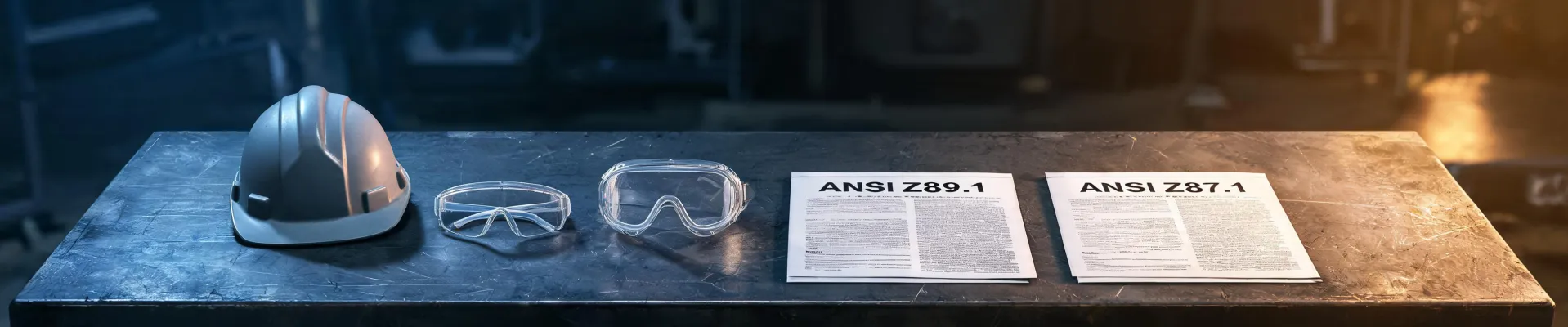
When you're reviewing safety goggles drawings or spec sheets from a supplier, check for ANSI Z87.1 marking—that's the baseline. Then look at the actual lens and frame fit. A $12 pair of goggles that seals and vents properly beats a $30 pair that fogs up and gets pushed onto the forehead. I don't have hard data on how many eye injuries happen in high-noise environments specifically, but anecdotally, the overlap is real. Buy both. Test both. Don't let the earmuffs get all the attention.
Where This Advice Breaks Down
A few honest limits. First, this is written for industrial and occupational buyers. If you're buying hearing protection for home use—mowing the lawn, woodworking in the garage—the calculation is different, and you don't need the same NRR budget.
Second, fit matters more than specs. A 26 dB Bluetooth earmuff that seals properly is better than a 31 dB X5A that sits loose because the headband wasn't adjusted. Get a sample pair and test it on the actual workers who will wear it for a full shift.
And third, none of this replaces a proper noise assessment. I can tell you what works on the sites I've walked. A sound meter and a fit test will tell you what works on yours.

Pranav Shah
Pranav Shah is a hand and arm protection analyst specializing in cut-resistant gloves, chemical gloves, impact gloves, electrical insulating gloves, disposable nitrile gloves, welding gloves, and protective sleeves. He applies ANSI/ISEA 105, EN 388, EN ISO 374-1, and EN 60903 methods while examining cut level, puncture force, abrasion cycles, permeation breakthrough, impact attenuation, dielectric proof voltage, dexterity, grip, and cuff coverage. His guides help manufacturers, utilities, laboratories, construction teams, and sourcing specialists choose glove systems around the actual hazard, exposure time, tool handling, contamination control, and replacement frequency.