-
Dimension 1: Safariland Military Holster + STX Finish vs. Generic Polymer Holster
-
Dimension 2: Hearing Protection and the Reusable Earplug Debate
-
Dimension 3: Safety Glasses Side Shields and Hi Vis Jacket — Where Generic Wins
-
Dimension 4: Paperwork, Compliance, and Why the Small Order Deserves Real Service
-
How I'd Actually Choose — Scenario by Scenario
Let me set the scene. I'm the procurement manager at a 40-person private security company. I've managed our equipment budget (~$85,000 annually) for 6 years, negotiated with 20+ vendors, and documented every order in our cost tracking system. Our next quarterly list includes duty holsters for 12 armed guards, 200 pairs of safety glasses side shields, 30 hi vis jacket units, and a running argument about whether you can reuse earplugs or if we should just keep buying foam in bulk.
You've probably read every shelf-level Safariland vs. generic comparison already. This isn't that. I'm comparing the two buying routes on the same four dimensions we use for every purchase: up-front unit cost vs. lifecycle cost, failure consequences, compliance documentation, and hidden friction (minimums, lead times, return policies). Our purchasing policy requires three quotes per order, and that discipline is the only reason I can write this down with numbers instead of vibes.
Here's the spoiler: the answer isn't 'you get what you pay for.' On two categories, generic wins outright. On one category, the Safariland premium is basically a non-issue because it's cheaper over 36 months. And on one dimension, the deciding factor has nothing to do with the product at all—it's whether your small order gets treated like a real order.
Dimension 1: Safariland Military Holster + STX Finish vs. Generic Polymer Holster
Our armed guard teams use a Safariland military holster — the ALS/SLS retention system with the Safariland STX tactical finish on the exterior. The price is roughly 2.5x to 3x a generic injection-molded polymer holster. (Ballpark figures, verify current dealer quotes: a retention duty holster from Safariland tends to run $200–260 as of early 2025, while generic duty holsters at $40–70 are common.)
'Great,' I thought when the quote came in, 'we're paying for the name.' Then I ran the three-year TCO.
Generic $45 holster: replaced once within two years when the thumb break or retention hood degraded. Add downtime to source a replacement, plus liability exposure if a weapon leaves the holster during a shift — that math doesn't fit on a spreadsheet. Year three, you buy another one, plus a little extra for fitment time. Three-year TCO lands around $90–110 before you count the tail risk.
Safariland, with the STX tactical finish: the surface handled abrasion and impact wear notably better in year one and two. The retention hood and belt clip still actuated cleanly at month 36. One holster, three years, TCO roughly equal to the sticker price.
But the real cost wasn't on the holster. Our lead instructor pointed out that switching holsters meant re-qualifying on a different draw. That's hours of range time every changeover, and our contract guards aren't cheap to retrain. The 'savings' from switching holsters got eaten by retraining.
Verdict: When the weapon is the core tool and someone's legal team will read the incident report, the Safariland premium is, honestly, less of a price and more of a 'stop thinking about it' fee. But that only holds when drawing a firearm is the job. If your team is unarmed, admin-heavy, or low-risk, a generic holster is fine and I'd rather spend the delta on training.
Dimension 2: Hearing Protection and the Reusable Earplug Debate
This one caused the biggest internal argument. Our safety lead said foam disposables were the cheapest per use. Our field lead said reusable plugs are the only sensible option. Both were half right.
I pulled six months of records. Disposable foam earplugs bulk-bought, maybe $0.08–0.15 a pair, look unbeatable per unit. But the attrition rate was something like 30% a week, and some guards wanted a new pair per shift. Reusable plugs (flanged or corded) at $8–15, plus cleaning and storage time, can last 12+ months if the crew actually keeps track of them.
Crunch the per-shift-use numbers and the reusable option breaks even around month 6 to 9 for a fixed 12-person armed team with reasonable retention. For a high-turnover team where you can't chase accountability, disposables can still win on pure convenience.
But the deciding factor wasn't money. Under OSHA 29 CFR 1910.95, employees exposed to 85 dBA as an 8-hour time-weighted average need a hearing conservation program with fitting and retraining. A well-documented reusable earplug program with a fit panel is far easier to defend in an audit than a box of loose foam plugs sitting in the back of a trailer.
Verdict: Reusable earplugs are almost always cheaper for a stable crew, and the compliance story is stronger even at a small premium. Disposables only win when turnover is high and training cost is hard to recover.
Dimension 3: Safety Glasses Side Shields and Hi Vis Jacket — Where Generic Wins
This is the mindshift moment for me. We had been defaulting to the most visible brand on every line item. When I re-ran the same TCO model, generic won on almost every metric for these categories.
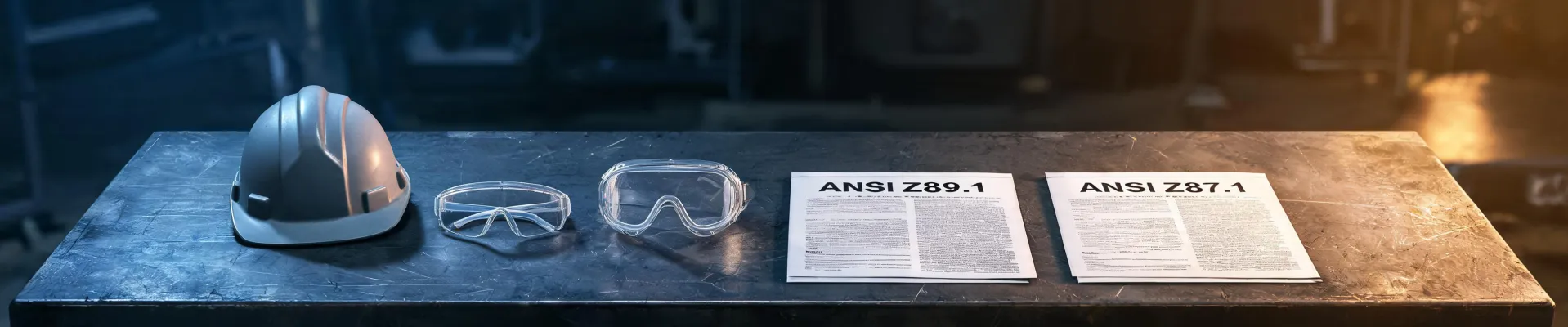
On safety glasses side shields, the real drivers are side-shield attachment and frame durability. As long as the eyewear carries an ANSI Z87.1 rating (and the side shields are marked Z87.1+ with shield markings), you've covered the eye protection requirement. I compared 200 pairs of generic glasses with side shields against the branded equivalent, projected over 24 months, and the cost per wearer-month looked basically identical. The difference came down to fit and whether the guards would actually wear them — not protection performance.
The hi vis jacket category was even more one-sided. Under ANSI/ISEA 107, a Class 2 or Class 3 hi vis jacket meets the same visibility performance requirements, and you can look up the certification mark on the garment itself. For our specific use — night patrol, moderate abrasion, washed five days a week — a $36 generic jacket performed about as well as a $78 branded one on everything except trim fit and after 12 months of wash cycles. The generic version with our company logo and name printed came to $12 less per unit, and the minimum order was lower. Thirty jackets at $42 less each is $1,260 — enough to outfit a second backup set for the entire crew.
I over-spent for years because our purchasing manual said 'branded = better.' It isn't. Verdict: For standardized, certified, low-consequence items — safety glasses with side shields, hi vis jackets — generic wins on price, and often on flexibility too. Save the premium for the things where failure becomes an incident.
Dimension 4: Paperwork, Compliance, and Why the Small Order Deserves Real Service
Compliance documentation is where the two routes should separate — but often don't. The NIJ Compliant Products List PDF and ANSI certification marks are available from either path. What actually separated vendors was hidden friction. In our 2023 spend audit, roughly 80% of our overruns came from minimum order thresholds, unauthorized substitutions, and 'small order handling fees' that only showed up on the invoice.
I had a vendor quote a $400 quarterly restock and then try to add a $75 handling fee for being under their minimum. That one got escalated. Today our scorecard rates vendors on 'consistent, transparent treatment of small orders' alongside price. It's a line item because it should be.
The most reliable distributors we keep are the ones who treat our $500 quarterly order the same way they'd treat a $50,000 one. That's why the small distributor who supplies our safety glasses side shields and reusable earplugs has been our pick for years — they answer the same way whether it's a sampling order or a full seasonal replacement.
Verdict: On formal compliance, price and size should be irrelevant. On hidden friction, the relationship and the willingness to be treated like a real customer often save more money than any single discount.
How I'd Actually Choose — Scenario by Scenario
If your team is armed, carries a duty weapon, and has real liability exposure, the Safariland military holster and mid-tier carrier are worth the premium. Run the TCO over 24–36 months, not the sticker. If your team is a fixed crew with steady staffing, a documented reusable earplug program is a near-lock. The compliance discipline pays for itself.
For standardized hi vis jackets and safety glasses side shields, I'd go generic with a clean certification trail. Check the certification, not the label. Reinvest the savings in range time or backup earplug cleaning supplies, both of which have measurable returns.
As for whether you can reuse earplugs — yes, if you're using the right type, cleaning and storing them properly, and treating them as part of a compliance program rather than a supply cabinet afterthought. If you're going to be sloppy about training records, disposables are cheaper to be lazy with. If you're going to be rigorous, reusable is usually cheaper and easier to defend.
Pricing and regulatory references reflect early 2025; confirm current quotes and current regulations at NIJ, ANSI, OSHA, and your local distributor before finalizing any order.

Lars Eklund
Lars Eklund is a lockout and electrical-safety analyst specializing in safety padlocks, lockout hasps, breaker and valve lockouts, group lock boxes, tags, voltage detectors, insulating tools, and arc-flash PPE kits. He applies ANSI Z244.1, NFPA 70E, and IEC 61243-3 practices while examining isolation points, lock capacity, key control, device fit, absence-of-voltage verification, approach boundaries, incident energy, arc rating, and restoration sequence. His guides help maintenance leaders, electricians, plant managers, and procurement teams build equipment-specific energy-control programs that support verification, group work, shift changes, emergency removal, and audit-ready traceability.