Who This Checklist Is For
If you're a safety manager, EHS coordinator, or procurement specialist responsible for specifying personal protective equipment for a crew—especially across multiple job sites—you've probably felt the tension between budget, compliance, and worker comfort. This checklist is for you.
I'm a quality compliance manager. I review every PPE delivery before it reaches our warehouses—roughly 200+ unique items annually. Over four years of doing this, I've rejected about 12% of first deliveries due to spec mismatches, missing certs, or outright wrong products. In Q1 2024 alone, three orders failed because someone assumed a hard hat was a hard hat.
Here are the five most common mistakes I see—and how to fix them before you place your next order.
Step 1: Start With Compliance, Not Price
It’s tempting to think you can just compare unit prices. But identical-looking products from different vendors can result in wildly different outcomes. The 'always get three quotes' advice ignores the transaction cost of vendor evaluation and the value of established relationships.
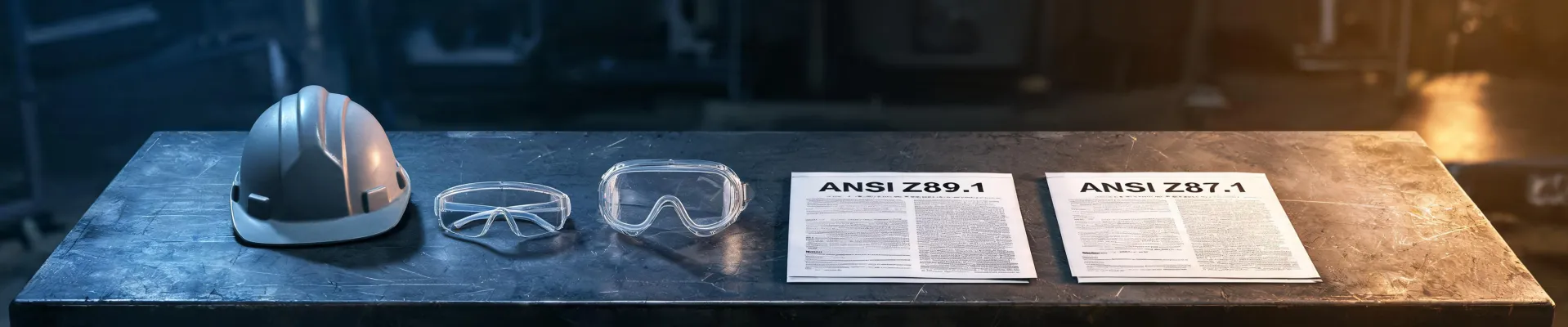
What I check first: Does the product have a verifiable standard mark? For safety glasses, that's Z87+ in the US (not just Z87). For hard hats, Type 1 vs Type 2 matters—a lot. Type 2 protects against lateral impact, not just top-of-head. If your crew works in confined spaces or near moving equipment, lateral protection isn't optional.
Common pitfall: We once received 500 units of safety vests that looked fine—until I checked the tags. The ANSI Class 3 marking was printed, not sewn in. The vendor claimed it was 'within industry standard.' We rejected the batch, and they redid it at their cost. Now every contract includes explicit marking requirements.
Step 2: Don't Assume a Hard Hat Is Just a Hard Hat
Honestly, I'm not sure why some procurement teams still order standard full-brim hard hats without considering the job site environment. My best guess is it comes down to habit.
The Pyramex Ridgeline hard hat is a good example. It's a Type 2, vented design with a ratchet suspension system. But if your crew works in high-heat environments, the cooling liner upgrade makes a real difference. If they're on sloped roofs, a hard hat with chin strap isn't optional—it's a safety requirement.
Checklist item:
- Type 1 or Type 2?
- Vented or solid?
- Does it need a chin strap? (Yes, if there's fall risk.)
- What accessories? (Slotted caps accept earmuffs, visors, etc.)
Step 3: Face Your Glove Confusion Head-On
It’s tempting to search for 'work boots' or 'nitrile gloves vs latex' and assume the first result is good enough. But here's where specifications get fuzzy.
Nitrile gloves vs latex: Nitrile gloves offer better chemical resistance and are less likely to cause allergic reactions. But not all nitrile is the same—thickness and coating length matter. For general handling, 4-5 mil is fine. For chemical splash, you need at least 8 mil and a longer cuff. Latex gloves, meanwhile, offer better dexterity but degrade with oils and solvents.
Real-world example: I ran a blind test with our warehouse team: same cut-resistant liner with nitrile coating vs natural rubber coating. 85% identified the nitrile-coated pair as 'less slippery' without knowing the difference. The cost increase was about $0.30 per pair. On a 2,000-unit run, that's $600 for measurably better grip and fewer dropped items.
Step 4: Treat High-Vis as Its Own Category, Not an Afterthought
When someone says 'pyramex safety vests,' they're usually thinking about high-visibility apparel. But there's a world of difference between a surveyor's vest and a Class 3 garment with breakaway functionality.
Common mistake: Ordering the same hi-vis vest for road work and warehouse picking. Road work requires Class 3 with high contrast (e.g., lime with orange trim), reflective tape on the torso and arms, and breakaway clasps for entanglement hazards. A basic mesh vest won't cut it.
We didn't have a formal hi-vis selection process. Cost us when a Type R vest (only front and back tape) was delivered for a job site requiring Type E (sleeves with tape). The $2,200 order had to be returned—on our dime.
Step 5: Don't Forget the 'Other' PPE
Most people focus on hard hats, glasses, and gloves. But what about bump caps? Earplugs? Work boots? The Pyramex Ridgeline hard hat is great, but for low-clearance environments where impact risk is minimal, a bump cap might be more practical.
Checklist item:
- Do workers need hearing protection? (Check the noise map, not the spec sheet.)
- Are work boots rated for electrical hazards or slip resistance? (Different job sites require different standards.)
- Do you have eyewear for both men and women? (Frame sizes matter for comfort and compliance.)
Final Checks Before You Order
Before you hit 'submit' on your next PPE order, run this quick audit:
- Are all standards explicitly stated? Z87+, ANSI Type 2, etc.
- Do you have documentation? Certificates of compliance, not just marketing claims.
- Is there a backup plan? If the vendor misses the delivery window, do you have a local supplier who can cover? (In March 2024, we paid $400 extra for rush delivery on gloves. The alternative was missing a $15,000 safety audit. Worth every dollar.)
One last thing: Don't assume your team knows everything. The third time we ordered the wrong quantity for earplugs, I finally created a verification checklist. Should have done it after the first time.
If you're still unsure about a specific spec—like whether you need a hard hat with chin strap or which type of glove is right for your chemicals—call your supplier's technical rep. I've never fully understood why some safety managers skip that step. If someone has insight, I'd love to hear it.
(And if you're on a tight deadline, remember: paying for guaranteed delivery is way cheaper than explaining a shutdown to your boss.)

Maeve Callahan
Maeve Callahan is a head-protection analyst covering Type I and Type II hard hats, climbing-style safety helmets, bump caps, chin straps, suspensions, liners, and face-shield carriers. She applies ANSI Z89.1, EN 397, and EN 12492 criteria while comparing impact attenuation, penetration resistance, lateral deformation, electrical class, retention strength, field of vision, mass, fit range, and temperature conditioning. Her guides help EHS teams, contractors, utilities, and buyers select helmet systems for overhead hazards, work at height, electrical exposure, accessory compatibility, and worker acceptance.