-
Who This Checklist Is For
-
Step 1: Verify the Compliance—Don't Just Read the Label
-
Step 2: Check the Total Cost—Not Just the Unit Price
-
Step 3: Check the 'Boring' Features (This Is Where Most Buyers Get It Wrong)
-
Step 4: Verify the Long-Term Availability—Don't Fall in Love With a Discontinued Product
-
A Few Things to Watch Out For
I manage PPE ordering for about 25 people in our warehouse and field crew. Roughly $50k annually across 8 vendors. And if you'd told me five years ago I was leaving money on the table with every order, I'd have shrugged. But here we are.
When I first started buying safety gear—circa 2019—my process was simple: find the cheapest option that had a safety rating sticker. That approach worked exactly until it didn't. The $8 hard hats? Broke after three weeks. The 'hi-vis' vests that were see-through after one wash? Yeah, those went straight in the trash.
By 2023, I had a system. This isn't a theory piece. Here are the 4 things I check on every PPE order now—and you should too.
Who This Checklist Is For
You're buying PPE for a team—maybe 10 people, maybe 100. You're not a safety specialist, but you're the one placing the order. You want products that actually protect people, hold up to real work, and don't blow your quarterly budget. This checklist is for you.
Step 1: Verify the Compliance—Don't Just Read the Label
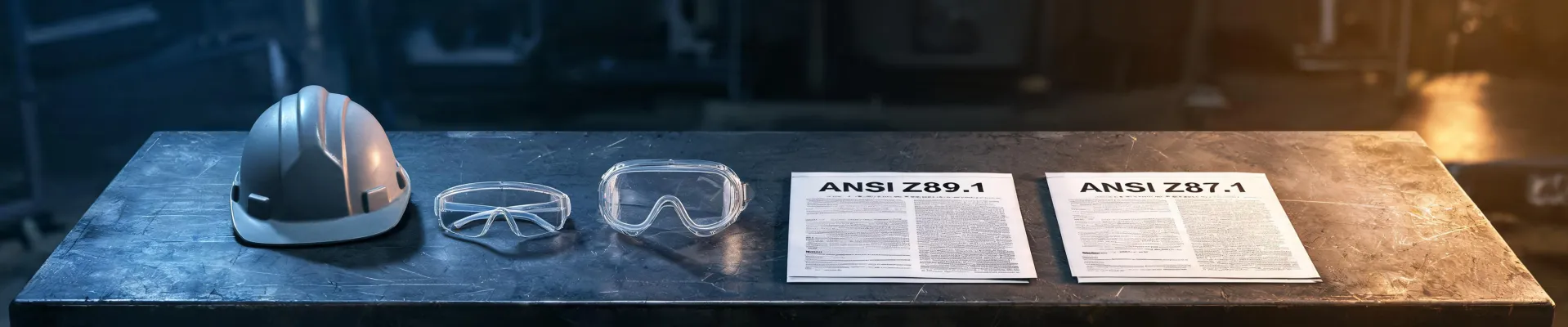
It's tempting to think if a product has a standard number on the box, it's good to go. But the box doesn't tell you the whole story. For example, take safety glasses. You'll see Z87 stamped on a lot of frames. That's a minimum. But if you're near chemical splashes, you need Z87+ for high-impact rated lenses. The regular Z87? Not enough.
When I ordered Pyramex G205 safety goggles for our crew, I double-checked the Z87+ rating. The product page was clear—rated for high-impact and chemical splash. That's the level of detail you want. If the spec sheet is vague, move on. For hard hats, check if it's Type 1 (top impact only) or Type 2 (top and lateral impact). Pyramex vented hard hats, for instance, are mostly Type 1. That's fine for general construction. But if you have workers near lateral hazards (like steel beams at shoulder height), you need Type 2. The product page should say it clearly. If it doesn't, ask.
Quick check: Does the product page explicitly mention the standard (ANSI Z87.1-2020, ANSI/ISEA 107-2020 for hi-vis)? If you see vague claims like 'meets all relevant standards,' ask for the actual certification. That vagueness is a red flag.
Step 2: Check the Total Cost—Not Just the Unit Price
I learned this the hard way in 2021. I found a deal on hi-vis jackets—$18 each versus $30 for our usual. Ordered 40. They arrived with single-stitched seams and a reflective tape that peeled off after two wash cycles. The replacement cost plus downtime? More than if I'd paid the $30. The vendor who lists all fees upfront—even if the total looks higher—usually costs less in the end. I've learned to ask 'what's NOT included' more often than 'what's the price.' For example, with a hi vis jacket, you're looking at ANSI Class 3 or Class 2. Class 3 has more reflective tape and is required for highway work. If you buy Class 2 for a highway crew, you're not really saving money—you're buying a liability. The unit price is lower, but the total cost of non-compliance is way higher. That's a mistake I made once.
Another example: Merrell work boots. The $70 pair might seem like a deal. But if the soles delaminate in six months and you have to replace them, you've wasted time and money. The $120 pair that lasts two years? Actually cheaper per month. (Don't hold me to exact pricing—rates fluctuate. But the principle holds.)
Step 3: Check the 'Boring' Features (This Is Where Most Buyers Get It Wrong)
Most people focus on the safety rating and the price. But the stuff that makes a product usable day-to-day—that's where the real value is. For safety glasses, the anti-fog coating matters a lot. If your team is working in humid conditions or moving between hot and cold areas, regular lenses fog up constantly. Workers take them off to wipe them, which means they're not protected. The Pyramex G205 goggles I mentioned? They have a good anti-fog coating. Cheaper options? Usually fog up in minutes. For hard hats, look at the suspension system. A standard ratchet system adjusts quickly. But the Pyramex vented hard hat also has a cooling liner option. If your team works outdoors in summer, that's not a luxury—it's comfort that keeps them wearing the helmet. A worker who takes off their hard hat because it's too hot is unprotected. That's a failure of procurement, not safety.
Then there's gloves. The question 'can you use nitrile gloves for food prep' comes up a lot. The short answer: yes, but only if they're food-grade certified. General-purpose nitrile gloves might have manufacturing residues or be too thick for delicate work. You need gloves specifically marked for food contact. Pyramex makes food-grade nitrile options. But if you're ordering from a generic supplier, ask for the certification. This is the kind of detail that separates a good order from a mess.
Step 4: Verify the Long-Term Availability—Don't Fall in Love With a Discontinued Product
This is one I learned about two years ago. I found a specific model of hi-vis vest that was perfect. Great price, good fit. We used it for six months. Then I tried to reorder and it was discontinued. No direct replacement with the same specs. I had to re-evaluate from scratch. That cost me about 4 hours of research and phone calls. Now, before I commit to a new product, I check two things: how long has it been on the market? And are accessories/parts available? For example, Pyramex has been around for decades, and their popular models (like the Vented Hard Hat and the G205 goggles) have been consistent. That's a good sign. For a product that's new to the market, check if the vendor commits to a minimum production period. If they won't say, it's risky.
The same goes for safety glasses. If you buy a proprietary lens design, and the manufacturer stops making it, you're stuck with frames you can't replace. Stick to common sizes or models where replacement lenses are widely available.
A Few Things to Watch Out For
Don't assume that because a product is more expensive, it's better. Some vendors charge a premium for branding alone. That's why I always request a sample if I can. For hard hats, test the fit. For glasses, check for pressure points on the nose bridge. For gloves, check the dexterity rating. Specifications don't tell you everything.
Also, watch for 'bargain' bundles. I once saw a deal on 100 pairs of safety glasses for $80. They were the cheapest I'd ever found. Turned out they were not ANSI rated at all. Just 'safety-style' frames. Useless. If the price is way below market, there's usually a reason. The market rate for ANSI-rated safety glasses is roughly $3 to $12 per pair (as of early 2025, at least). If you see $0.80, something's off.
Last thing: don't forget about storage. Some PPE degrades in extreme temperatures or sunlight. Hard hats left in a truck cab in summer can weaken without visible damage. Check storage requirements before you order, especially if your team keeps gear in vehicles.

Maeve Callahan
Maeve Callahan is a head-protection analyst covering Type I and Type II hard hats, climbing-style safety helmets, bump caps, chin straps, suspensions, liners, and face-shield carriers. She applies ANSI Z89.1, EN 397, and EN 12492 criteria while comparing impact attenuation, penetration resistance, lateral deformation, electrical class, retention strength, field of vision, mass, fit range, and temperature conditioning. Her guides help EHS teams, contractors, utilities, and buyers select helmet systems for overhead hazards, work at height, electrical exposure, accessory compatibility, and worker acceptance.