When I took over ordering PPE for our company back in 2021—for 200+ employees across two facilities—I made every mistake you can imagine. I bought the wrong size gloves. I ignored specs. I trusted a cheap price. And I got called into my VP's office to explain why we had a room full of unusable hard hats.
That's when I realized: ordering safety gear isn't just about picking products off a catalog. It's about knowing the standards, understanding your people, and verifying the supplier actually delivers what they promise.
Here's a 5-step checklist I now use. No fluff. Just what works.
Step 1: Identify the Hazard, Not Just the Product
Most people start with the product name: "I need safety glasses." But that's not enough. You need to match the gear to the specific hazard.
For example, if we're talking Pyramex over the glasses safety glasses for workers who already wear prescription frames, the fit matters way more than the tint. Are they working outdoors? Then mirrored or tinted is fine. Indoors? Clear or blue-light blocking is better.
If it's a Pyramex bump cap—when do you actually need one? Not for construction. Think warehouse workers, maintenance staff, or anyone getting under low pipes. Bump caps protect against bumps and lacerations, not falling objects. That's a common mix-up.
I've seen managers order Type 1 hard hats for workers who just need head protection from scrapes. Save the heavy-duty stuff for actual drop hazards.
My rule: start with what they're exposed to, then find the product. Not the other way around.
Step 2: Verify Standards Compliance—Don't Assume
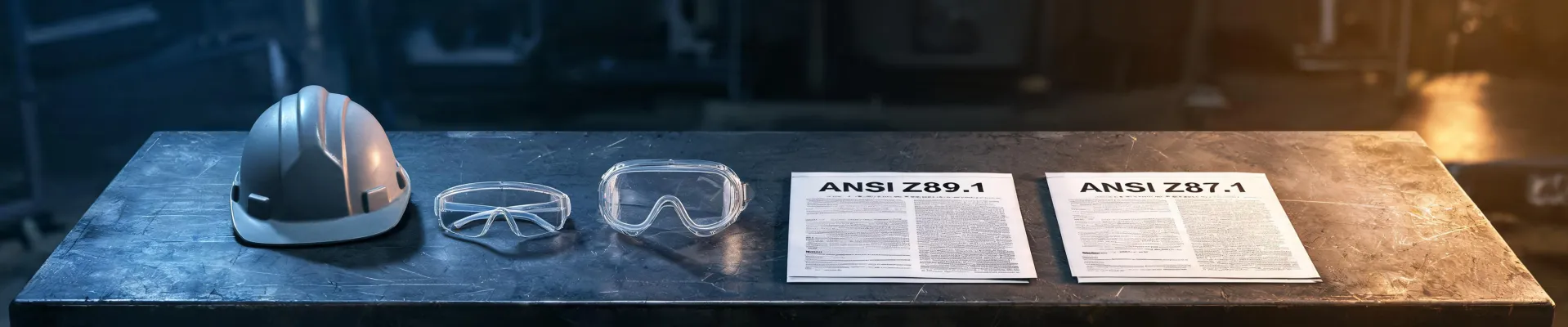
I used to think "if it's sold as safety gear, it must be safe." Nope. I once ordered a bulk lot of "safety goggles" that turned out to be not even ANSI Z87.1 rated. The supplier's website said "impact-resistant"—which technically means nothing without the standard.
Now I check the actual stamp or label. Every legitimate product will have it. For glasses, you want Z87+. For hard hats, Type 1 or Type 2 (depending on whether lateral impact is a risk). For gloves, look for cut resistance levels (A1–A9).
Also: don't trust the catalog photo. Compare the product spec sheet to the actual unit. I found a pair of Pyramex safety glasses once that listed "anti-fog" on the box but the actual coating wasn't marked. The supplier was surprised. (I wasn't.)
Step 3: Consider Real-World Usability—Not Just Price
The cheapest option isn't the cheapest if nobody wears it. We bought these super cheap gloves once—like $0.50 a pair. Workers hated them. They sat in the supply closet for months. We ended up tossing half. That's not saving money.
A better approach: test a few options before ordering in bulk. For example, a hi vis hoodie needs to be comfortable enough to wear all day, or workers will take it off. Same for a hard hat light—if it's awkward to attach, it never gets used. We now order 5–10 samples from different brands, let workers try them for a week, then pick the winner.
Another thing I learned the hard way: verify compatibility with other gear. A hard hat that doesn't fit with earmuffs is useless. A bump cap that's too bulky for a welding hood? Same problem.
Step 4: Validate the Supplier—Before You Order
The vendor that said "we can get you anything" was the same vendor that sent me the wrong product three times in a row. Not ideal, not terrible—but not reliable.
Now I run a quick sanity check on any new supplier:
- Ask for a sample of the exact product I'm ordering.
- Confirm lead time in writing. Verbal promises don't count.
- Check return/replacement policy. Especially for safety gear—if it doesn't fit or fails, you need a clear process.
- Get the spec sheet and compare it to the product I'm receiving.
This isn't rocket science. It's just a five-minute call that saves weeks of headaches.
Step 5: Create a Simple System for Ongoing Orders
The third time we ordered the wrong quantity and got the wrong product, I finally made a checklist. Pathetic, I know. But it works.
You don't need a fancy ERP. We use a shared spreadsheet with:
- Product name and SKU
- Supplier contact and pricing
- Lead time
- Quantity and frequency (reorder point)
- Notes from last order (what went wrong, what improved)
Plus, I have a simple rule: for the first order with any new supplier, always verify the product against the spec sheet before accepting delivery. We found a case of Pyramex bump caps that didn't meet the Type 2 rating we ordered. They looked identical. But the label didn't say it. Caught it before it went to workers.
What Not to Do (From Experience)
- Don't skip the verification step just because the website looks professional. A good site doesn't mean good inventory.
- Don't assume a product "meets standards" based on the product name. Read the actual spec sheet.
- Don't order bulk until you've tested at least three people using the gear.
- Don't keep using a supplier that can't provide proper invoices. Learned that one the hard way with a $2,400 expense report rejection—handwritten receipts don't fly with accounting.
Bottom line: buying PPE is a process. Get the hazard right, check the standard, test the product, verify the supplier, and build a system you can repeat. It's not glamorous. But it saves time, money, and—most importantly—keeps people safe.

Maeve Callahan
Maeve Callahan is a head-protection analyst covering Type I and Type II hard hats, climbing-style safety helmets, bump caps, chin straps, suspensions, liners, and face-shield carriers. She applies ANSI Z89.1, EN 397, and EN 12492 criteria while comparing impact attenuation, penetration resistance, lateral deformation, electrical class, retention strength, field of vision, mass, fit range, and temperature conditioning. Her guides help EHS teams, contractors, utilities, and buyers select helmet systems for overhead hazards, work at height, electrical exposure, accessory compatibility, and worker acceptance.