-
What the list is actually for
-
The 7-step pre-order checklist
-
Step 1: Do the replacement math before you compare prices
-
Step 2: Match the lens technology to the actual hazard, not the brochure
-
Step 3: Verify the Z87.1 marking, including on replacement lenses
-
Step 4: Run a 30-minute fit and interference test (the step almost nobody does)
-
Step 5: Price consumables by specification, not by name
-
Step 6: Audit the safety gear around the order — including what you didn't buy
-
Step 7: Write the restock terms into the purchase order
-
Step 1: Do the replacement math before you compare prices
-
Common mistakes I still catch in my own checklist
I've been handling PPE and MRO orders for a mid-size fabrication shop for six years. I've personally made — and documented — 14 significant ordering mistakes, totaling roughly $11,400 in wasted budget. Now I keep the pre-order checklist below pinned above my desk, and it costs me about 40 minutes per order.
This is for anyone who owns the safety cabinet: the shop foreman ordering 200 pairs of safety glasses, the office manager who inherited the Tyvek suit order, the new buyer who just got handed three vendor quotes for leather welding gloves. If you're comparing quotes right now, run them through these seven steps before you sign. The order I'm about to describe took a week to untangle, and it cost more than the glasses themselves.
The cheapest quote I approved in 2022 ended up costing 38% more than the second-cheapest by the time the lenses were replaced. That's the entire reason this list exists.
What the list is actually for
Not for finding the lowest price. For finding the lowest total: purchase price plus replacement frequency plus the cost of people not wearing the gear plus the cost of an audit or a shutdown when something slips. Unit price is the part of the iceberg you can see from the dock.
The 7-step pre-order checklist
Step 1: Do the replacement math before you compare prices
Take the two quotes and ask how many units you'll actually go through in 12 months — not how many you'll order. Those are different numbers.
A $3.80 lens that hazes over and gets wiped with a shop rag lasts maybe three weeks on a weld line. A $7.20 lens with a hard coat and anti-fog can last two months. On 60 wearers, that's 1,040 units versus 360 units: $3,952 versus $2,592. Same coverage, different number.
Did I get that right the first time? No. My first version of that spreadsheet compared order quantity instead of usage, and I "saved" us about $1,900 that never showed up on the P&L.
Step 2: Match the lens technology to the actual hazard, not the brochure
Three questions decide this for safety eyewear, and none of them are "which one has the most features":
- Does the wearer move between temperature zones? Cold room to a hot line, or an air-conditioned office to a shop floor in July. If yes, anti-fog matters more than impact rating — both pass Z87.1, but only one stays on the face.
- Is anyone over 45 and refusing to wear readers? More common than the industry admits. The Edge Eyewear Delano G2 with a 2.0 diopter reader solved it for four of our welders who kept flipping their prescription glasses onto their foreheads.
- Is there reflected glare off a horizontal surface? Yard work, wet loading docks, anything outdoors. Polarized lenses cut that glare; without it, people start lifting the glasses to look down.
Our Reclus units are the ones that survive the cold-room-to-weld-bay transition without fogging. That's the ZDF coating doing its job, not the spec sheet.
But here's what I learned the hard way: anti-fog coatings degrade, and the cleaning method decides half their lifespan. I've read Edge Eyewear Reclus safety glasses reviews praising the fog resistance after six months of daily wear, and I've also had a batch where the coating failed inside eight weeks — because people were wiping the lenses with solvent wipes from the janitorial closet. Ask your wearers what they clean with before you blame the supplier.
Step 3: Verify the Z87.1 marking, including on replacement lenses
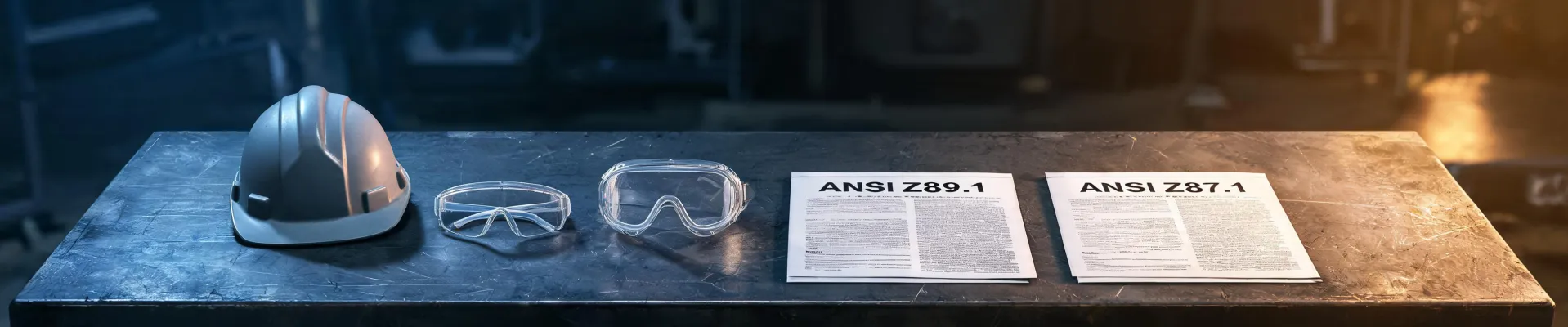
OSHA 1910.133 requires eye and face protection that meets ANSI/ISEA Z87.1-2020. The marking goes on both the lens and the frame. A "+" after Z87 (Z87+) means the unit passed the high-velocity impact test; a plain Z87 does not. Most people check the frame and stop there.
The trap is replacement lenses. If you buy spares from a third party and they don't carry the marking, you've just purchased cosmetic glass. I nearly did this on a 300-piece order to save about $0.60 per lens. When I asked the supplier for the certificate, I got a screenshot. Screenshots are not certificates — get the PDF with the standard number on it and file it with the PO.
Step 4: Run a 30-minute fit and interference test (the step almost nobody does)
You cannot tell from a catalog whether a pair of safety glasses fits under your hard hats, or whether the temples fight with over-the-ear muffs. Pull three of your actual wearers — one with a narrow face, one who wears a hard hat all day, one who wears hearing protection — and hand them samples for half an hour.
Watch for three things:
- The gap between the brow and the top of the frame. Too big, and the wearer catches debris anyway.
- Temple pressure under the ear where the muff seal sits. If the muff seal breaks, noise protection fails too — two programs, one problem.
- Whether people push the glasses up onto their forehead without noticing. That's a signal the nose piece is wrong, and it means you're paying for eye protection that spends its day in someone's hair.
Why does 30 minutes matter? Because a pair that doesn't fit is a pair that isn't worn, and a pair that isn't worn has no value in a TCO model at all. It's also the kind of thing that surfaces in an inspection as a training deficiency. As of January 2025, OSHA's maximum penalty for a serious violation is $16,550 — verify current figures at osha.gov, but you get the scale. That single number is larger than most annual eyewear budgets.
(Should mention: you can run this test before you order 300 units, not after. We did it after. Twice.)
Step 5: Price consumables by specification, not by name
Two words that cost me money: "Tyvek suit." That's not a specification, it's a brand. Tyvek 400 and Tyvek 800 are different garments built for different hazards, and the quote doesn't always tell you which one is arriving. Ask for the data sheet, the fabric weight in gsm, and the seam construction. A sewn seam and a taped seam are not the same product at the seam line, and that's exactly where protective clothing fails.
Same rule for leather welding gloves, and this one is easier to compute. A $6 pair at 40 hours a week burned through in about seven weeks. A $14 pair with a thicker split-leather palm and a longer gauntlet lasted four months. Per month of coverage: $3.43 versus $3.50 — basically a tie. Then you count the three trips to the supply cabinet and the half-hour of downtime every time a weld fails because a glove split. The $14 pair won, and not narrowly.
Check the standard too. Welding PPE falls under ANSI Z49.1 for safety in welding and cutting. If your glove supplier can't name the leather thickness in millimeters and the coating, they're pricing by guesswork.
Step 6: Audit the safety gear around the order — including what you didn't buy
Here's something vendors won't tell you: your PPE order changes how the rest of the building behaves. Switching to a solvent-heavy lens wipe on a 200-person site means more fumes near the sensors. Adding a third weld bay means more smoke. Within a year, you'll hear the complaint:
"Why does my smoke detector randomly go off?"
At our shop it was three reasons stacked on top of each other. Dust from a grinding station mounted too close to a photoelectric head. A humid week that condensed on the optical chamber. And one unit installed in 2013 that was quietly past its service life. Nobody fixed any of it, so the crew did what crews do: someone wrapped the detector in cling film and kept welding. That particular decision costs more than every line item in this article combined.
What most people don't realize is that detectors have a shelf life. Ten years is the common replacement guidance for the whole unit, and models certified to UL 217 (8th edition, 2021) carry stricter requirements around nuisance alarms than older editions did. If your shop generates dust or welding fume, ask your installer which detector type suits the room and keep the head away from the source. Then write the replacement date on the housing with a Sharpie. It takes five seconds and it may be the cheapest safety measure in the building.
Step 7: Write the restock terms into the purchase order
The quote is not the price. It's the opening position. Here's the thing: the first quote is almost never the final price in an ongoing relationship, and there's usually room to move once you're a reliable customer with a stable order history.
What I ask for in writing now:
- Price protection for 12 months on repeat items — the glasses, the gloves, the coverall size that always sells out first.
- A restock clause with a stated lead time, not "standard turnaround." Standard turnaround often includes buffer time the vendor uses to manage their own production queue. It is not a measurement of how long your order takes.
- Minimum order quantities matched to shelf life, not to the discount break. A 20% discount on twelve months of gloves you'll use in four months is a $0 saving and a storage problem.
Common mistakes I still catch in my own checklist
I have mixed feelings about how much of this is process and how much is just relationships. On one hand, a written checklist removes the guesswork. On the other hand, the two suppliers who rescued us during a shortage in 2023 weren't on any checklist — they were people I'd called for six years. I keep both: the checklist for the transaction, the phone for the emergency.
Four things that still slip through:
- Comparing unit prices across different replacement cycles. The most common error, and it survives even experienced buyers. Normalize everything to cost per month of coverage.
- Skipping the wearer feedback loop. If nobody has asked the crew which pair they actually reach for, your next order is a guess dressed up as a plan.
- Treating a certificate screenshot as documentation. It isn't. Get the PDF with the standard number, and file it with the PO.
- Forgetting that standards get revised. ANSI/ISEA Z87.1-2020 is the edition I'm working from as of January 2025 — verify the current edition yourself before citing it in a compliance file, because marking requirements have changed between editions before.
There's something satisfying about the order that finally goes out correct. After three rejections in one quarter and a 90-day stretch where everyone was squinting, the checklist stopped the bleeding. The best part isn't the money — it's not lying awake wondering whether 400 pairs of glasses are going to fail an audit in three months.
Run the seven steps once. Forty minutes is cheaper than the week you'll spend fixing the order.

Mariko Sato
Mariko Sato is a workplace emergency-response equipment analyst covering industrial first-aid kits, AEDs, eyewash stations, emergency showers, burn kits, spill kits, bloodborne-pathogen kits, and fire extinguishers. She references ANSI Z308.1, ANSI/ISEA Z358.1, IEC 60601-2-4, and NFPA 10 while examining supply class, treatment capacity, activation time, flow rate, tepid-water delivery, shock energy, inspection interval, extinguisher rating, and placement distance. Her guides help EHS managers, facility teams, clinics, warehouses, and buyers plan equipment quantities, locations, maintenance, replenishment, responder access, and compatibility with site-specific emergency scenarios.