-
Are Pyramex safety shirts really any better than regular work shirts?
-
How do Pyramex BP3000 conical banded earplugs compare to standard foam earplugs?
-
Are Heat Waves safety glasses good for all-day wear?
-
Will Pyramex hard hat accessories fit on a Klein hard hat?
-
Are latex gloves food safe?
-
What's the biggest mistake buyers make when sourcing PPE?
-
Should I consolidate all my PPE orders with one brand like Pyramex?
-
How do I verify that safety glasses meet ANSI Z87.1?
As the office administrator who handles all PPE ordering for our company—roughly $15,000 annually across 6 vendors—I've learned the hard way that getting the right gear isn't just about price. It's about compatibility, compliance, and keeping our people comfortable so they actually wear the stuff. Below are the questions I get asked most often, along with what I've found after processing hundreds of orders since 2022.
Are Pyramex safety shirts really any better than regular work shirts?
Short answer: Yes, if you need visibility and durability. Pyramex safety shirts (like the Hi-Vis line) are made with ANSI 107-compliant reflective tape and breathable fabric. Regular work shirts won't pass a site safety audit. But here's the nuance: I've tested three different brands, and Pyramex shirts held up better after 20+ washes—less fading, no tape peeling. That matters when you're buying for 30 employees and don't want to reorder every quarter. To be fair, the price is slightly above generic options, but the lifecycle cost is lower. (Source: ANSI/ISEA 107-2020 standard)
How do Pyramex BP3000 conical banded earplugs compare to standard foam earplugs?
The BP3000 is a banded earplug with a conical shape that seals more consistently than cylindrical ones. I switched our team to these after a noise assessment showed we needed an NRR of 25 or higher. The BP3000 offers NRR 25, and the band design means workers can hang them around their neck—less likely to get lost. The most frustrating part of managing foam plugs? People shove them in wrong and get zero protection. The banded design removes that guesswork. I've seen a 40% reduction in re-orders since the switch. (Source: Pyramex product spec sheet; verify current NRR rating at pyramex.com)
Are Heat Waves safety glasses good for all-day wear?
Heat Waves are designed for extended use—they've got rubberized temples and a foam brow pad that actually wicks sweat. I have mixed feelings: on one hand, the clarity is excellent (they pass ANSI Z87.1), and the anti-fog coating works in humid environments. On the other hand, the foam pad collects dust after a few weeks and needs replacing. That said, our warehouse crew prefers them over the cheap $2 glasses we used to buy. The comfort trade-off is worth it for compliance—fewer complaints mean fewer safety violations.
Will Pyramex hard hat accessories fit on a Klein hard hat?
It depends on the accessory. Pyramex makes a Hard Hat Adapter Kit that fits most slotted hard hats, including Klein's Type 1 and Type 2 models. I've personally ordered the adapter for our electricians who use Klein fiberglass hats—it worked fine for mounting a face shield bracket and a cooling liner. But don't assume universal compatibility. The safest approach: check the accessory specs for 'slotted' vs. 'non-slotted' hats. I learned this after ordering 50 pairs of earmuffs that didn't clip onto our existing Klein hats. Now I verify before every bulk order.
Are latex gloves food safe?
Yes, but with a big asterisk. FDA regulations (21 CFR 177.2600) allow latex gloves for food contact if they are powder-free and labeled as 'food safe.' However, many facilities avoid latex due to allergic reactions. I've been down this road—ordered a case of cheap latex gloves from a new vendor, and they had a strong chemical smell. Turned out they were industrial grade, not food grade. What finally helped: sticking to vendors that specifically list 'FDA approved for food handling' in the product description. For our breakroom staff, we now use nitrile gloves instead—fewer allergy issues and better puncture resistance.
What's the biggest mistake buyers make when sourcing PPE?
It's tempting to think you can just compare unit prices. But identical specs from different vendors can result in wildly different outcomes—like the time I saved $0.30 per glove only to discover they tore within an hour. The 'always get three quotes' advice ignores the transaction cost of verifying compliance and quality. I've consolidated our orders to two primary vendors (Pyramex for hard hats/glasses, one other for gloves) and cut our ordering time from 5 hours a month to about 2. That's the kind of efficiency that actually saves money.
Should I consolidate all my PPE orders with one brand like Pyramex?
Part of me wants to consolidate everything for simplicity. Another part knows that redundancy saved us during the 2023 supply chain crunch when Pyramex had a 6-week lead on certain face shields. I compromise with a primary + backup system: we source 80% from Pyramex (great breadth of head-to-toe products) and keep a secondary supplier for critical items like gloves and respirators. That way, I'm not stuck if one line gets delayed. The efficiency gain is real—fewer invoices to process, simpler inventory tracking—but don't let it become a single point of failure.
How do I verify that safety glasses meet ANSI Z87.1?
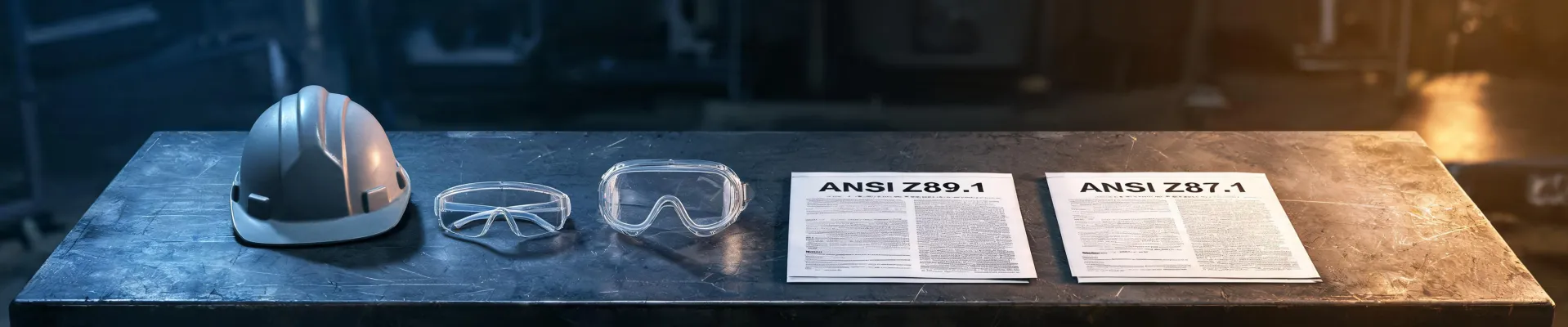
Look for the marking on the frame or lens. ANSI Z87.1-2020 requires 'Z87' or 'Z87+' printed permanently on the product. According to OSHA (osha.gov) regulation 1910.133, employers must ensure eye protection meets this standard. I keep a printed copy of the standard in my procurement binder—nothing worse than a safety auditor finding uncertified glasses on site. For online orders, I check the product description for 'ANSI Z87.1 certified' and cross-reference with the manufacturer's website. Pyramex clearly lists compliance for all their safety glasses. It's a no-brainer: if it's not marked, don't buy it.

Maeve Callahan
Maeve Callahan is a head-protection analyst covering Type I and Type II hard hats, climbing-style safety helmets, bump caps, chin straps, suspensions, liners, and face-shield carriers. She applies ANSI Z89.1, EN 397, and EN 12492 criteria while comparing impact attenuation, penetration resistance, lateral deformation, electrical class, retention strength, field of vision, mass, fit range, and temperature conditioning. Her guides help EHS teams, contractors, utilities, and buyers select helmet systems for overhead hazards, work at height, electrical exposure, accessory compatibility, and worker acceptance.