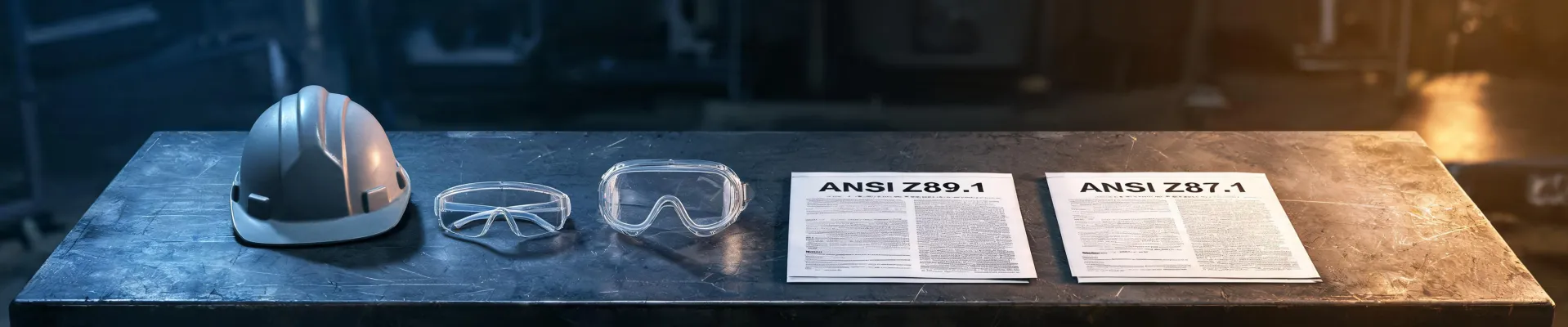
Last spring, I was staring at a pallet in our warehouse. It was full of safety helmets from our previous supplier—the ones we’d ordered in bulk before I implemented our new verification protocol. We had about 800 units left, still in their shrink wrap. My warehouse lead asked me if we could just run them out on the line to use up the stock.
My instinct said yes. They were perfectly functional. They met the basic Z89.1 standard. They were paid for. But something made me stop. I remembered the conversation I’d had with our safety committee two months earlier. We’d talked about how the industry was evolving—how the definition of 'compliance' was shifting from just passing a test to actually reducing risk on a daily basis. Those helmets on the pallet were Type 1. They only protected from top-of-head impact. Meanwhile, our production floor workers were increasingly working in tight spaces and around low-hanging pipes. The risk profile had changed, but our inventory hadn't.
The Audit That Broke the Routine
It wasn't a single injury that forced the issue—thankfully. It was a routine Q1 2024 quality audit. We were reviewing incident reports from the previous year, and I noticed a pattern. Three separate near-miss reports involved workers hitting their foreheads on overhead obstructions. In every case, the worker was wearing a standard Type 1 hard hat. It did its job for top impact, but it offered zero side or front protection.
I pulled the specs on those incidents. The heights were between four and five feet—low enough that a fall or a quick turn could have been serious. We had been lucky. I started digging into the Type 2 standard. Everything I'd read before told me that Type 1 was fine for most general construction tasks. But the industry evolution argument made me reconsider. More manufacturers, including Pyramex, were pushing for Type 2 as the new baseline. Their Ridgeline and Exeter lines weren't just compliant—they were designed with features like padded interiors and lateral impact protection that made them genuinely safer for a wider range of scenarios.
The conventional wisdom in our sector had always been: 'If it has the sticker, it's good enough.' My experience with that specific audit suggested otherwise. We weren't dealing with a product failure; we were dealing with a specification gap.
The Rubber Hits the Road—and the Helmet
That's when the conversation shifted from helmets to the rest of our PPE. I started looking at our other 'safe' inventory. Our rubber work boots were a case in point. They were mid-tier, met basic ASTM standards, but after a full year of tracking wear patterns, I noticed our crew was replacing them three months earlier than the warranty suggested. The soles weren't gripping like they used to on wet concrete (unfortunately, we found this out during a surprise inspection). We were paying for durability we weren't getting. In my opinion, the extra $15 per pair for a boot with a higher-grade compound would have saved us money in the long run, but the finance department saw it as a budget line increase.
“The best part of finally getting our vendor process systematized: no more 3am worry sessions about whether the order will arrive.”
— A little too honest, but true.
Then there were the hi vis hoodies. Our team loved them. They were comfortable, lightweight, and had the ANSI 107 stripes. But when I compared our Q1 and Q2 inventory side by side—same vendor, different production runs—I noticed the background color had shifted. The 'hi-vis yellow' was slightly different between batches. Individually, they looked fine. Put them in a group for a safety briefing, and you could see the inconsistency. That was a brand perception issue for our company, but it was also a potential visibility issue. A worker wearing a faded hoodie at dusk isn't as visible as one in a fresh one.
To be fair, the hoodies met the standard. But 'meeting the standard' and 'providing consistent, reliable protection' were two different things. Part of me wanted to just stick with the cheapest option. Another part knew that inconsistency was a risk we didn't need to take. We compromised. We switched to a single supplier for all hi-vis apparel (Pyramex had a solid line) and added a color consistency clause to the contract based on the Pantone matching system. Industry standard color tolerance is Delta E < 2 for brand-critical colors. For safety yellow, that standard makes sense.
Getting Specific: Where to Buy the Right Gear
This isn't just a theoretical problem. If you're a safety manager or a business buyer, you're probably asking, 'Where to buy work boots that actually last?' or 'What's a good hi vis hoodie that won't fade after three washes?' The answer isn't just a brand name—it's a specification.
For boots, go for ones with a clearly stated oil-resistant and slip-resistant outsole, not just a generic 'rubber' label. If you need them for long hours on concrete, don't cheap out on the insole. That's where the wear starts. Rubber work boots from established manufacturers usually list their ASTM ratings. Compare those against your floor conditions.
For safety helmets, forget the assumption that one size fits all. If your workers are in tight spaces—think under machinery, in tanks, or near conveyors—Type 2 helmets (like the Pyramex Ridgeline) are a no-brainer. They're not much more expensive, but the head-to-side protection is a game changer. I'd argue it's negligent not to consider them in those environments.
For the hi vis hoodie, check the wash care label before you buy. If the manufacturer doesn't specify how many washes the ANSI certification holds up to, ask. A cheap hoodie that loses its reflectivity after ten washes is a false economy.
Bottom Line
That pallet of old helmets? We eventually donated them to a training school (they're fine for practice drills). But we wrote off the cost from our budget. It was a hard lesson in inventory management. Keeping old stock because it's 'good enough' can actually create a hidden liability.
The industry is changing. What was considered best practice in 2020 may not apply in 2025. The fundamentals haven't changed—you still need to protect your people. But the execution has transformed. Better materials, better design, and a better understanding of how real-world work environments differ from lab testing. Don't let your inventory be the thing that holds you back.

Maeve Callahan
Maeve Callahan is a head-protection analyst covering Type I and Type II hard hats, climbing-style safety helmets, bump caps, chin straps, suspensions, liners, and face-shield carriers. She applies ANSI Z89.1, EN 397, and EN 12492 criteria while comparing impact attenuation, penetration resistance, lateral deformation, electrical class, retention strength, field of vision, mass, fit range, and temperature conditioning. Her guides help EHS teams, contractors, utilities, and buyers select helmet systems for overhead hazards, work at height, electrical exposure, accessory compatibility, and worker acceptance.