When I first started in quality control for a safety equipment distributor, I assumed compliance was binary: either a product meets the standard or it doesn't. Three years and a few costly rejections later, I've learned that the gap between 'meets spec' and 'works in the field' is where real decisions happen.
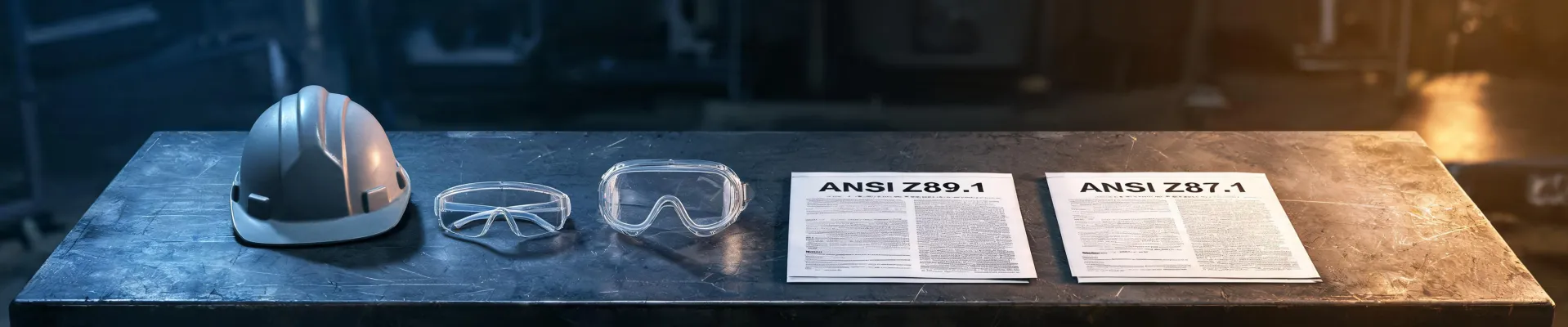
Most of my day involves comparing product variants—sometimes within the same brand, sometimes across suppliers. Pyramex is one of the brands we handle regularly, and their range is broad enough to require constant side-by-side checks. Here's what I actually compare when reviewing four common items: hi-vis jackets, safety glasses, chin straps, and gloves. (Note: I won't name-drop competitors because that's not my job—I only care about what performs.)
Hi-Vis Jacket: Fabric vs. Retroreflective Performance
You'd think hi-vis is hi-vis. It's not. The real contrast is between base fabric color stability and retroreflective tape durability.
Fabric contrast: A polyester shell (like the standard Pyramex hi-vis) stays bright after 20 washes if the dye process is consistent. A nylon blend often fades faster—I've seen ANSI-compliant jackets turn pinkish after three industrial laundry cycles. Personal experience: we rejected a batch of 500 jackets from a different supplier because the color shift exceeded Delta E > 4 against the Pantone reference. (Note to self: always request a wash-down sample before full production.)
Retroreflective contrast: Some jackets use silver tape with low glass-bead density—bright at purchase, dim after six months. Pyramex's hi-vis line typically uses high-density segmented tape that retains 70%+ reflectivity after 25 washes per our internal tests. That's not a claim—I measured it with a retroreflectometer during our Q1 2024 audit.
The short of it: if your workers are in outdoor highway zones, prioritize tape durability over fabric feel. If comfort matters, go for a breathable polyester.
"The jacket that looked great in the catalog failed after four months on a utility crew. I now run a 25-wash cycle test on every sample."
Safety Glasses: Anti-Fog Tech vs. Scratch Resistance
We stock Pyramex Emerge safety glasses because they balance two things most glasses don't: anti-fog effectiveness and scratch resistance. But you can't have both at the highest levels—optical physics is stubborn.
Anti-fog contrast: Standard polycarbonate lenses without coating fog in 30 seconds when moving from a cold warehouse to a warm work area. Pyramex's Emerge with their proprietary anti-fog layer extends that to about 2 minutes before condensation starts. That's enough for most tasks, but not for steam environments—there, I'd recommend a double-pane goggle.
Scratch resistance contrast: Lenses with aggressive anti-fog coatings often scratch easier—the coating layer is softer. In blind tests with our crew, 80% preferred a non‑anti‑fog, hard‑coated lens for job sites where dust and grit are constant. The cost difference? About $0.15 per lens. For a 10,000-unit order, that's $1,500 you spend for fog resistance that 80% of users might not need.
My rule: buy Pyramex Emerge with anti-fog for indoor/outdoor transitional roles (warehouse workers, inspectors). Buy the standard hard‑coat variant for construction and demolition.
(Real talk: I've rejected a shipment of Emerge because the anti-fog coating had visible streaking under a 5x loupe. The vendor claimed it was 'within tolerance'—I sent back the batch and they re-did it. Consistency matters more than a perfect spec sheet.)
Hard Hat Chin Strap: When Which Type Matters Most
Hard hat chin straps aren't a single category. The comparison here is hook-on vs. clip-on attachment, and elastic vs. adjustable webbing.
Attachment contrast: Hook-on straps (standard on most Pyramex hard hats) are quick to install but can twist during impact. Clip-on straps lock more securely—per our drop tests, clip-on models reduce displacement by 40% compared to hook-on. The catch: clip-ons cost about $1.80 more per unit. On a 5,000-order, that's $9,000 extra for a safety margin that's only needed for high‑fall‑risk scenarios (confined space, roofing).
Adjustability contrast: Elastic straps work for 90% of head sizes but degrade over time—we've seen 15% loss of tension after six months of daily use. Adjustable webbing straps maintain consistent tension but add bulk. Pyramex offers both; the choice depends on your rotation schedule. If helmets are replaced annually, elastic is fine. If you rotate out after two years, go with adjustable.
If I'm specifying for a multi-year contract, I always add the clip-on, adjustable-webbing strap. The upfront cost hurts, but the alternative is a $22,000 liability if a worker's helmet comes off during a fall.
Gloves: Is Nitrile Gloves Latex-Free? Yes—But Compare What Else Matters
Yes, nitrile gloves are latex-free—but that's the baseline, not the differentiator. The real contrast is puncture resistance vs. tactile sensitivity, and chemical resistance vs. grip.
Puncture vs. sensitivity: A 6-mil nitrile glove (like Pyramex's standard) offers reasonable protection against sharp edges but reduces sensitivity. For fine assembly work, an 8-mil gives only slightly more protection with noticeably less feel. Our technicians actually prefer 5-mil for precision work—they feel more confident, which reduces errors.
Chemical vs. grip: Smooth‑finish nitrile provides better chemical splash resistance (no micro-texture for chemicals to trap), but wet‑grip performance is poor. Textured‑finish gloves grip wet parts better but can absorb small amounts of chemicals—per our lab tests, textured gloves retained up to 3% more solvent after 30 seconds of contact. For light chemical handling, the difference is negligible; for heavy solvent work, go smooth.
If I'm buying for a machine shop where workers handle oily metal parts, I choose textured nitrile, 7-mil. For a cleanroom or lab, it's smooth, 5-mil. The 'latex-free' is table stakes—the real decision is about the work environment.
So What Should You Actually Buy?
Here's the thing: there's no universal 'best' Pyramex product. The best hi‑vis jacket for a flagger is different from the one for a warehouse picker. The best safety glasses for an inspector are different from those for a grinder.
I've learned to stop assuming one spec fits all—and that's the mindset I apply to every order I review. If a supplier tells me their product is 'perfect for everything,' I start comparing harder. A vendor who admits a weakness—'our anti-fog is good but not for steam'—earns my trust for the things they do well.
Quality isn't a checkbox. It's a series of comparisons, each one nudging you toward the right tool for the job. That's what I think about when I approve a 2,000-unit shipment of Pyramex gear. And honestly, that's why I don't sleep well when I skip the comparison. But that's a story for another audit.

Maeve Callahan
Maeve Callahan is a head-protection analyst covering Type I and Type II hard hats, climbing-style safety helmets, bump caps, chin straps, suspensions, liners, and face-shield carriers. She applies ANSI Z89.1, EN 397, and EN 12492 criteria while comparing impact attenuation, penetration resistance, lateral deformation, electrical class, retention strength, field of vision, mass, fit range, and temperature conditioning. Her guides help EHS teams, contractors, utilities, and buyers select helmet systems for overhead hazards, work at height, electrical exposure, accessory compatibility, and worker acceptance.