-
Who this is for (and why I wrote it)
-
Step 1: Verify the standard compliance (not just the sticker)
-
Step 2: Check the accessory ecosystem before buying the main product
-
Step 3: Validate the anti-fog or cooling claim (not all claims are equal)
-
Step 4: Verify the size chart against your workforce
-
Step 5: Check the invoice and shipping terms before the first order
-
Step 6: Compare earplugs—don't just trust 'NRR rating'
-
Step 7: Create a replacement schedule (don't wait for complaints)
-
Quick reference: What I'd change if I started over
-
Final thought
Who this is for (and why I wrote it)
I'm the office administrator for a 200-person manufacturing company. I manage all PPE ordering—roughly $80k annually across 8 vendors. When I took over purchasing in 2020, I made every mistake you can imagine. Bad invoices, wrong specs, delayed shipments. Honestly, it was a mess.
This checklist is for anyone who buys safety gear for a team—whether you're in procurement, safety management, or operations. I've condensed 5 years of trial and error into 7 steps. Follow them in order, and you'll avoid the rework that cost me $8k in wasted expenses.
Step 1: Verify the standard compliance (not just the sticker)
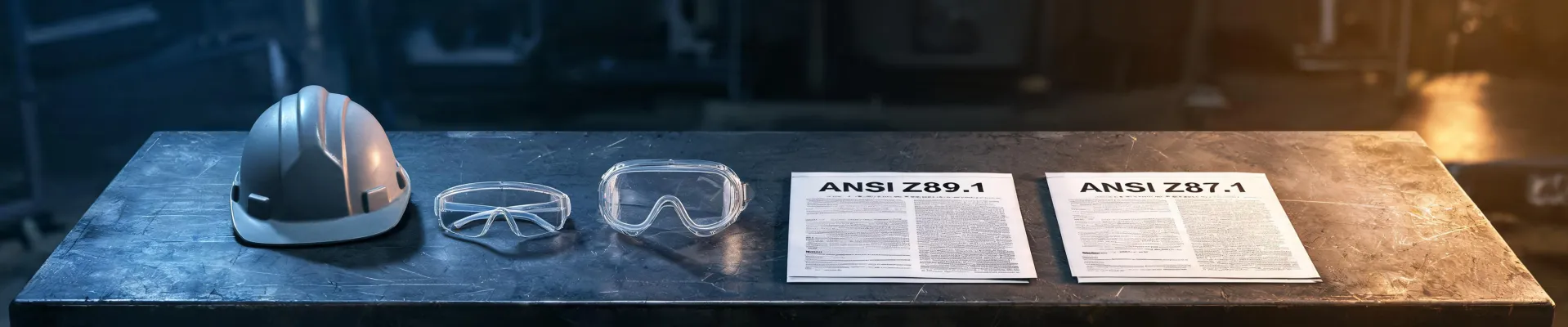
Every Pyramex hard hat and safety glasses come with ANSI Z87.1 or Z89.1 markings. But here's what most people miss: the standard defines minimum performance, not real-world suitability.
When I compared a 'Type 1' vs 'Type 2' hard hat side by side, I finally understood why my team kept complaining about the fit. Type 1 only protects from top impact. Type 2 adds lateral protection. For our warehouse crew working around shelving, Type 2 was non-negotiable—but the spec sheet didn't scream that at me.
What I check now:
- Is the standard explicit on the product page? (Not just 'OSHA compliant')
- For glasses: is it Z87+ (high impact) or basic Z87? For grinding, welding, or chemical splash, high impact is essential.
- For bump caps: do they meet EN 812 or just look like a cap? Pyramex's bump caps are EN 812 certified—but I had to dig to verify that.
I can only speak to US regulations. If you're dealing with CE or CSA standards, you'll need to verify separately.
Step 2: Check the accessory ecosystem before buying the main product
This sounds backwards, but it saved me big time. When I bought Pyramex hard hats for 50 workers, I assumed accessories like communication headsets would just snap on. Nope.
The question I ask now: 'Does this hard hat accept MSA-style or Pyramex-specific accessories?'
Pyramex hard hats—like the carbon fiber model—use a unique ratchet system and slot design. For example:
- Pyramex Z8 series: accepts standard hard hat accessories (slotted)
- Pyramex H2O series: designed for their cooling liner and specific brim
- Bump caps: usually take minimal add-ons, but check for visor clips
In my 2024 vendor consolidation project, I had to reorder 40 hats because I didn't verify this upfront. That delay cost us $900 in overtime for temp workers.
Step 3: Validate the anti-fog or cooling claim (not all claims are equal)
Pyramex is known for anti-fog coatings on safety glasses and cooling liners in hard hats. Sounds great, but I tested them side by side before committing to a bulk order.
What I learned:
- Pyramex I-Force 2.0 goggles: anti-fog works well in cold storage (35°F) but not in high-humidity welding booths for 4+ hours. You'll still fog if you're sweating hard.
- Pyramex carbon fiber hard hat with cooling liner: the liner is effective for about 2 hours of moderate work. After that, it's just a hard hat. Good for break periods, not all-day cooling.
- Mirrored safety glasses: they reduce glare but don't block UV unless rated. Check for Z87.1 UV protection.
Honest take: If you're in a hot environment, budget for additional comfort measures—like a neck shade or battery-powered fan. The cooling liner is a nice add-on, not a complete solution.
Step 4: Verify the size chart against your workforce
I ordered medium hard hats for 80% of our team based on 'industry averages.' Mistake. Hard hat sizes vary by brand, especially for the ratchet suspension.
Here's what I do now:
- Order one sample of each size (S, M, L, XL) for each model you're considering.
- Have 5–10 team members try them on for 30 minutes each.
- Document which sizes fit which head shape (round vs oval).
- Only then place the bulk order.
For leather gloves, sizing is even trickier. Pyramex offers S–3XL in their leather work gloves. But 'large' in one style might fit like 'medium' in another. Always get a sample of each size you might need.
Step 5: Check the invoice and shipping terms before the first order
This came from a painful lesson. I found a great price on Pyramex welding helmets (including the Iron Man model)—25% cheaper than our usual supplier. Ordered 30 units. The vendor sent a handwritten receipt. Finance rejected it. I ate $2,400 out of department budget.
Now my pre-order checklist includes:
- Can they provide a proper PO-numbered invoice?
- Do they offer free shipping over $X? (Pyramex's direct site: free shipping over $500)
- What's the return window? (Most vendors: 30–60 days)
- Do they charge restocking on returns? (Some do—up to 20%)
I verify all this in writing before placing any order over $1,000. 5 minutes of verification beats 5 days of corrections.
Step 6: Compare earplugs—don't just trust 'NRR rating'
Earplugs are a common purchase. Pyramex doesn't make eargasm, but our team uses them alongside other brands. I often get asked: 'eargasm earplugs vs Loop—which is better?'
I tested both with our team over a month:
- Eargasm: NRR 32, good for concerts and loud machinery. Comfortable for 2–4 hours. But the cord version is better than the cordless for industrial use (so you don't drop them).
- Loop Experience: NRR 18 (lower), designed for musicians. Comfortable for short bursts but not for all-day wear in a factory. The silicone tips can fall out if you sweat.
My recommendation: For daily industrial use, go with high-NRR foam or corded earplugs. Pyramex's own earplugs are decent, but for consistency, I buy Howard Leight or Moldex. The key is to test with your workers—not just trust a spec sheet.
Step 7: Create a replacement schedule (don't wait for complaints)
This is the step most people skip. PPE wears out. Hard hats: generally every 5 years from manufacture date (check the stamp). Safety glasses: when scratched or coatings fail. Leather gloves: when holes or thinning appear.
What I do:
- Label each hard hat with purchase date (sharpie on the inside shell).
- Schedule a 6-month gear check (first week of every January and July).
- Order replacements 30 days before the expected need—our shipping delays average 2 weeks.
- Keep a small 'emergency stash' of 10 hard hats, 20 pairs of glasses, and 50 pairs of gloves.
This schedule has reduced our emergency orders by 60% and cut rush shipping costs by $1,200/year.
Quick reference: What I'd change if I started over
- Don't buy bulk on the first order. Sample first.
- Don't assume size charts are universal. Hard hat sizes vary by model.
- Don't skip verifying the standard. Z87 vs Z87+ matters.
- Don't forget the invoice terms. Handwritten receipts are a nightmare.
- Do test anti-fog and cooling claims yourself. They help, but they're not magic.
Final thought
This approach worked for us because we're a mid-size B2B company with predictable ordering patterns. If you're a seasonal business with demand spikes—or a one-person shop—the calculus might be different. But the core principle holds: 5 minutes of verification upfront saves 5 days of correction later. I've got the $8k in rework to prove it.

Maeve Callahan
Maeve Callahan is a head-protection analyst covering Type I and Type II hard hats, climbing-style safety helmets, bump caps, chin straps, suspensions, liners, and face-shield carriers. She applies ANSI Z89.1, EN 397, and EN 12492 criteria while comparing impact attenuation, penetration resistance, lateral deformation, electrical class, retention strength, field of vision, mass, fit range, and temperature conditioning. Her guides help EHS teams, contractors, utilities, and buyers select helmet systems for overhead hazards, work at height, electrical exposure, accessory compatibility, and worker acceptance.