I'll start with a confession. I work at Pyramex as a quality and compliance manager, and my day job is reviewing PPE before it ships. Every month, that means roughly 150 SKU batches: hard hats, bump caps, safety glasses, goggles, gloves and hi-vis clothing. In 2024, I rejected about 4% of first-article samples because they did not match the agreed spec. Those batches never reached a worker. What keeps me up at night is what happens after products leave my desk—especially when a safety manager reduces a complicated decision to 'safety glasses vs goggles.'
I understand the question. It comes from a real place: a team just had a near miss, or a supervisor wants a better spec before the next order. But 'which one should we buy' is not the first question. Start with hazard, not hardware.
At First Glance: Safety Glasses vs Goggles
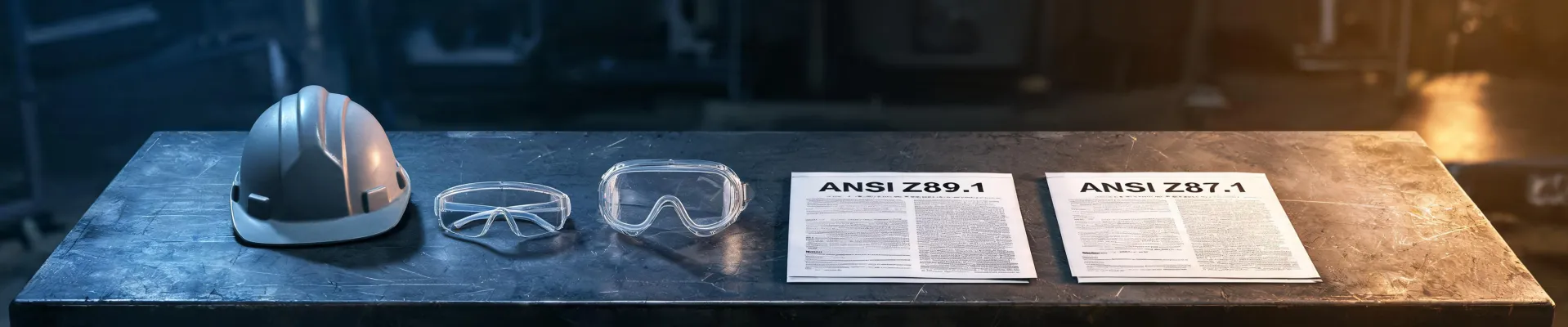
Safety glasses and goggles both protect the eyes, but they work in different ways. A pair of safety glasses uses lenses mounted in frames with temples, and the space around the lenses remains open. They can include side shields to stop particles coming from an angle, but they don't create a seal. Goggles press a frame against the face to close that gap. Because of that seal, goggles can block dust, mist and liquid from entering through the edges, while glasses generally cannot.
Neither one is automatically stronger. If you define protection as impact resistance, some high-impact glasses can out-perform a non-impact goggle. If you define protection as keeping a liquid out, glasses cannot do what a sealed goggle does. The categories are different tools, not rival products.
The Real Problem: Why the Binary Question Fails
Here's what most people don't realize: the open gap around safety glasses is not a flaw. It's a design tradeoff. An open frame keeps air moving and keeps the lens from fogging as quickly, which matters when someone wears the product for hours. Goggles trade that airflow for a seal. If you choose goggles for every task because they look safer, workers in a warm or humid plant will find reasons to lift them off their faces. That's not a discipline problem. It's a spec problem.
Conversely, a manager can choose glasses for a task with chemical splash because workers will actually wear them. The lens may stop a splash to the front, but liquid can still enter from the bottom or sides. Wrong product in the right place. That's exactly how 'we tried goggles, they fogged' turns into 'can we just use glasses instead'—and that decision can end badly.
What 'Appropriate Protection' Actually Means
I'm not an industrial hygienist, and I won't inspect your facility remotely. But from a quality-compliance point of view, appropriate means the product matches the exposure. It doesn't mean the product is the most expensive, the most popular, or the one that looks the toughest.
OSHA's eye protection rule, 29 CFR 1910.133, requires workers to wear appropriate eye or face protection when exposed to hazards like flying particles, liquid chemicals, chemical gases or vapors, and injurious light radiation. The word 'appropriate' carries the whole process. The ANSI/ISEA Z87.1-2020 standard is the marking used to demonstrate that a product was tested. But a product can carry a Z87 marking and still not be appropriate for splash or fine dust conditions.
Think in terms of what a test measures. Impact-rated glasses with side shields perform well against projectiles, but they are not sealed against splash. A direct-vented goggle has vents around the lens and may be fine for impact, but it is not the right answer for chemical splash because liquid can move through those openings. Indirect-vented or non-vented goggles fit splash tasks better. If you don't define the hazard, the data on the spec sheet won't help you.
Also, one worker often has more than one exposure. A maintenance mechanic may spend the morning doing light grinding and then wipe down a machine with solvent in the afternoon. The protection should change with the task. A universal product for everyone in every role sounds efficient, but it usually means the spec is wrong most of the time.
What Does a Wrong Category Cost?
First, there is the false security cost. If a worker believes their glasses are protecting them from a chemical hazard, they may keep working longer than they should. When a splash comes from below, it hits the lens, but the liquid wraps around the frame. The injury still happens. And later, the report will say the employee was wearing eye protection. The real cause missing is the seal, and that never makes it into the training module.
Second, workers stop trusting the program. A goggle that fogs every twenty minutes gets pushed up onto a forehead. A glass that was never meant for splash leaves someone exposed. I don't have hard data on how many injuries happen while PPE sits on a forehead, but my sense from reviewing field returns and complaints is that mismatch between product and hazard drives more problems than outright refusal to wear PPE.
This way of thinking is normal in other PPE categories. No one buys one pair of Caterpillar work boots and calls the whole job done. A general pair works for dry warehouses or trades, but a rubber boot is the starting point for wet or chemical environments, and an electrical-hazard-rated boot is for electrical work. Same for head protection. A bump cap is often the right product in low-clearance areas where workers bump their heads rather than get hit from above. Nobody calls a bump cap a downgrade if the hazard assessment doesn't require a full hard hat. That's precise matching.
A Better Starting Point for Any Eye-Protection Order
Here is a simple process that works whether I'm reviewing a new product or a customer is choosing a line item:
- Identify the hazard first. Is it dry flying debris, high-velocity impact, dust, chemical splash, or optical radiation? Each hazard points to a different category.
- Pick the product category after. Glasses for dry particles when a seal is not needed. Goggles for splash, mist, powders or fine dust. Face shields over goggles for severe chemical or high-energy exposures.
- Verify the marking. Look for a current ANSI/ISEA Z87.1-2020 marking on the lens or frame. If the task involves high impact, look for a high-impact marking. No marking means reject the sample.
- Make it wearable. A worker may not wear a true spec if the product squeezes, fogs, or blocks peripheral vision. Lightweight frames, good lens tints, and anti-fog treatments are not luxury features. They are compliance features.
For a general dry task where the main hazard is an unexpected flying chip, a lightweight pair like the Pyramex Emerge safety glasses tends to get worn because it doesn't feel heavy. It is not the answer to chemical splash, but nothing is the answer to everything. For an outdoor job where glare makes workers want to remove clear glasses, a style like the Pyramex Exeter safety glasses with Sky Red lens can close a gap that no standard test can measure—the gap between wearing and not wearing.
I also want to say something about efficiency. Adding goggles to the shelf when you already use glasses sounds like more cost and more confusion. But efficient doesn't mean one SKU to rule them all. It means each task has a correct product and workers are not tempted to substitute. In our QA operation, moving product specs from paper sheets into a digital checklist cut matching errors by roughly a third in 2023. The same principle works on the selection side: a short, hazard-based approval list makes the right decision the easy decision.
So the next time you hear 'safety glasses vs goggles,' rephrase it: for which task, under which hazard? You may need glasses, goggles, and both with a face shield. Let the hazard choose. Put the product in a labeled bin. And make sure every team member knows the difference. That is quality work, because it keeps PPE on faces where it belongs.

Maeve Callahan
Maeve Callahan is a head-protection analyst covering Type I and Type II hard hats, climbing-style safety helmets, bump caps, chin straps, suspensions, liners, and face-shield carriers. She applies ANSI Z89.1, EN 397, and EN 12492 criteria while comparing impact attenuation, penetration resistance, lateral deformation, electrical class, retention strength, field of vision, mass, fit range, and temperature conditioning. Her guides help EHS teams, contractors, utilities, and buyers select helmet systems for overhead hazards, work at height, electrical exposure, accessory compatibility, and worker acceptance.