-
Pyramex Hard Hat Assembly: Check It Like You Mean It
-
Pyramex Venture II Safety Glasses: Which Version Is the Right One?
-
Is Nitrile Gloves Food Safe? Yes, When the Glove Is Made for Food Contact
-
PPE for a Transmission Pan Job (Yes, This Search Is a Real One)
-
Hard Hat Near Me: Where to Buy and What to Check First
-
Where This Advice Stops
If you need the short version of how to assemble a Pyramex hard hat, here it is: the padded brow band on the suspension goes toward the front of the shell, and every suspension tab has to click into its slot. That's about 60 seconds per hat once you've done it. Don't skip the click check—run your fingers around the inside and make sure each tab is fully seated, not just resting on the plastic. A suspension that isn't clicked in can let the shell separate from your head during an impact, and that's how a hard hat stops being protection.
I've been ordering PPE for a 14-bay repair shop since 2019. I've made my share of avoidable mistakes with safety gear, including one order of thirty hard hats that had to be redone because the suspensions were installed backward. The good news is that the questions people ask most—about hard hat assembly, Pyramex Venture II safety glasses, nitrile gloves, and buying a hard hat locally—all have simple answers once you know what to check.
Pyramex Hard Hat Assembly: Check It Like You Mean It
If the Pyramex hat arrives with the suspension separate or just loose inside the shell, that's normal. The job is simple, and it's also easy to get wrong if you rush.
- Set the shell upside down on a clean bench. Find the front of the hat. If it has a cap-style brim, the brim is the clue. If it's a full-brim style, the inside usually has a 'front' marking or the brand label sits at the front.
- Pick up the suspension and find the padded brow band. That band needs to end up at the front of the shell, because it rests against the forehead when the hat is worn.
- Push each suspension tab through its slot from the inside until it clicks. Start at the front and work around the shell. If a tab won't seat, stop and check whether the suspension is rotated 180 degrees.
- Do a pull test. Grab the suspension from the inside and tug it. If anything shifts or pops free, seat those tabs again before someone wears the hat.
After that, put the hat on and turn the ratchet knob until it fits snugly. The knob should be at the back of your head. If it's pressing your forehead, the suspension is in backward. In 2021 I watched a new tech do exactly that to an entire order of 30 hats. They all looked perfect in the box. The crew figured it out in about ten seconds, and the fix ate most of a morning plus about $700 in shop labor.
OSHA's head protection rule, which is 29 CFR 1910.135, doesn't describe a hard hat as an accessory. For the shell to manage impact, the suspension has to be connected the way the manufacturer designed it. Honestly, I don't know why the instructions are still printed so small. My best guess is that hard hats look so simple that nobody reads them. That's exactly when the mistakes happen.
Pyramex Venture II Safety Glasses: Which Version Is the Right One?
Pyramex Venture II safety glasses are the pair I recommend for general shop work. They're light, they use a polycarbonate lens, and the versions meant for impact protection carry an ANSI/ISEA Z87.1+ high-impact marking. They're affordable enough that we keep a box of extras by the front counter instead of treating every pair like a precious object.
But Venture II is a product family, not one exact lens. The right version depends on the task. If fog is your problem, don't assume all Venture IIs are anti-fog; get one that's marked anti-fog. For outdoor sun, clear lenses are the wrong answer; pick a tinted or mirrored version. For indoor work, clear is usually the practical default.
While you're buying, check that the box shows Z87+ somewhere. Some online listings describe a product as safety glasses even when the label on the actual frame doesn't say it. The plus sign means high impact, and for a shop environment, high impact is the spec I want. My early mistake was stocking only one lens type because we're an indoor shop. Then two technicians spent a summer complaining in the parking lot. A couple of tinted pairs cost almost nothing and solved it.
Is Nitrile Gloves Food Safe? Yes, When the Glove Is Made for Food Contact
The short answer to 'is nitrile gloves food safe' is yes—but only when the glove is made for food contact. The word nitrile by itself doesn't make a glove safe around food. A glove intended for food handling should say so on the box or spec sheet, usually mentioning FDA 21 CFR food-contact requirements. If the product doesn't state that, treat it as not food safe.
It's tempting to believe that the base material is the only thing that matters. It isn't. Industrial nitrile gloves and food-service nitrile gloves are made under different requirements with different additives on and in the material. A glove that's perfectly fine around motor oil might include processing chemistry that was never evaluated for direct food contact. And a food-service glove is often thin by design because kitchen work needs dexterity, not oil resistance.
For food prep, buy powder-free nitrile that is clearly food rated, change gloves between tasks, and don't use one pair for raw food and then ready-to-eat food. The glove protects the food from your hands; it doesn't clean or sanitize anything.
PPE for a Transmission Pan Job (Yes, This Search Is a Real One)
If you got here by typing something like 'ppe transmission pan,' you aren't the only one. It sounds like an odd phrase, but it's a real question with a simple answer: hot automatic transmission fluid, sharp pan edges, and your face close to the work. Use rated eye protection, use oil-resistant nitrile gloves that are thick enough for the job, and don't reach into a drained pan without checking for sharp edges.
The reason the food-glove question and the transmission pan question belong together is that our supply cabinet used to have both boxes in the same spot. A tech picked up the thin food-service pair for a pan job. They softened in the hot fluid and tore while he was handling the pan, and he ended up with fluid on his arm. No serious burn, but it was luck. Since then, food-rated gloves stay in the break room, work gloves stay by the tools, and we keep colors different so nobody has to guess.
For mechanical work like that, I buy a heavier nitrile work glove, and if the pan has sharp fins, a proper mechanic's glove. The mil rating on the glove box is a thickness guide; thin gloves are for quick clean jobs, not for handling hot transmission parts. When in doubt, put the food-safe gloves back and grab something heavier.
Hard Hat Near Me: Where to Buy and What to Check First
If you need a hard hat today, start with an industrial or welding supply shop near you, then check whether a big-box store shows local stock for the exact model. Call first and ask if it's in stock. Driving across town for a hat that isn't there wastes the whole afternoon.
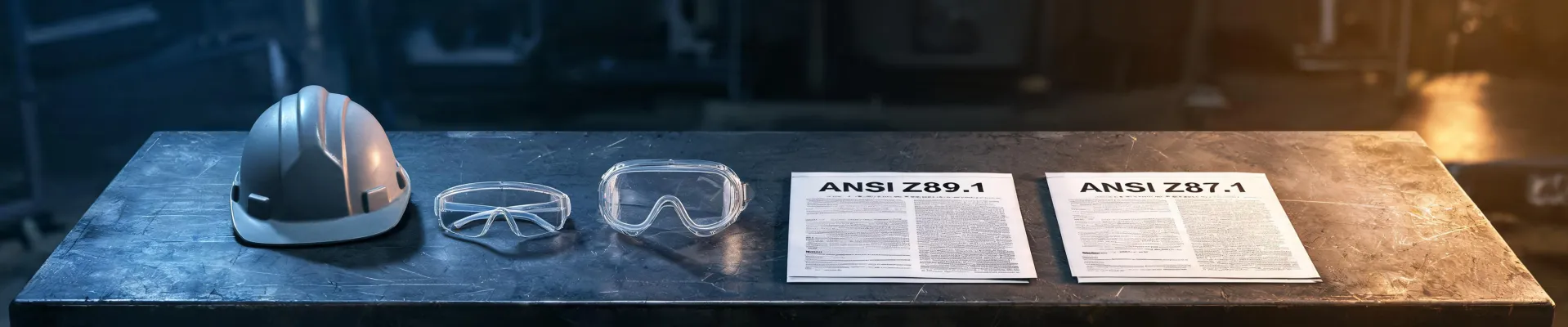
The trap is buying whatever is hanging on the hook because you are already in the store. Pull the hard hat out of the box and look for an inside label that references ANSI/ISEA Z89.1. The label should also show the type and electrical class. Type II adds lateral impact protection. If your work involves electrical hazards, don't buy a hat until you confirm the label says Class E.
A single hard hat matters whether you're a one-person garage or a fleet manager. The local shop that sold us our first two hats never made us feel small, and they still get our consumables orders today. Some online sellers give better case pricing, but when you need one hat today, local wins. I've also had counter employees act like a one-hat sale wasn't worth their time. Those stores don't get a call when we need sixty.
Where This Advice Stops
Why add a stop section? Because every mistake above came from treating a category as if it were one product. A vented hard hat is not the same as a solid-shell hat around liquids. Safety glasses don't seal against dust or chemical splash. A food-contact glove is not a heavy work glove, no matter what the base material is called.
The label and the manufacturer's instructions are the final authority on any piece of PPE. Pyramex makes solid gear, but all PPE works only when used within its limits. If you take anything from my mistakes, take that: read the label, click the tabs, and don't let anyone rush you past the boring part.

Maeve Callahan
Maeve Callahan is a head-protection analyst covering Type I and Type II hard hats, climbing-style safety helmets, bump caps, chin straps, suspensions, liners, and face-shield carriers. She applies ANSI Z89.1, EN 397, and EN 12492 criteria while comparing impact attenuation, penetration resistance, lateral deformation, electrical class, retention strength, field of vision, mass, fit range, and temperature conditioning. Her guides help EHS teams, contractors, utilities, and buyers select helmet systems for overhead hazards, work at height, electrical exposure, accessory compatibility, and worker acceptance.