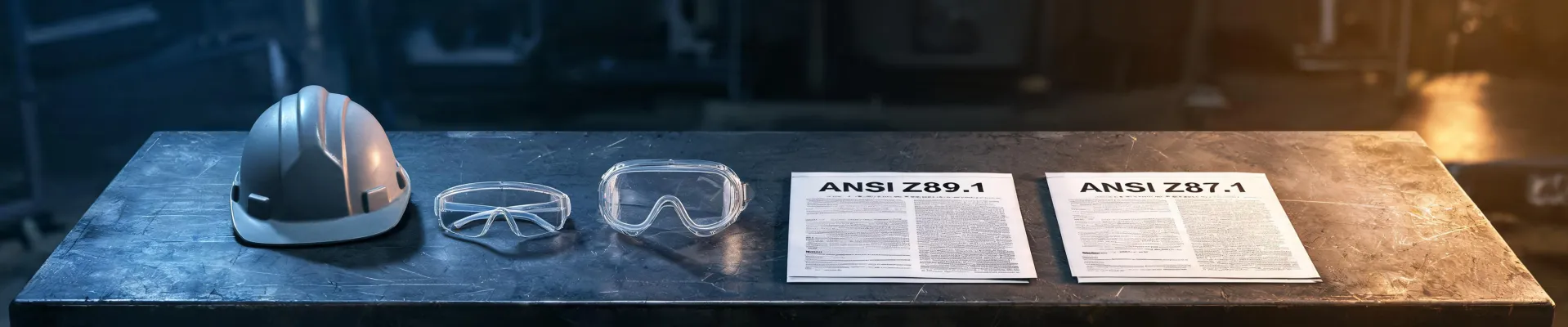
- Don't assume a familiar brand or higher price means the right protection
-
Mistake #1: Assuming 'carbon fiber' means 'premium everything'
-
Mistake #2: Assuming 'Class E' means it's automatically electrical-safe
-
Mistake #3: The 'cowboy hat hard hat' looked cool but wasn't practical
-
Mistake #4: Cleaning work boots wrong—and why it matters
-
My transparent pricing epiphany
-
Your bottom line
Don't assume a familiar brand or higher price means the right protection
In my first year managing safety gear procurement (2019), I placed a $3,200 order for what I thought were premium hard hats. They looked great on the spec sheet. Two weeks later, the site safety officer flagged them: they weren't rated for electrical work, even though the listing said 'Class E compatible.' We had to return the entire batch—all 64 units—and rush-order the correct ones. That mistake cost us $890 in restocking fees and expedited shipping, plus a 1-week delay on a critical job.
Here's the hard truth I learned: when you're buying safety helmets—whether it's a Pyramex hard hat carbon fiber model, a cowboy hat style, or standard bump caps—the price tag and brand name only tell you part of the story. The real value comes from knowing exactly what standards apply to your work environment and verifying them before you click 'buy.'
Why I started writing my own pre-check list
After that $890 lesson, I created a simple checklist that my team now uses for every PPE order. It's saved us from at least five similar mistakes in the past three years. I'll share the key points here, but first let me walk you through the specific traps I fell into—and how Pyramex products actually helped me avoid them once I knew what to look for.
Mistake #1: Assuming 'carbon fiber' means 'premium everything'
I ordered a batch of Pyramex carbon fiber hard hats because I thought 'carbon fiber' automatically meant better impact protection and lighter weight. It's true that carbon fiber helmets are generally lighter and stronger than fiberglass or polyethelene models—but only if they're rated to the right standard. The ones I picked were ANSI Z89.1 Type 1 (top impact only), but our crew needed Type 2 (top and lateral impact). The carbon fiber construction didn't matter if the test type wasn't right.
Takeaway: Always check the ANSI/OSHA rating first, then the material. Pyramex offers several carbon fiber models with Type 2 ratings—but you have to read the product code, not just the title.
Mistake #2: Assuming 'Class E' means it's automatically electrical-safe
This was the killer. The listing said 'Class E compatible,' but I later learned that Class E is a voltage rating (up to 20,000 volts) that requires a specific design—no vents, no metal parts, and a certain thickness. The hats I ordered looked like Class E hard hats, but they were actually Class C (conductive) with a sticker that said 'meets electrical resistance requirements for some applications.' That vague language cost me.
Now I ask vendors: 'What's NOT included in the certification?' before asking price. For Pyramex, their actual Class E models (like some in the TRU-Lock series) clearly state 'ANSI Z89.1 Class E' in the description. If the product page doesn't say that explicitly, I move on.
Mistake #3: The 'cowboy hat hard hat' looked cool but wasn't practical
Our site supervisor wanted a 'cowboy hat hard hat' for outdoor work walks. We bought a well-known style—it looked great. But the brim was too wide for entering confined spaces, and the non-vented shell made it stuffy in summer. Within three months, the guys stopped wearing it.
Best practice: Involve the actual workers in the selection. Pyramex makes a couple of cowboy hat-style hard hats that are ANSI Z89.1 Type 2 and have optional cooling liners—but only if you order them with the right accessories. I learned to ask: 'Will this fit through a 24-inch manhole? Does it accept a chin strap? Can I add a sweatband?' If you can't answer yes to all three, it's not a universal solution.
Mistake #4: Cleaning work boots wrong—and why it matters
This isn't a hard hat or glasses topic, but it came up on the same job site. One guy soaked his leather safety boots in water to clean them. They shrunk and cracked. A simple google search of 'how to clean work boots' would have shown that you should use a damp cloth and mild soap, then let them air dry away from direct heat. But nobody told him.
From my perspective, proper maintenance of PPE—including boots—is part of the safety culture. I now include a 5-minute gear care demo during new hire orientation. It costs nothing and extends equipment life by months.
My transparent pricing epiphany
The biggest shift in my buying approach came when I started asking suppliers to itemize every cost: product, shipping, any restocking fees, and warranty terms. The first vendor who did that without me asking—they listed everything upfront—turned out to be the cheapest in the end, even though their unit price was $2 higher than the competition. Why? Because there were no hidden charges later.
In my opinion, that's the mark of a trustworthy partner. Pyramex isn't the only brand I buy from, but they're one of the few that consistently shows complete specs and pricing on their product pages. If you're comparing safety glasses like the Pyramex Trulock SB9510ST—those have a clear ANSI Z87.1+ rating, anti-fog coating, and the price listed includes the strap. No surprises.
But I'm not saying Pyramex is perfect for everyone. Take this with a grain of salt: I can only speak to mid-size construction companies with predictable ordering patterns. If you're a seasonal business with demand spikes, your calculus might be different. And if you need hard hats for a specialty application like proximity to live electrical lines, always double-check the Class rating with the manufacturer directly—don't rely on the product title alone.
Your bottom line
Here's what I'd do differently if I could go back to 2019:
- Write down the specific ANSI/OSHA requirements for your site before shopping.
- Ask: 'What standards does this model NOT meet?'
- Order one sample first—not 64 units.
- Include workers in the selection process.
- Budget for restocking fees or return shipping in your total cost calculation.
That checklist has saved us roughly $4,700 in mistakes over the last 18 months (I've tracked 47 potential errors caught before processing). Not bad for a lesson that started with $890 wasted.

Maeve Callahan
Maeve Callahan is a head-protection analyst covering Type I and Type II hard hats, climbing-style safety helmets, bump caps, chin straps, suspensions, liners, and face-shield carriers. She applies ANSI Z89.1, EN 397, and EN 12492 criteria while comparing impact attenuation, penetration resistance, lateral deformation, electrical class, retention strength, field of vision, mass, fit range, and temperature conditioning. Her guides help EHS teams, contractors, utilities, and buyers select helmet systems for overhead hazards, work at height, electrical exposure, accessory compatibility, and worker acceptance.