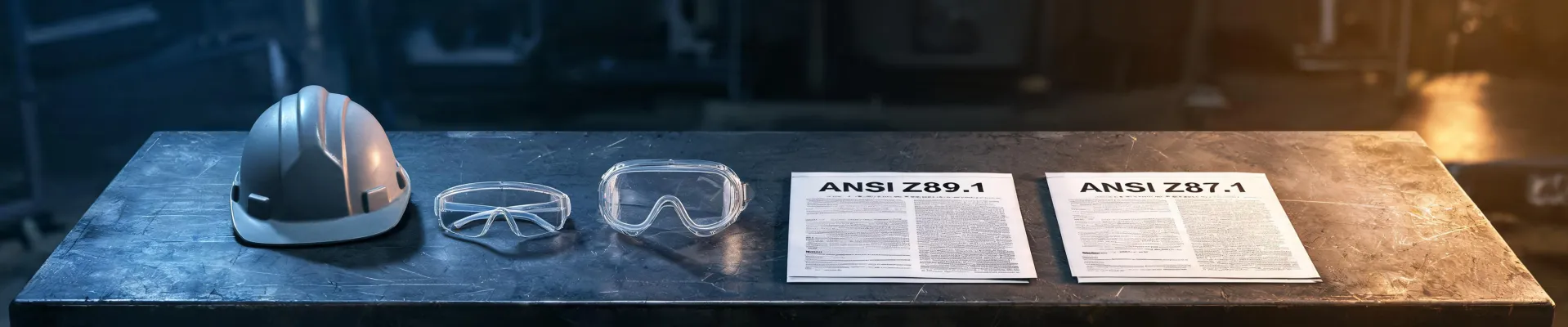
Last summer, our company rolled out a new safety policy. Nothing dramatic—just a push to get everyone in proper PPE after a near-miss in the warehouse. My boss (the VP of operations) handed me the mandate: "Get us compliant. And keep it under budget."
Easy, right? I mean, I handle all our office supply ordering—roughly $50,000 annually across eight vendors. How hard could a few hard hats and safety glasses be? Famous last words.
The thing about managing PPE for 400 employees across three locations is that everyone has an opinion. Welders want heavy-duty gloves. The assembly line wants anti-fog glasses. The warehouse guys want boots that don't feel like concrete blocks by hour four. And finance wants one invoice, not ten.
Here's what I learned from six months of trial, error, and one very expensive lesson about hidden fees.
The Scavenger Hunt Begins
When I took over purchasing in 2020, I was pretty green. I figured the best approach was to shop around for each category. Get the cheapest hard hats from one place, the best deal on glasses from another, and hope the boots would somehow sort themselves out.
Spoiler: they didn't.
I started with the easy stuff. For safety glasses, I'd heard good things about Pyramex—specifically the Pyramex Zone II safety glasses. They were recommended by a buddy in manufacturing who said they were "super comfortable" and didn't fog up as bad as the cheap ones. I ordered a sample pack for the team to try.
"What most people don't realize is that 'standard turnaround' often includes buffer time that vendors use to manage their production queue. It's not necessarily how long YOUR order takes."
My first order of Pyramex sustainable Ever-Lite safety glasses came in faster than expected (a pleasant surprise). The team loved them—way more than the bulk-bin generic ones we'd been using. The anti-fog coating actually worked, which, if you've ever had a worker stop every 20 minutes to wipe their lenses, you know is a huge deal.
(Note to self: next time, order a few extra pairs of the Zone II for visitors. They're cheap enough, and it saves the scramble.)
The Welding Fiasco
Then came the tricky part. Our maintenance crew needed leather welding gloves and a welding respirator. Two different categories, two different vendors from my initial research.
I found a company that had great prices on the gloves—$12 a pair cheaper than our usual supplier. I was feeling pretty smug. Ordered 30 pairs. Saved about $360 on paper.
Then the invoice arrived. Handwritten. No itemized list. No purchase order number. Just a total and a note saying "Thanks."
Finance rejected it. The vendor couldn't provide a proper invoice. I had to eat that $360 out of the department budget. My VP was not impressed. (To be fair, neither was I.)
"I've learned to ask 'what's NOT included' before 'what's the price.'" — My mantra after that fiasco.
For the respirator, I went with a well-known brand—3M, honestly—because I didn't want to mess around with respiratory protection. That part was straightforward. But the experience taught me a lesson about vendor relationships: price isn't everything. The vendor who can send a proper invoice is worth the extra few bucks.
The Boot Question
Now, the wild card. A few of the warehouse guys heard about our new PPE push and asked about boots. Specifically, they wanted to know who sells Brunt work boots. (Apparently, Brunt boots have a reputation for being comfortable right out of the box—no 40-hour break-in period. That's a big deal when you're on concrete all day.)
Here's the thing: Brunt doesn't have a huge dealer network. They're mostly direct-to-consumer. So finding a distributor was trickier than I expected. I called around to six different industrial suppliers. Only two carried them. One had a 3-week lead time. The other had them in stock but charged a restocking fee on any return—something they conveniently didn't mention until I asked.
"Here's something vendors won't tell you: the first quote is almost never the final price for ongoing relationships. There's usually room for negotiation once you've proven you're a reliable customer."
I ended up ordering from the direct-to-consumer site. It was easier, and the price was the same. The guys were happy—the boots held up. But it was one more vendor to track, one more login to manage, and one more headache for the accounting team.
The Consolidation Moment
By month four, I was managing nine different PPE vendors for different categories. The ordering process alone was eating up about 6 hours a month. Accounting was complaining. The warehouse manager was complaining. Even I was complaining.
That's when I looked back at my Pyramex order and thought, "Wait—what else do they make?"
Turns out, Pyramex has a pretty broad range. Beyond the safety glasses (which we already loved), they make hard hats, bump caps, work gloves, hi-vis apparel (jackets, vests, the whole deal), and a ton of accessories. They're not a one-stop shop for everything—I still needed welding-specific gear from other suppliers—but they covered about 70% of our needs.
I consolidated. Cut our vendor count from nine to four. Ordering went from a half-day affair to about 90 minutes. Accounting was thrilled. So was my VP.
(Mental note: I really should write up a proper vendor consolidation guide for the team. Would save the next person this headache.)
What I'd Do Differently
Looking back, here's the honest breakdown:
- Start with a vendor audit. Don't just buy piecemeal. Map out what you need and who can cover multiple categories. The price per item might be slightly higher, but the time saved on ordering and accounting is real.
- Check invoicing capability before the first order. I cannot stress this enough. If a vendor can't provide a proper PO-friendly invoice, walk away. It's not worth the headache.
- Don't over-optimize for unit price. The $360 I "saved" on welding gloves cost me more in time, stress, and department reputation than it was worth.
- Ask about hidden fees upfront. Restocking fees, minimum order requirements, shipping minimums—ask before you buy, not after.
- For boots, go direct if you can. Brunt work boots are legit good, but their distribution is still maturing. Buying direct was the path of least resistance (Prices as of 2025; verify current availability).
"The vendor who lists all fees upfront—even if the total looks higher—usually costs less in the end." — My new rule of thumb.
Final Thought
Dodged a bullet when I doubled down on the Pyramex glasses for the whole crew. Almost went with a cheaper unbranded option to save $200 company-wide. Would have meant more fogging, more complaints, and probably more replacements. The comfort and anti-fog on the Pyramex Zone II (and the sustainable Ever-Lite line) were genuinely better. The team noticed. That's the kind of win that makes a purchasing admin look good.
Also, that budget I saved from the consolidation? Rolled it into getting better welding respirators for the maintenance crew. Sometimes you have to spend a little more in one area to save in another.
So glad I pushed for the vendor consolidation. Almost stuck with the status quo, which would have meant more chaos, more invoices, and more late-night stress. If you're in a similar boat—managing PPE for a growing team—take it from someone who learned the hard way: do the consolidation first. Your future self (and your accounting team) will thank you.
Pricing for safety glasses and general PPE as of early 2025; verify current rates with suppliers. Manufacturer availability (e.g., Brunt work boots) may vary by region. Check manufacturer websites for certified distributors.

Maeve Callahan
Maeve Callahan is a head-protection analyst covering Type I and Type II hard hats, climbing-style safety helmets, bump caps, chin straps, suspensions, liners, and face-shield carriers. She applies ANSI Z89.1, EN 397, and EN 12492 criteria while comparing impact attenuation, penetration resistance, lateral deformation, electrical class, retention strength, field of vision, mass, fit range, and temperature conditioning. Her guides help EHS teams, contractors, utilities, and buyers select helmet systems for overhead hazards, work at height, electrical exposure, accessory compatibility, and worker acceptance.