-
Step 1: Confirm the Hazard (Not Just the 'Standard')
-
Step 2: Verify Compatibility—Especially with Other Gear
-
Step 3: Check the 'Inexpensive' Trap—Total Cost, Not Unit Price
-
Step 4: When Urgent, Pay for Guarantee—Not Speed
-
Step 5: Verify the Specs Twice (Especially the 'Social Media' Stuff)
-
Final Note: The Common Mistakes I Still See
I'm the office administrator for a mid-sized construction services firm—about 120 people across three job sites. I manage all our PPE ordering, which runs roughly $15,000 annually across maybe a dozen vendors. I report to operations on specs and to finance on the bill. Not a safety expert, but I've processed enough orders to know where the pitfalls are.
When I took over purchasing in 2020, I thought ordering safety glasses was straightforward. Pick a style, pick a lens color, done. Three wrong orders and one emergency rush later, I learned there's a checklist. Here's what I use now. It applies whether you're buying Pyramex hard hats, Pyramex V2 Readers for folks who need magnification, or even wondering about completely unrelated stuff like whether nitrile gloves are safe for food prep—spoiler: they are, but check the specific standard.
This isn't about becoming a safety engineer. It's about getting the right stuff on-site, on budget, on time. Five steps.
Step 1: Confirm the Hazard (Not Just the 'Standard')
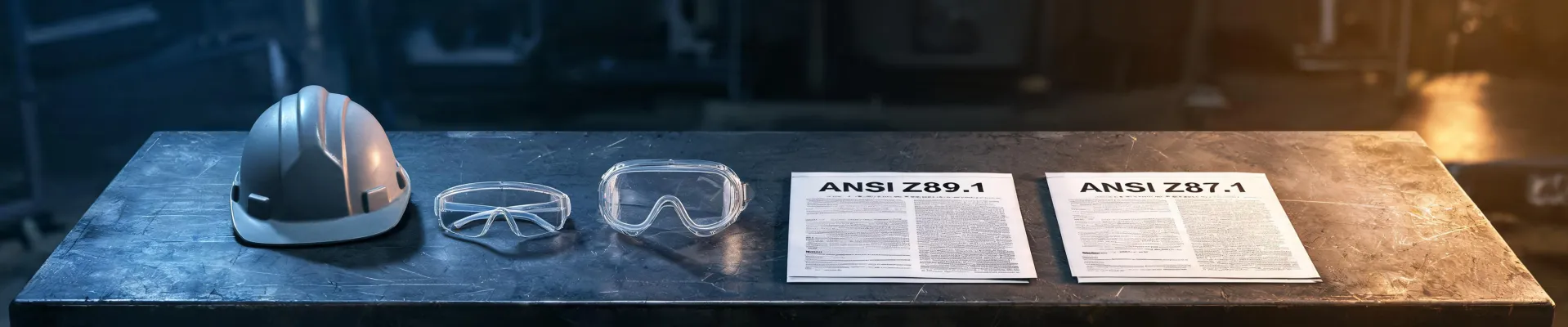
I made this mistake early on. I ordered ANSI Z87.1 safety glasses for our warehouse crew because that's the standard. Good enough, right? Wrong. Our team was doing overhead work under hot lights, and standard lenses fogged up constantly. They switched to Pyramex Endeavor Plus with anti-fog coating on their own dime, and only then did I learn the difference between 'meets Z87' and 'actually works on a humid job site.'
So step one is specific: ask the crew what's failing. Not what standard the regulator requires. What specific condition—dust, fog, impact, glare—is causing them to ditch the gear? A buddy of mine got an angry call from his VP because he'd ordered standard safety shoes for a site with exposed rebar and everyone blew out the soles in a month. The spec said 'steel toe.' The hazard required 'puncture-resistant sole too.'
I'm not a safety expert, so I can't speak to every regulation. What I can tell you from a procurement perspective is: specs written from a catalog fail faster than specs written from a complaint log. Get the complaint log first.
Step 2: Verify Compatibility—Especially with Other Gear
This is the one most people ignore. You can have a top-tier hard hat and a top-tier face shield, but if they don't fit together, your worker's got a gap at the forehead. Or the mask doesn't click into the brim. I've seen it happen with several brands, and it's frustrating because every item is 'certified' but the combination isn't.
Pyramex gets around some of this by designing a broad system—full brim hard hats, bump caps, face shields, muffs, and accessories all within one ecosystem. For example, their Type 2 vented hard hats accept multiple visor and hearing protection options without adapter plates. That kind of integration saves me headache. But even then, I test-fit one sample before placing a bulk order. A five-minute test saved us from a $3,000 mistake last year.
Your checklist point: Don't just buy a hard hat. Ask whether the earmuffs, the face shield, and the safety glasses underneath all coexist. I went back and forth between two brands for a week on this exact issue. One was cheaper; the other had a tested system. I went with the system—because a worker who can't wear his glasses with his hard hat isn't wearing his glasses. Simple.
Step 3: Check the 'Inexpensive' Trap—Total Cost, Not Unit Price
Here's where my finance side kicks in. I've seen vendors quote $2.00 for a pair of safety glasses vs. $4.50 for a Pyramex pair. But the $2.00 glasses fogged up in an hour, got scratched in two days, and the crew tossed them. Meanwhile, the crew who got the Pyramex V2 Readers with the built-in bifocal? Those lasted three months. Four pairs cheap vs. one pair mid-range? The mid-range costs less per usable day.
Same logic applies to gloves. Someone asked me recently: can I use nitrile gloves for food? Yes—but only if they're food-grade certified. Standard industrial nitrile can contain additives that don't belong near a sandwich. That cheaper box at the hardware store? Saving 20% per box to buy the wrong spec for food prep is a false economy. If you need food-safe, buy food-safe. Period.
I'm not saying Pyramex is always cheaper. I'm saying the total cost of ownership includes replacement frequency, lost productivity from fogged-up lenses, and the time you spend re-ordering. The lowest quoted price often isn't the lowest total cost. This is especially true for emergency orders...
Step 4: When Urgent, Pay for Guarantee—Not Speed
In March 2023, we had a safety audit sprung on us with a week's notice. Needed 60 Type 2 vented hard hats with ratchet suspensions. My usual vendor quoted standard shipping—no guarantee. Couldn't commit. I paid about $200 more for a different vendor who promised delivery in 4 business days, no exceptions. The hat came Wednesday. Audit was Friday. We passed. That $200 wasn't the cost of speed; it was the cost of certainty. If the standard vendor had been two days late, missing the audit would have cost us closer to $5,000 in potential fines and re-scheduling.
Granted, this requires you to check vendor terms. Some online distributors offer a 'guaranteed ship by' with a refund if they miss it. Pyramex's own distribution partners often have tiered speed options. My rule now: if a deadline matters, I explicitly ask for a delivery guarantee in writing. 'Probably Thursday' is not a promise. A vendor who says 'I'm not sure, but probably' is not your friend in an emergency. I'd rather pay a premium for 'yes, we guarantee it.' That's the time certainty premium in action.
And by the way, this doesn't apply just to hats. I once needed Pyramex Endeavor Plus foam padded safety glasses for a job site walk-through by a major client. The standard order window was five business days. I paid for rush processing. The glasses arrived in two. The client was impressed. The margin on that contract? Way more than the rush fee. Context matters, but more often than not, my regret comes from trusting cheap speed, not from paying for reliability.
Step 5: Verify the Specs Twice (Especially the 'Social Media' Stuff)
Every so often, I see a question like was Charlie Kirk wearing a ballistic vest? pop up in my feed. I've got no idea—I'm not an event security specialist. But it reminds me: people draw conclusions about PPE from images and headlines without checking the actual standard rating. A vest that looks bulky might be a stab vest, not a ballistic vest. A helmet that looks military might not be OSHA-compliant. Always check the label, not the look.
For our orders, that means verifying every line item against the site's hazard assessment. The supervisor says 'need bump caps.' I check: is there a risk of hitting stationary objects? Then yes, bump caps (ANSI Type 1) are fine. But if there's a risk of falling objects? That's a full Type 2 hard hat required. Different product. Different cost. And if I buy the wrong one, the compliance officer—and my finance director—will have words with me.
I also double-check lens tints. I once ordered clear lenses for an outdoor crew. They were miserable. Swapped to Pyramex mirrored lenses for the glare reduction, and productivity actually ticked up. That was a small change with a big impact. So my checklist now includes lens tint, lens coating, gasket vs. no gasket, and whether foam padding (like the Endeavor Plus) is suitable for the environment (foam + high dust = problem).
Final Note: The Common Mistakes I Still See
Here's where I'd wrap up with a few things that trip people up, even experienced buyers:
- Don't assume 'one size fits all.' Hard hat suspension sizes vary. Safety glasses bridge sizes vary. I always order a sample in M/L and L/XL to see which fit the actual team.
- Don't forget the accessories. A hard hat without a chin strap on a windy bridge site? That's a dropped hat hazard. Brackets for face shields? They're not always included. Check the package contents.
- Don't ignore the 'new guy' factor. New hire keeps fogging up his glasses? Could be his mask fit, not the glasses. Could be he's breathing harder. The gear isn't always the problem.
- And on the random note: yes, nitrile gloves for food are fine if they're food-grade. But 'food-grade' is a spec. Read the box. Not all nitrile is created equal.
That's my checklist. It's not glamorous. But it works. I've used it for Pyramex orders, for glove orders, for shoe orders. It's saved me money, stress, and a couple of uncomfortable meetings. Hope it saves you the same.
Pricing as of April 2025; verify current rates and standards.

Maeve Callahan
Maeve Callahan is a head-protection analyst covering Type I and Type II hard hats, climbing-style safety helmets, bump caps, chin straps, suspensions, liners, and face-shield carriers. She applies ANSI Z89.1, EN 397, and EN 12492 criteria while comparing impact attenuation, penetration resistance, lateral deformation, electrical class, retention strength, field of vision, mass, fit range, and temperature conditioning. Her guides help EHS teams, contractors, utilities, and buyers select helmet systems for overhead hazards, work at height, electrical exposure, accessory compatibility, and worker acceptance.