I thought we were saving money. We weren't.
When I reviewed our Q3 PPE spend last year, I found something disturbing: we'd spent 40% more on emergency replacements than planned. Not because our crew was careless—but because the "budget-friendly" safety glasses we bought lasted half as long as expected. That $2.50 pair of specs? It cost us about $12 in administrative time, restocking fees, and lost productivity per worker.
The irony isn't lost on me. I'm the guy who approves every safety product that hits our warehouse floor. I'm supposed to catch this stuff. But even I fell for the lowest-bidder trap.
What we think the problem is vs. what it actually is
Most safety managers I talk to think the problem is simple: "Workers won't wear PPE because it's uncomfortable." Or "We need better training." Or "The boss won't approve better gear."
And sure—those things matter. But they're symptoms, not root causes.
The deeper issue: we evaluate PPE on price, not cost
Here's what I mean. When you buy a safety helmet for $8 versus $15, you're looking at the purchase order and thinking, "Great, saved $7." But what happens next determines the real cost.
Cheap hard hats often have lower-impact suspension systems, less durable shell materials, and fewer adjustment points. In practical terms, that means:
- More replacements. That $8 helmet might need replacing after one moderate impact. A better one might survive multiple bumps.
- More complaints. Uncomfortable gear means workers find ways to not wear it—or modify it unsafely.
- More admin time. Every reorder, every return, every complaint takes someone's time. Yours or a purchasing agent's.
I learned this the hard way. In 2023, we rolled out a cheaper safety goggle line to save about $0.80 per unit. Within four months, the fogging complaints were off the charts. We swapped them out, ate the loss, and went back to our previous brand. Net savings: negative $2,100. That's what I call pennywise, pound foolish.
The cost of ignoring the real problem
Let's say a worker on your crew has a close call. A piece of debris hits their hard hat. The hat is fine—no visible damage. But if the impact exceeded the helmet's capacity, it's compromised. Do you replace it?
If you're using a $8 helmet, you probably toss it. If you're using a $20 one, you might check the manufacturer's guidelines and see if it's still good. But here's the thing: the real cost isn't the helmet. It's the potential injury if the next impact isn't absorbed.
I've seen companies pay $22,000 in rework costs because a batch of gloves failed a tear test during an audit. I've seen a $3,500 safety upgrade to a goggle line reduce eye injuries by 70% over a year. The numbers don't lie—when you measure total cost of ownership, premium PPE is often cheaper.
What I actually do now
I'm not saying every cheap product is bad. Some budget options are surprisingly good. But I stopped evaluating PPE by price alone. Here's what I do instead:
- Run small-scale trials. I grab 10 workers from different shifts, give them two product options, and let them test for two weeks. I ask three questions: "Would you wear this willingly?" "Does it do the job?" "Would you recommend it?"
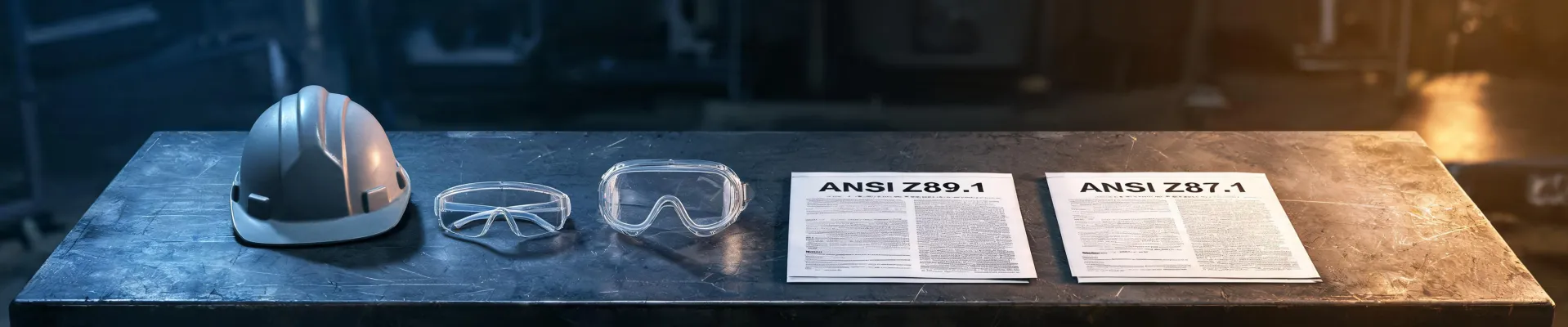
- Check the standards. ANSI Z87.1 for eye protection, ANSI/CSA Z94.1 for hard hats—these aren't suggestions. I verify the product meets the latest version. If a vendor can't show me the cert, I don't buy.
- Total cost calculation. I multiply purchase price by expected lifespan, add admin overhead, and add a 10% buffer for complaints or returns. That's my real cost. If a $10 goggle lasts 6 months and a $14 lasts 18 months, the $14 is a no-brainer.
- Partner with specialists. I'll be honest—we don't make helmets. We're not goggle experts. That's why I work with suppliers who live and breathe this stuff. The vendor who said "this isn't our strength—here's who does it better" earned my trust for everything else.
The vendor who said "we can't help you"
I once called a major PPE distributor about a specific requirement—a hi-vis vest with a particular pocket configuration. The rep paused and said, "You know what? That's not our strength. We have a few options, but they're mediocre. Let me connect you with a specialty supplier."
I was stunned. Most reps would have sold me something and hoped for the best. Instead, they lost a small sale but gained a loyal customer for everything else. That's the kind of honesty that signals real professionalism.
Wrapping up
If your safety program isn't performing the way you want, don't assume it's a training problem or a worker attitude problem. Step back and ask: are we buying the right gear for the actual job? Are we measuring cost correctly? Are we partnering with people who know their limits?
I've been on both sides of this equation. And I can tell you: the true cost of cheap PPE isn't the few bucks you save up front. It's the injuries, the downtime, the compliance failures, and the erosion of trust. Good safety gear isn't an expense—it's an investment that pays for itself.
Disclaimer: Pricing and availability vary by vendor and region. Always verify product certifications for your specific application. This article reflects my personal experience and should not substitute professional safety advice.

Maeve Callahan
Maeve Callahan is a head-protection analyst covering Type I and Type II hard hats, climbing-style safety helmets, bump caps, chin straps, suspensions, liners, and face-shield carriers. She applies ANSI Z89.1, EN 397, and EN 12492 criteria while comparing impact attenuation, penetration resistance, lateral deformation, electrical class, retention strength, field of vision, mass, fit range, and temperature conditioning. Her guides help EHS teams, contractors, utilities, and buyers select helmet systems for overhead hazards, work at height, electrical exposure, accessory compatibility, and worker acceptance.