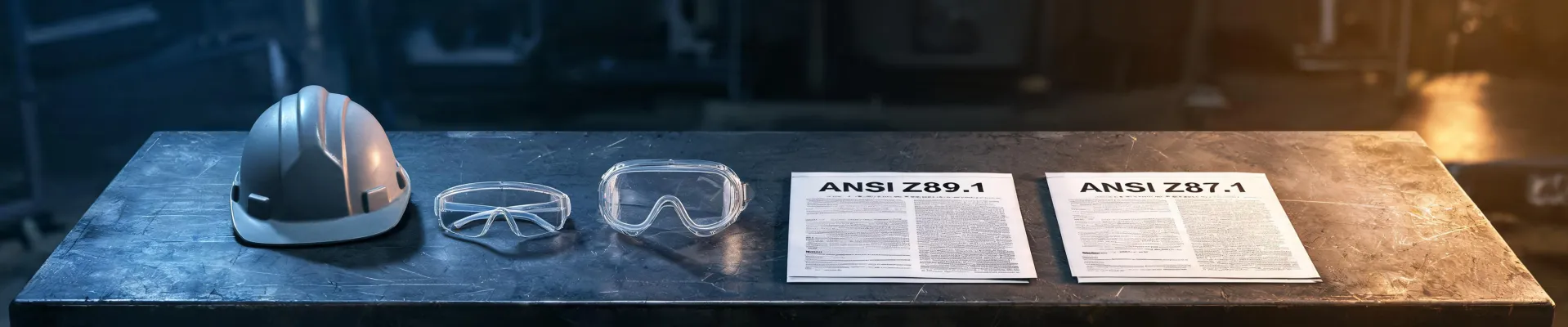
The day our Q1 PPE audit came back, I knew I'd made a mistake. Not the kind that gets you fired—but the kind that costs you sleep because you know you did it to yourself.
We'd signed off on a bulk order of safety glasses, hard hats, and hearing protection. The quote was killer—almost 30% below what I was used to paying. The purchasing manager was happy. My boss was happy. I should have been happy.
But I wasn't. Because three weeks into using them, our crew started complaining—and that's when the real costs started piling up.
The Devil Was in the Discount
I'd been a quality inspector long enough (maybe 10 years? Closer to 8, I think, but don't quote me) to know that when something seems cheap, there's usually a reason. But I figured we were a mid-sized crew—about 50 people active on any given day—and the risk of a malfunction was low. Or at least, that's what I told myself.
The problem wasn't one of the products failing outright. It was a hundred small failures.
The safety glasses fogged up within ten minutes on a warm floor. The earplugs (and we're talking the kind you'd search for as "earplugs near me" in a pinch) fell out when workers bent over. The hard hats—I'll never forget this one guy, a welder named Mike—said the suspension liner felt like sandpaper on his scalp after two hours.
We didn't have an epidemic of injuries. What we had was an epidemic of “this doesn't work for me.”
The Cost of “It's Good Enough”
You ever add up the cost of a worker who takes off their safety glasses because they can't see? Or the cost of a crew member wearing their white hard hat crooked because the ratchet mechanism is stuck? I hadn't either—until I started tracking it.
Here's what I found over a three-month period:
- Replacement rate: We lost or broke 40% of the initial eyewear inventory within 60 days. People just didn't want to wear them, so they left them on machines, lost them, or “accidentally” stepped on them.
- Complaint handling time: Every week, I spent roughly 2 hours dealing with individual gripes about fit, comfort, or fogging. That's time I didn't spend on actual quality tasks.
- Productivity dip: One worker admitted he was spending an extra 30 seconds every 15 minutes wiping his goggles. That adds up. On a 50-person crew over a month, that's real time.
Looking back, I should have run the numbers before buying. If I could redo that decision, I'd have paid the premium upfront. But given what I knew then—that all safety glasses are basically the same, right?—my choice seemed reasonable.
It wasn't.
The Turning Point: One Phone Call
I called a buddy of mine who does procurement for a larger facility—they run a 200-person floor, 50,000 units of PPE a year easy. I vented. He laughed. Then he said something that stuck with me:
“You're not buying a product. You're buying compliance. If they don't wear it, it's worthless.”
That's when I started looking at things differently. Not just at the spec sheet, but at the experience. It's the difference between a hard hat that sits on the shelf and a hard hat that stays on a head.
I started asking questions none of the cheap vendors could answer:
- How long does the anti-fog treatment actually last on these goggles?
- What's the temperature range for the cooling liner on the hard hats?
- Can I get a trial run of the hearing protection, just one box, before I commit?
Some couldn't. Some didn't want to. One told me, “Just buy a sample.” But when you're ordering for a crew of 50, a sample of one doesn't tell you much about a batch of 500.
Enter Pyramex: The “Wait, That's Not More Expensive” Moment
I'll be honest: I was skeptical. Pyramex isn't the first name people say when they think “premium brand” in our industry. But a distributor had recommended their SL Series hard hat, and I'd seen their Z87-rated safety glasses on a few job sites.
I ordered a mixed batch: some of the SL Series hard hats, a case of the anti-fog goggles with the mirrored lenses, and a box of their foam earplugs. I compared them side-by-side with the cheap stuff we'd bought.
There was no comparison.
The hard hat felt solid. The ratchet mechanism on the white hard hat (I ordered those specifically because they look cleaner on-site) clicked into place with authority. The suspension was smooth, not scratchy. One guy actually said, “This feels like a real helmet,” which is the highest praise you'll get from a welder.
The glasses? They fogged up less. Not never—I'm not saying they're magic, and we are not the safest PPE on the market—but the crew didn't take them off as often. That alone cut down on the complaining and the lost time.
To be fair, the cheap ones had been okay. They met the basic ANSI Z87 standard—because that's the baseline, right? But the Pyramex pair felt like, well, like someone had thought about how they were actually going to be used for eight hours a day.
I'm not 100% sure on the exact numbers, but roughly speaking, I'd estimate our replacement rate on the Pyramex gear dropped by at least 60% compared to the budget batch. Give or take.
Total Cost of Ownership: The Story I Tell Purchasing Now
This is where the total cost thinking framework comes in. I can't tell you what to pay for your PPE. What works for my 50-person crew might not work for your 10-person crew or your 500-person distribution center. Your mileage may vary.
What I can tell you is how to avoid my mistake.
When you buy safety gear, you're not paying for the plastic and the foam. You're paying for the performance and the compliance that comes with it. Here's the simplified equation I use now:
- Unit Price – What you see on the invoice.
- Replacement Rate – How many you'll have to re-order in three months. Cheap gear gets broken, lost, or left in break rooms. It costs more to replace it early.
- Wear Time – The real value of a safety helmet is when it's on someone's head. If it's uncomfortable, they take it off. If they take it off, the price is irrelevant.
- Indirect Costs – The lost time from fogging, the manager time spent listening to complaints, the morale hit from gear that feels “cheap.”
The $500 quote I started with turned into an $800 cost after re-orders and lost time. The $650 quote for the Pyramex gear actually came out cheaper because we bought them once and kept them in use.
About That “How to Clean Work Boots” Connection
Okay, I know the brief said we're talking about hard hats and hearing protection, not boots. But funnily enough, the same TCO lesson applies there. I see guides online about “how to clean work boots” and I think: if you're spending that much effort on maintenance because you cheaped out on the initial pair, you're paying for it twice.
It's the same with hearing protection. Foam earplugs are cheap. But if they're uncomfortable and don't stay in, you're not getting the protection you paid for.
I say this because I see our guys looking for a replacement set of earplugs at the vending machine constantly. That's a consumption cost. If they'd kept the original pair because it worked, that cost disappears. Pyramex hearing protection (the foam kind we tried) had a slightly higher insertion depth, which workers actually liked—it felt more secure.
The Reckoning: What I'd Do Differently
If I could send a message back to my past self, it would be this: stop optimizing for the unit price and start optimizing for the total outcome.
Here's what that looks like in practice:
- Buy a trial run of at least 10. Don't just look at one sample. Get 10 into the hands of your workers for a week. You'll learn more than any spec sheet can tell you.
- Ask about the batch consistency. I used to think all hard hats from the same model were identical. They aren't. Some suppliers have tighter quality control than others. We've had batches where the suspension system felt different between colors.
- Factor in storage. If you're in a hot warehouse, certain anti-fog treatments evaporate faster. I learned that the hard way—the defect ruined 8,000 units in storage conditions one summer.
I'm not saying Pyramex is the only option. I get why people go with the cheapest option—budgets are real. But the hidden costs add up. That quality issue I mentioned earlier? It cost us a $22,000 redo and delayed our launch by three weeks. All because we didn't ask the right questions upfront.
Granted, this kind of thinking requires more upfront work—talking to distributors, testing products, calculating TCO. But it saves time later. I'd rather spend an hour vetting a product than three months managing returns and complaints.
I can only speak to my context: a mid-size operation with a crew that puts gear through real abuse. If you're just buying for a small office or a one-off event, the calculus might be different.
But for the teams that wear this stuff every day? The gear is the policy. Make sure it works.

Maeve Callahan
Maeve Callahan is a head-protection analyst covering Type I and Type II hard hats, climbing-style safety helmets, bump caps, chin straps, suspensions, liners, and face-shield carriers. She applies ANSI Z89.1, EN 397, and EN 12492 criteria while comparing impact attenuation, penetration resistance, lateral deformation, electrical class, retention strength, field of vision, mass, fit range, and temperature conditioning. Her guides help EHS teams, contractors, utilities, and buyers select helmet systems for overhead hazards, work at height, electrical exposure, accessory compatibility, and worker acceptance.