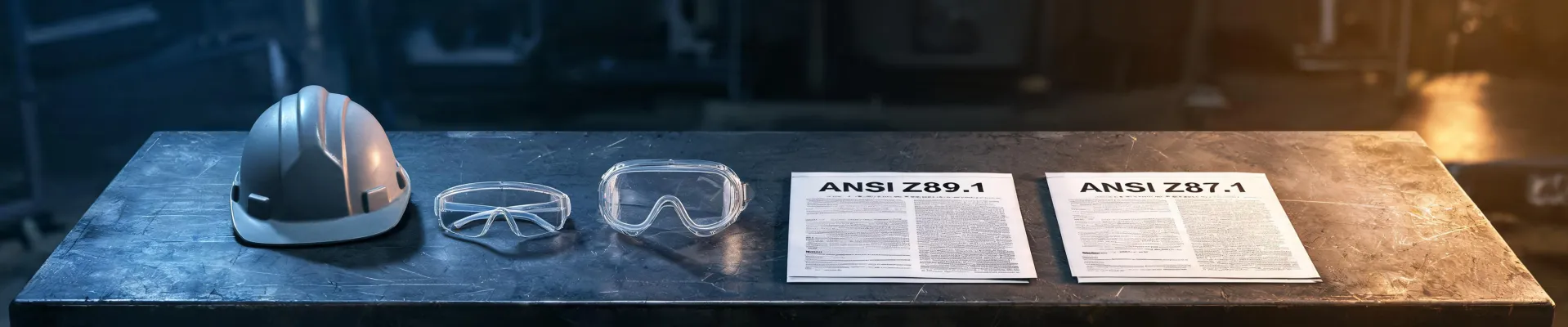
If you're responsible for buying PPE for a team, you've probably seen both sides of it. Orders that arrive perfect and get on the floor immediately. And orders that create a three-week headache of returns, reorders, and 'should've known better.'
I manage quality and brand compliance for a mid-size distributor. Over the past 4 years, I've reviewed hundreds of PPE orders—everything from hard hats and safety glasses to hi-vis vests and earplugs. Some came in and passed first time. Others got rejected before they ever touched a warehouse shelf. The difference usually came down to one thing: whether the person ordering had a checklist.
Here's a 4-step quality check I use for every order. It works whether you're buying a single box of Pyramex BP3000 conical banded earplugs for a welding shop or kitting out a 500-person crew with full PPE. This worked for us, but our situation was high-volume with repeat orders. If you're a one-off buyer, the calculus might be different.
Route 1: The 'Cheapest Available' Trap
Look, I get it. Budgets are real. But in my experience managing over 200 unique procurements annually, the lowest quote has cost us more in about 40% of cases. Here's what happens: you save $200 on a pallet of hard hats, but three months later, suspension systems start failing. That $200 savings turns into a $1,500 problem when you factor in returns, admin time, and lost trust from your crew.
Not ideal.
Route 2: The Evaluated Quality Approach
This is the route that works. It means investing time upfront—but saving money and frustration down the line. Here's the checklist.
Step 1: Verify Standards, Not Just Labels
Most of us look for 'ANSI Z87' or 'Type 2' on a spec sheet. We nod, and move on. That's not enough. The standard certification is the minimum, not the differentiator.
What to do: Specifically ask the supplier for the test report or certificate. For example, if you're buying a class 2 hard hat, confirm the 'Type 2' certification includes the lateral impact test. I learned never to assume a spec sheet tells the full story after a 2022 incident where a batch of supposedly 'Type 2' hats failed an internal drop test. The vendor's certificate only covered a smaller version of the standard. Cost us a re-test and a delay.
Checkpoint: A product like a Pyramex hard hat liner—this is an accessory that changes the performance of the hat. If you're buying it separately, verify it's compatible and doesn't void the hat's certification. Some combinations aren't approved together.
We didn't have a formal process for verifying certificates before that. Cost us when a batch of 2,000 bump caps arrived with a certificate that referenced a different standard. Now every contract includes a request for a third-party test report.
Step 2: Check Material and Construction Details
This is where many buyers stop looking. They see 'safety glasses' and assume 'one pair is like another'. That's a bad assumption to make.
What to do: Specifically, ask for a sample or check the specifications for:
- Lens coating: If you're buying for an environment with steam, welding sparks, or humidity, anti-fog is non-negotiable. Check if it's a permanent coating or a spray-on treatment. The latter wears off.
- Shell material for hard hats: HDPE vs. ABS vs. Polycarbonate. Each has trade-offs. HDPE is more impact-resistant in cold temperatures. ABS is better for chemical resistance. A class 2 hard hat needs a shell designed to handle top and lateral impact.
- Stitching for gloves and hi-vis: Is it reinforced? What's the thread material? Kevlar in high-heat zones? Blind tests with our team showed that a difference in D-ring placement on hi-vis vests made a 15% difference in wearer comfort.
Checkpoint: If you're ordering slip on work boots for men, most people check the sole material. They forget to check the ankle support construction. That's where long-term safety and fatigue come from. I assumed 'same specifications' meant identical results across brands. Didn't verify until we had a crew complaining about boot comfort. Turned out the cheaper boot had a thinner nylon insert instead of a steel shank. Learned to never assume that.
Step 3: Test Fit and Comfort (the 10-Minute Rule)
Safety equipment only works if people wear it. A class 2 hard hat that's too heavy, or a set of earplugs that are too stiff, gets left on the truck. You've seen it.
What to do: If possible, get a sample of the exact product you're ordering. Have 3 to 5 workers in the actual conditions test it for 10 minutes. Not 'hold it in their hand' for 10 seconds. Put it on. Bend down. Walk around. Sweat. That's the test. For Pyramex BP3000 conical banded earplugs, the cone shape is specifically designed for a secure fit. Test if it holds under movement. The best part of this approach: catching a poor fit before the bulk order ships, not after.
Checkpoint: Ask for feedback on specific pressure points. What feels 'firm but comfortable' to one person might cause a headache after two hours for another. There's something satisfying about a line of workers willingly putting on their gear, knowing it won't annoy them.
I can only speak to domestic operations for this step. If you're dealing with teams in extreme hot or cold environments, the fit and material properties change drastically. Your mileage may vary.
Step 4: Calculate the Real Total Cost (Not Just the Unit Price)
This is the step that separates experienced buyers from those who get burned. The unit price is just the beginning. Here's what you need to add up:
- Shipping: Free? Minimum order? Flat rate? In 2023, a rush order cost us an extra $400 in freight because we didn't plan ahead.
- Defect rate: If one in 50 hard hats has a scratch, that's a 2% loss. On a 10,000 unit order, that's 200 unusable hats. If the supplier doesn't accept returns, that cost gets added to your unit price. The cheapest option often has a higher defect rate.
- Compliance paperwork: Are certificates provided upfront, or do you need to pay for a separate compliance audit?
- Lead time: A longer lead time means more inventory carrying cost, or the risk of a stockout. A 30-day lead time vs. a 10-day lead time could cost you a lot in missed productivity.
- Training: Does the gear require training to use properly? Slip on work boots for men are straightforward. A complex fall protection harness? Not so much.
Checkpoint: Ask the supplier for a 'landed cost' quotation. That includes all fees to get the goods to your door. A supplier who resists this is likely hiding costs.
From experience, the time savings alone from a better product can justify a 10-15% higher unit price. Real talk: that $200 you saved on the quote got eaten up by the $180 in extra admin costs to process the returns from the minor sizing issues. Add the cost of a team waiting a day for the right boots to arrive? Ballpark? Around five figures. Way more than you'd think.
What About 'What is PPE in Accounting'?
Here's something I get asked by newer procurement staff: 'What is PPE in accounting?' It refers to Property, Plant, and Equipment—a completely different term. It's easy to get confused. When I'm ordering a class 2 hard hat, I'm dealing with Personal Protective Equipment. When accounting capitalizes a new building, they're dealing with PPE. Same abbreviation, totally different meaning. Just a heads-up in case someone sends you a spreadsheet with PPE entries and you think they're ordering hard hats. Happened in my Q2 2024 audit.
A Few Final Red Flags
- Overly cheap quotes: If a price for a slip on work boot for men is 40% below the average market rate, there's a catch. Low quality materials, or the specs aren't being met. This pricing was accurate as of Q4 2024. The market changes fast, so verify current rates before budgeting.
- Vague specs: 'Meets industry standards' is not a spec. Ask for the specific standard, the year, and the test method.
- Unwillingness to provide a sample: Treat this as a major red flag. If they can't send a $15 sample, your 500-unit order might be a gamble you don't want to take.
- No returns policy: Even the best buyers make mistakes. A rigid 'no returns' policy on a safety order is a deal-breaker.
The bottom line: Buying PPE is a decision that affects your people's safety and your company's operational efficiency. Using this checklist for your next Pyramex order—or any order, regardless of brand—can save you time, money, and a lot of frustration. There's something satisfying about a perfectly executed order. After all the coordination, seeing it arrive on time, on spec, and accepted by your team—that's the payoff.

Maeve Callahan
Maeve Callahan is a head-protection analyst covering Type I and Type II hard hats, climbing-style safety helmets, bump caps, chin straps, suspensions, liners, and face-shield carriers. She applies ANSI Z89.1, EN 397, and EN 12492 criteria while comparing impact attenuation, penetration resistance, lateral deformation, electrical class, retention strength, field of vision, mass, fit range, and temperature conditioning. Her guides help EHS teams, contractors, utilities, and buyers select helmet systems for overhead hazards, work at height, electrical exposure, accessory compatibility, and worker acceptance.