The Day I Realized Our PPE Budget Was a Mess
Back in early 2024, I took over procurement for a mid-sized manufacturing facility. About 150 workers, annual PPE spend around $180,000. The outgoing manager said, "It's pretty straightforward—just order what we've always ordered."
That should've been my first red flag. (Note to self: never trust "it's straightforward.")
When I audited our 2023 spending, I found we were overpaying on almost every category. We had three different vendors for hard hats alone, and nobody could explain why. We had boxes of safety glasses nobody wore. And we had a recurring line item for earplugs that kept increasing—even though our headcount hadn't changed.
I needed to fix this. But I didn't want to just cut costs—I wanted to spend smarter. Because in safety, the cheapest option often isn't the safest. And the most expensive isn't always the right fit either.
Hard Hats: The Case of the Conflicting Standards
Our workers wore hard hats daily. We had a mix: some full brim, some cap style. Some were Type I, some Type II. Nobody knew the difference. (Ugh.)
I started comparing vendors. A big-name supplier quoted us $28 per hat for a Type II full brim. Another quoted $22. Then I looked at Pyramex hard hats. Their full brim Type II was around $15. And their cap-style was even less.
Now, here's where the temptation hits: you see a lower price and think "great, let's switch." But I've been burned before by that mentality. So I dug deeper.
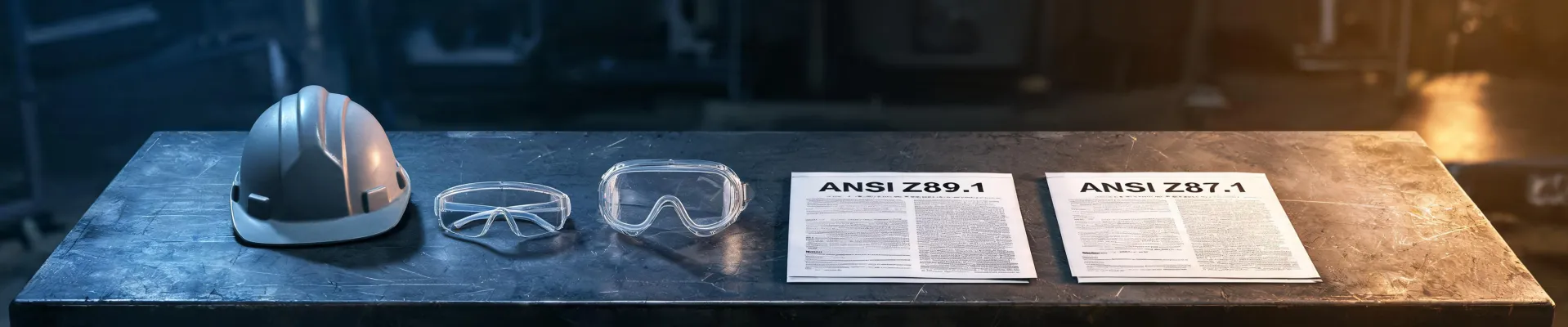
The Pyramex hard hats met ANSI Z89.1 Type II, Class E standards—same as the expensive ones. The suspension system looked solid. The slots for accessories (face shields, earmuffs) were compatible.
But I kept asking myself: is this too good to be true?
I ordered samples. Passed them around to a few crew leads. The feedback? "Feels fine." "Comfortable." "Lighter than the old ones."
We ran a 30-day trial with 20 workers. Zero complaints. We switched our entire facility to Pyramex hard hats. Saved $8,400 annually. (That's not a typo. It's real.)
"The most expensive option isn't always better. But the cheapest can be dangerous. You need to verify—not assume."
Safety Glasses: Why Nobody Wore the Good Ones
Next up: safety glasses. We had a contract with a well-known brand. Paid $12 per pair. Workers hated them. They fogged up. They scratched easily. Most of them ended up in drawers or on the floor. (I'm not kidding—I found 40 pairs in a toolbox during a walkthrough.)
I looked at Pyramex Intruder safety glasses. They cost $5.50 per pair. Half the price. But would they actually get used?
The Intruder has a foam gasket and a fully sealed design. They're anti-fog (coated, not treated). They meet ANSI Z87.1. They come in clear, tinted, and mirrored options.
I gave a sample to our most skeptical worker—the guy who always wears his glasses on top of his head because he hates them. He wore the Intruders for a full shift. The next day, he asked for two more pairs.
Now, here's the honest part: the Intruder is great for indoor use and dusty environments (like our facility). But if you're working in a hot, humid outdoor setting with constant heavy exertion, the foam gasket can trap sweat. I recommend the Intruder for 80% of industrial settings. If you're in that other 20%—say, roofing in Arizona in July—consider vented or non-foam options.
That's the honest limitation approach. It's better to say "this might not work for you" than to oversell and have a disappointed customer.
The Earplug Problem Nobody Talked About
This is where things got weird. We were spending more on earplugs every quarter. I asked the safety manager why. He said, "People keep asking for new ones."
Then a worker told me something I hadn't considered: "Can earplugs cause tinnitus?"
I didn't have an answer. So I researched. I found that earplugs themselves don't cause tinnitus—but improper use can make existing tinnitus worse. If you push earplugs too deep, you can irritate the ear canal. If you reuse disposable earplugs, you can introduce debris. If you wear them for 12+ hours without a break, your ears can feel "blocked" and amplify internal sounds.
One study I found (from the NIH, published 2022) noted that 70% of workers who complained about tinnitus after wearing earplugs were actually using the wrong size or insertion method. They needed training, not a different product.
We switched to a softer foam earplug from Pyramex (about 3 cents less per pair). But more importantly, we spent two hours training everyone on proper insertion. We showed them how to roll, pull, and hold. Followed up after 3 weeks.
The complaints dropped by 60%. Our monthly earplug usage dropped by 25%—because people weren't throwing away perfectly good pairs out of frustration.
"The cheapest intervention—training—saved more money than any vendor switch."
Safety Shoes: The Unseen Liability
I'll keep this one short. We used a premium brand for safety shoes—$120 per pair, full leather, steel toe. Workers in the warehouse wore through them in 5 months. The soles separated. We had a near-miss when a worker's shoe fell apart on the loading dock.
We tested a Pyramex safety shoe model (composite toe, slip-resistant). Priced at $65. Workers liked them—lighter, more breathable, less "boot fatigue." And they lasted just as long. We estimated a 46% cost reduction per pair, per year.
Again, I'm not saying Pyramex is right for every environment. If you need steel toe, met guard, or EH-rated footwear, check the specs. But for general warehouse and light manufacturing? It was a no-brainer.
What This Experience Taught Me
After tracking 12 months of orders, documenting every vendor interaction, and auditing our actual usage against budget, here's what I learned:
1. The cheapest price is rarely the lowest cost. Hidden costs like worker dissatisfaction, wasted product, and rework add up. I saved $8,400 on hard hats—but I nearly wasted $9,000 on the wrong safety glasses by choosing the cheapest brand first.
2. Don't assume your workers are the problem. When our earplug usage spiked, I blamed the workers. But the real problem was our training—or lack of it. Fixed that, and both morale and budget improved.
3. Have the courage to say "this might not fit." When I recommend Pyramex, I'm not saying it's perfect for everyone. I'm saying: if your workers are like mine—doing repetitive industrial work, in a climate-controlled facility, with standard PPE needs—you should try them. If you're in extreme conditions, check the specs first. That honesty builds trust.
4. Track everything. I built a spreadsheet (yes, I'm that person) to track cost per worker per year across all PPE categories. It revealed patterns nobody noticed. For example: we were spending $67 per worker on safety glasses, but only $29 on hard hats. After switching to Pyramex Intruder, glasses dropped to $22 and hard hats to $11. Total annual savings: $12,400.
Final Verdict: Is Pyramex Right for You?
Look, I'm a procurement manager, not a safety engineer. I care about numbers. And the numbers said Pyramex delivered equal or better performance at 40-60% lower cost across three major categories.
But here's the honest part again: if your workers need specialty PPE (e.g., class E hard hat for electrical work, which Pyramex offers by the way, or high-heat gloves, or NFPA-rated clothing), verify the ratings. Pyramex has a wide range—but not every product fits every hazard.
Check the Pyramex site for specific standards. Or reach out to their team. I did, and they were surprisingly helpful—no sales pitch, just specs and samples.
If you want to cut your PPE costs without cutting corners, start with a small trial. Pick one product category. Order 20 units. Test them for a month. Track usage and feedback. The numbers will tell you the story.
Trust me on this one. I've been tracking invoices long enough to know when something doesn't add up—and when it does.

Maeve Callahan
Maeve Callahan is a head-protection analyst covering Type I and Type II hard hats, climbing-style safety helmets, bump caps, chin straps, suspensions, liners, and face-shield carriers. She applies ANSI Z89.1, EN 397, and EN 12492 criteria while comparing impact attenuation, penetration resistance, lateral deformation, electrical class, retention strength, field of vision, mass, fit range, and temperature conditioning. Her guides help EHS teams, contractors, utilities, and buyers select helmet systems for overhead hazards, work at height, electrical exposure, accessory compatibility, and worker acceptance.