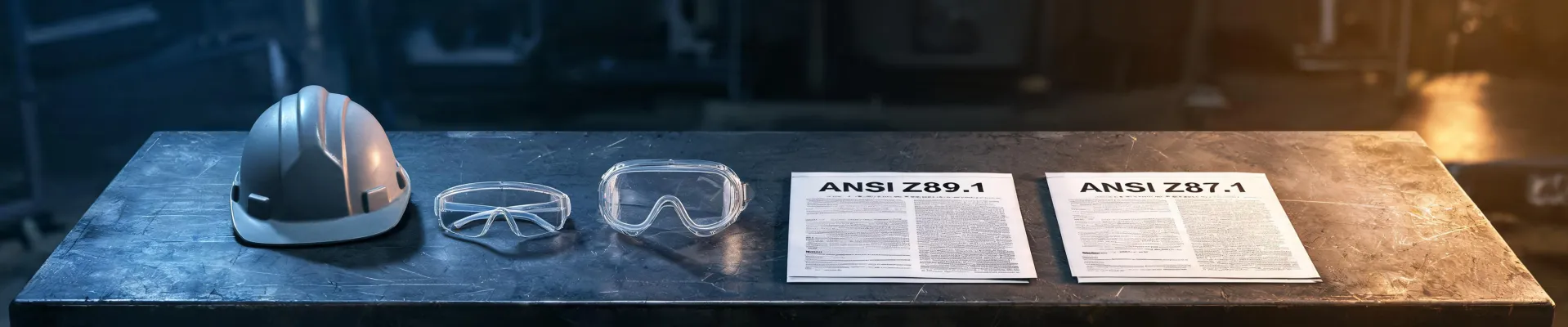
I don't buy safety equipment based on price. I approve it based on certainty: does this product meet its claimed standard, can we trace it to a production batch, and will people actually wear it when the supervisor leaves the site?
So here is my opinion, stated plainly: The cheapest hard hat in the catalog is the most expensive one if nobody wears it. A comfortable, full-brim vented helmet that stays on a head protects far more than a bargain cap style that spends the day on the truck seat. Simple.
Pyramex SL Series Hard Hat vs. Ridgeline Vented Full Brim Hard Hat
My job involves looking at labels for a living. In Q1 2025, I reviewed around 1,100 head protection items before they were added to our distribution program. I check shell molding, suspension attachments, and the ANSI/ISEA Z89.1 labels that tell you what a hat can and cannot survive. The Pyramex SL Series Hard Hat shows up on a lot of purchase orders because it covers the essentials: tough shell, adjustable suspension, and a low cost per unit. For certain low-hazard sites, that is usually enough.
But if I had one recommendation that would increase compliance on outdoor work, it would be the Pyramex Ridgeline Vented Full Brim Hard Hat. The full brim is not a fashion choice. It channels rain away from your collar, keeps direct sun off the back of your neck, and makes the hard hat feel less like a bucket. The vented version lets heat escape from the top of the shell, which is exactly the feature that makes a worker leave the hat on in July.
Here is something vendors will not tell you: venting is not just about comfort. A hard hat that keeps your head cooler is more likely to be worn on every ladder, every trench, and every lift. An unused hard hat meets zero standards.
If your site has electrical hazards, make sure the exact model carries the correct electrical class. Vented hats often do not qualify for high-voltage work. That is why I always keep a non-vented spec around. The mistake I see most often is assuming every hard hat is interchangeable. They are not.
Certification, Not Just a Sticker
That assumption is the reason I became pickier about suppliers. I still kick myself for a mistake in 2024 that cost us $22,000 in rework and expedited shipping. A supplier promised a large quantity of helmets and showed up at the dock with no lot certificates. The product might have been fine. 'Might have been fine' is not a quality standard. Now every purchase order includes lot-level documentation before release.
The same logic applies to rush orders. When a deadline is non-negotiable, paying for certainty is often the cheapest possible decision. In March 2025, I approved an extra $84 for expedited delivery on a small order of Ridgeline Vented Full Brim Hard Hats. The contractor had one day between shutdown and restart to get the crew trained. Five workers idling for a day would have cost far more than that $84. Certainty was the cheap option.
Welding Gloves and the Wrong Question
Head protection gets the attention. Welding gloves and work boots usually do not. That is a mistake.
Most people ask me, 'Which welding gloves are the thickest?' That is the wrong question. A thick glove blocks heat but takes away dexterity. A TIG welder needs a thin, flexible hide. A stick welder in a heavy shop needs a longer cuff and thicker leather. If the glove prevents a controlled weld, the welder will take it off and work bare-handed. That is worse than any marginal difference in thickness.
When I evaluate welding gloves, I look for cuff length, type of leather, and liner. I also verify that the material has not been waterproofed with something that will soften and melt at high heat. The thickest pair is not automatically the best pair.
Hawx Work Boots and the ASTM Label
The same spec-first thinking applies to feet. If you want a specific place to start, the Hawx work boots are worth a fit test, but only after you see the ASTM F2413 mark on the inside shaft. That mark tells you the toe and sole protection have been tested. Before you pay for any boot, check that label. Then check whether the heel and tread actually match the surface you stand on for ten hours.
You do not need the most expensive boot. You need a boot with the right rating, the right sole, and a toe shape that your workers will tolerate all week. A boot with a great label but a painful fit is not worn, and an unworn boot is the same as no boot.
How to Clean Leather Gloves Without Ruining Them
Now for one of the most common reasons good leather gloves die young: bad cleaning. When someone asks me how to clean leather gloves, I give a shorter answer than they expect. Brush off the dirt. Wipe with a damp cloth. If they are greasy, use saddle soap or a mild leather cleaner. Let them dry naturally, away from heaters and direct sunlight. Once dry, rub in a small amount of leather conditioner. That is it.
Do not machine wash them. Do not soak them. Do not dry them on a heater. A washing machine stiffens and shrinks leather almost every time, and heat accelerates the damage. For welding gloves, damp leather is especially dangerous because it can cause a steam burn against hot metal. If a pair gets wet, hang it in a dry, ventilated room and wait until fully dry before the next hot job.
The surprise was not that expensive gloves wear out fast. It was that expensive gloves wear out faster when cleaning is done wrong. The brand does not fail; the care routine fails.
But Isn't This Just an Upsell?
I can hear the purchasing agent asking, 'So you want us to spend more?' Not exactly. I want you to spend with certainty.
If a low-priced cap-style hard hat meets the listed hazard, passes your inspection, and workers actually wear it, then the Pyramex SL Series Hard Hat is enough. If a vented full-brim hat gets more wear, it is worth the extra few dollars. If the job requires an electrical-rated helmet, a vented hard hat may not qualify; confirm the exact model before relying on comfort features. Match the product to the hazard and the setting.
My Bottom Line: Start With Certainty
Since my first shop-floor audit, the conclusion has stayed the same: buy certainty, verify labels, and maintain leather. Choose the Pyramex SL Series Hard Hat for simple cap-style compliance. Choose the Pyramex Ridgeline Vented Full Brim Hard Hat for all-day wear in hot weather. Match your welding gloves to the process. Check your Hawx work boots for the ASTM mark. And when you think about how to clean leather gloves, remember: brush, wipe, dry, condition. Train that routine and the gear will do its job.
An unworn hard hat protects nobody. A mislabeled boot protects nobody. A pair of leather gloves destroyed by a washing machine protects nobody. The best PPE decision is made before the need shows up, with the evidence in your hand. That is the only way I know to buy safety and time at the same time.

Maeve Callahan
Maeve Callahan is a head-protection analyst covering Type I and Type II hard hats, climbing-style safety helmets, bump caps, chin straps, suspensions, liners, and face-shield carriers. She applies ANSI Z89.1, EN 397, and EN 12492 criteria while comparing impact attenuation, penetration resistance, lateral deformation, electrical class, retention strength, field of vision, mass, fit range, and temperature conditioning. Her guides help EHS teams, contractors, utilities, and buyers select helmet systems for overhead hazards, work at height, electrical exposure, accessory compatibility, and worker acceptance.