-
6 PPE Buying Mistakes I Made (So You Don't Have To)
-
1. What's the single most common mistake people make when buying PPE?
-
2. What's the most overlooked detail in choosing a hard hat?
-
3. Is nitrile gloves latex free? And what does that actually matter?
-
4. Wait—what does Type K fire extinguisher have to do with PPE?
-
5. How do I know if a safety glass is actually protective? Is Z87 enough?
-
6. Is the most expensive PPE always the best?
-
1. What's the single most common mistake people make when buying PPE?
6 PPE Buying Mistakes I Made (So You Don't Have To)
I've been handling safety equipment orders for about 10 years now. 16, if you count the early days when I was just helping out. I've personally made—and documented—some pretty significant mistakes. Total blunders that cost us roughly $7,000 in wasted budget over the years. Now I maintain our team's PPE checklist, mostly so I don't have to explain to my boss again why we have a box of 40 un-returnable bump caps in the wrong size.
If you're searching for stuff like "hard hat near me" or wondering if there's a difference between nitrile and latex, you're probably where I was back in 2018. Let me save you some headache.
The questions below are the ones I get asked most. And the ones I wish I'd asked.
1. What's the single most common mistake people make when buying PPE?
Most buyers focus on per-unit pricing and completely miss fit and sizing. I once ordered 50 pairs of work gloves for our warehouse team based on the catalog description "one size fits most."
They did not fit most.
About 15 guys couldn't get them on. Another 10 said they were too loose to work safely. We ended up keeping maybe 12 pairs for visitors. The rest? Sitting in a cabinet. That mistake cost us around $350—not a huge number, but the embarrassment of telling the crew we'd screwed up was worse. I still kick myself for not ordering a sample pack first.
The question everyone asks is "what's the price?" The question they should ask is "do you have sizing charts, and can we try them?"
2. What's the most overlooked detail in choosing a hard hat?
People think the main difference between hard hats is the color or the brand logo. Actually, the most overlooked factor is weight distribution and ventilation.
In my second year (2018), I ordered 30 standard hard hats for a crew working an outdoor summer project. Full brim, basic model. They looked fine on paper. But within a week, half the guys were wearing them tipped back on their heads because they were too hot and heavy. Useless for protection.
That's when I discovered the Pyramex Ridgeline full brim vented hard hat. It's Type 2 rated (side impact protection, which many don't realize is important), but the real game-changer was the vented shell and the cooling liner. The guys actually wore them. If I'd just asked the crew what they hated about their current hard hats, I could have saved a $600 redo.
Also—the sun shade. I know it sounds like a minor accessory, but if you're buying a Pyramex hard hat sun shade for outdoor workers, it dramatically improves comfort. Workers will keep their helmets on instead of taking them off to wipe sweat.
3. Is nitrile gloves latex free? And what does that actually matter?
Yes, nitrile gloves are latex-free. That's literally the point of them. But here's what I didn't understand until a coworker had a reaction.
People think the choice between nitrile and latex is just about allergies. Actually, the bigger issue is chemical resistance and durability. Nitrile gloves hold up better against oils, solvents, and punctures than latex. But they cost more.
In 2021, we ordered latex exam gloves for a painting job because they were cheaper. The paint thinners ate through them. Within an hour, guys were going through three or four pairs each. That cost us more in wasted gloves and lost time than if we'd just bought nitrile from the start.
The assumption is that price-per-box is the only metric. The reality is cost-per-task is what matters. If nitrile gloves last four times longer on the job, they're cheaper in the long run.
(Should mention: the specific type matters too. Heavy-duty nitrile gloves are different from exam-grade. Check the thickness in mils, not just the material name.)
4. Wait—what does Type K fire extinguisher have to do with PPE?
Good question. It doesn't, really, except that I once lumped a PPE order with a fire extinguisher purchase because it was easier for accounting. I ordered a Type K fire extinguisher for our break room kitchen, thinking it was the standard choice.
It was not. Type K is specifically for commercial kitchens with grease fires. We needed a standard ABC extinguisher. The vendor let us swap, but the delay meant we were without extinguisher coverage for three days.
The point: just because you can add something to a cart doesn't mean you should. PPE is specialized. Fire equipment is specialized. Mixing them in a single order without careful review creates confusion. I created a separate checklist for fire safety gear after that.
5. How do I know if a safety glass is actually protective? Is Z87 enough?
This is a great question, and most people stop at the Z87 stamp. I used to.
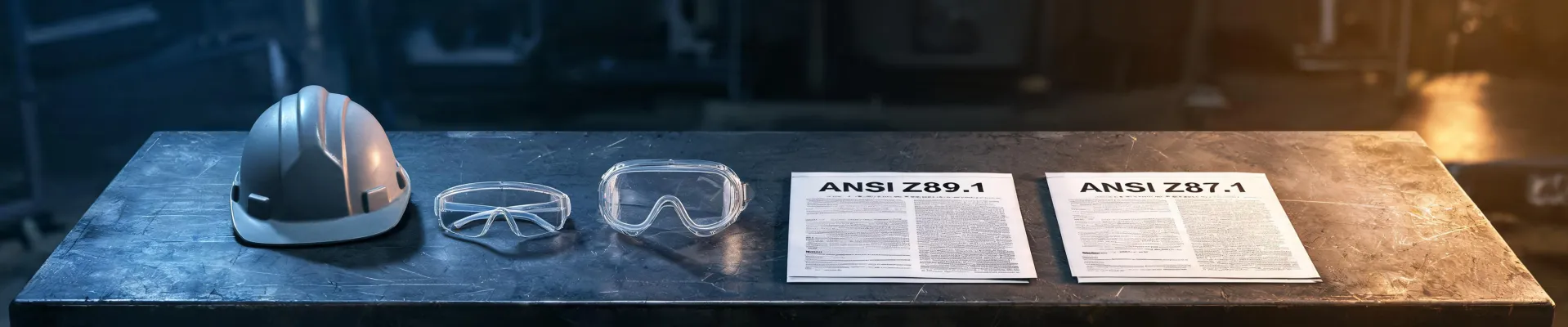
Z87 is the ANSI standard for impact resistance. It's a minimum. But there's a difference between basic Z87 and Z87+. The plus sign means it's been tested for high-velocity impact. If your workers are grinding, cutting, or chipping, Z87+ is what you need.
I learned this when a guy got a metal fragment in his eye. His glasses were Z87 rated, but the fragment hit at high speed. The glasses held, but it was too close a call. I switched our entire site to Pyramex safety glasses with Z87+ rating after that.
Also—anti-fog coating isn't a nice-to-have, it's a safety feature. A guy wiping fog off his glasses isn't looking at what he's cutting. Pyramex has good anti-fog options, but even those need proper care. Don't wash the coating off with harsh cleaners, or you'll be back where you started.
6. Is the most expensive PPE always the best?
No. I recommend Pyramex for a lot of situations because they hit a sweet spot of price, compliance, and worker comfort. But if you're doing heavy chemical handling, you might need something more specialized. If you're doing light assembly work, a cheaper option might be fine.
The trick is matching the gear to the risk. Not the budget. Not the brand name.
I recommend Pyramex for general construction, warehousing, and light industrial use. But if you're dealing with high heat, heavy chemicals, or extreme cold, do your research on specialized gear. Honest recommendation sometimes means saying "this solution works for 80% of cases—here's how to know if you're in the other 20%."
A lesson learned the hard way: the most expensive hard hat isn't the safest if your workers won't wear it. The best PPE is the stuff that actually gets used.

Maeve Callahan
Maeve Callahan is a head-protection analyst covering Type I and Type II hard hats, climbing-style safety helmets, bump caps, chin straps, suspensions, liners, and face-shield carriers. She applies ANSI Z89.1, EN 397, and EN 12492 criteria while comparing impact attenuation, penetration resistance, lateral deformation, electrical class, retention strength, field of vision, mass, fit range, and temperature conditioning. Her guides help EHS teams, contractors, utilities, and buyers select helmet systems for overhead hazards, work at height, electrical exposure, accessory compatibility, and worker acceptance.