The $22,000 Lesson I Almost Learned the Hard Way
I'll be honest: I was that guy. The one who bought the cheapest Z87-rated safety glasses in bulk, handed them out, and called it a day. In my first year as a quality inspector for a mid-sized construction supplier, I made the classic rookie mistake: assuming 'meets ANSI Z87' meant 'good enough for everyone.'
Then we got the complaint. A site supervisor called, frustrated. His crew was swapping out our glasses after two days because they fogged up constantly. They'd started bringing their own from home—which, you guessed it, weren't safety-rated at all. That's a liability nightmare. But the real cost? The re-evaluation, the rush order for replacements, and the lost trust? It ran us about $22,000 in rework and delayed a project launch by three weeks.
The question is: why did those glasses fail? Was it a bad batch? A manufacturing defect? Nope. The problem was way simpler—and way more common—than that.
The Real Problem Isn't the Glasses. It's the Spec.
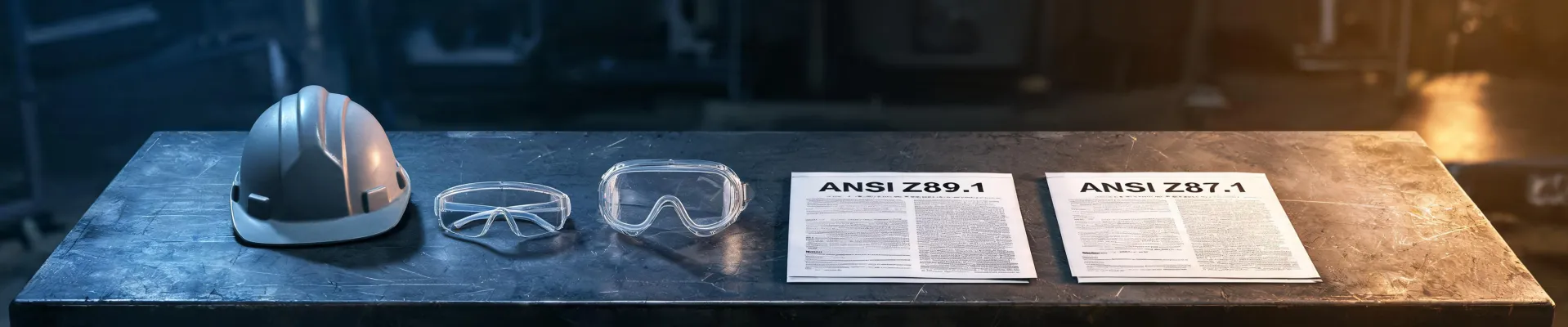
When most people buy safety glasses, they check one box: Z87.1. That's the basic ANSI impact standard. It means the lens won't shatter on impact. That's critical, of course. But Z87.1 doesn't say anything about fog resistance, scratch resistance, or how long the anti-fog coating lasts.
Here's what I didn't know back then: the coating is the most important part of a safety glass, and it's often the cheapest thing manufacturers cut corners on. A standard polycarbonate lens with a basic hardcoat might scratch in a week. A lens with an advanced anti-fog and anti-scratch coating—like the kind Pyramex uses in their Z87+ rated models—can last months.
The difference isn't even that expensive on a per-unit basis. But when you're ordering 50,000 units a year, the temptation to save $0.10 per pair is... real. And $0.10 per pair on a 50,000-unit order is $5,000. That's a real number. But the cost of replacing those glasses in the field—not to mention the safety risk—dwarfs that saving.
What 'Good Enough' Actually Costs You
Let me give you a concrete example. In our Q1 2024 quality audit, we tested three different safety glasses models against our internal durability spec:
- Model A (Budget tier): $1.80 per pair. Basic Z87. Anti-fog coating rated for 48 hours.
- Model B (Mid-range, like Pyramex's standard line): $3.50 per pair. Z87+. Anti-fog rated for 120 hours. Scratch-resistant hardcoat.
- Model C (Premium tier): $6.00 per pair. Z87+. Advanced anti-fog, anti-scratch, anti-UV. Replaceable lens system.
We distributed 200 pairs of each model to workers on a job site with known fogging issues. The results were pretty stark:
- Model A: 68% were replaced within the first week due to fogging or scratching.
- Model B: 12% were replaced in the same period.
- Model C: Less than 5%.
Now, the math is simple. Model A saves you $1.70 per pair upfront. But if you're replacing 70% of them within a week, your effective cost soars. Plus, you've got workers without proper eye protection during the swap. The $3.50 pair is the sweet spot for most general construction work. Not because it's the cheapest—but because it's the cheapest that actually works.
Why I Stopped Ignoring the 'Little Guys'
Here's another thing I learned early on: small contractors get screwed on specs all the time. A large company can demand a specific coating standard and get it verified. But a crew of five buying 20 pairs? They get whatever the supplier's cheapest bulk order is. That's where the $1.80 glasses end up.
If you've ever ordered a small batch of safety glasses and felt like you were treated like an afterthought—you weren't imagining it. The profit margin on a 20-pair order is tiny. Some suppliers don't want the hassle. But the way I see it, a $200 order today might be a $20,000 order next year if you treat that customer right. And more importantly, every worker deserves gear that won't fail them just because their company is small.
What You Should Actually Look For
So, how do you avoid my $22,000 mistake? Stop buying by brand alone. Start buying by coating spec. Here's your checklist:
- Z87+ is non-negotiable. Not just Z87. The '+' means it's passed the high-velocity impact test.
- Ask for coating longevity data. A good manufacturer (like Pyramex) will tell you their anti-fog rating in hours. If they won't, that's a red flag.
- Check the scratch resistance. A hardcoat that's 1H pencil hardness is different from one that's 2H. It matters.
- Buy one pair first. If you're a small company, don't order 50 pairs of a model you've never tested. Get one sample, wear it for a week, see if it fogs.
And to be fair, Pyramex isn't the only brand that makes good stuff. MSA and 3M both have solid lines. But what I've found with Pyramex is that their mid-range stuff (the Z87+ rated models with their proprietary anti-fog coating) is priced really well for what you get. It's rarely the cheapest, but it's almost never the most expensive. And it works. That's the sweet spot.
Take it from someone who learned this the expensive way: the $0.10 you save per pair on coating is the $22,000 you'll spend later on rework.
The Bottom Line (It's Short)
Don't buy safety glasses like they're a commodity. They're not. The coating is the product. The lens is just the carrier. And if you're a small contractor or a safety manager with a tight budget, don't settle for the bottom-tier. A $3.50 pair of properly coated glasses will last longer than five $1.80 pairs. Do the math for yourself—it's probably the cheapest upgrade you'll make all year.

Maeve Callahan
Maeve Callahan is a head-protection analyst covering Type I and Type II hard hats, climbing-style safety helmets, bump caps, chin straps, suspensions, liners, and face-shield carriers. She applies ANSI Z89.1, EN 397, and EN 12492 criteria while comparing impact attenuation, penetration resistance, lateral deformation, electrical class, retention strength, field of vision, mass, fit range, and temperature conditioning. Her guides help EHS teams, contractors, utilities, and buyers select helmet systems for overhead hazards, work at height, electrical exposure, accessory compatibility, and worker acceptance.