As a safety manager handling PPE procurement for a 145-person construction crew for the past eight years, I've personally made and documented six significant purchasing mistakes, totaling roughly $4,800 in wasted budget. When I first started this job in 2017, I assumed the cheapest product that matched the spec sheet was a safe choice. If the box said ANSI Z87.1, I didn't look any closer. If a helmet had a shell and a headband, I didn't think much about whether it was a bump cap or a hard hat.
That mindset cost me. The most painful part isn't just the money—it's the week-long delays while the right equipment ships, and the fact that some of those mistakes left crews briefly unprotected.
So here's the honest foundation: there's no universal "best" safety glass, no single "right" helmet, and no one pair of boots that works for every site. The right answer depends on the hazards your crew actually faces. What I can give you is the decision framework I now use—built from mistakes so you don't repeat them.
We'll cover the three decisions I've gotten wrong most often:
- Bump hat vs hard hat — and the moment a bump cap becomes a serious safety violation.
- Safety glasses vs safety goggles — and why the "safer-looking" option usually ends up on top of a worker's head.
- Work boots — the honest case for budget boots like Brahma, and the site condition that cancels it out.
Bump Hat vs Hard Hat: Know Which One You're Ordering
The most expensive headgear mistake I've made happened in September 2022. I ordered 140 hard hats for a crew building a warehouse mezzanine. The order arrived, and the general contractor's safety officer flagged it before a single one was distributed: they were bump caps, not hard hats. What I mean is, the spec sheet said "bump cap" but the purchase order said "hard hat"—and I didn't verify either before clicking confirm.
That error cost $890 in restocking fees plus a one-week schedule delay. It also added a rule to our checklist: verify the ANSI marking before you order, not after.
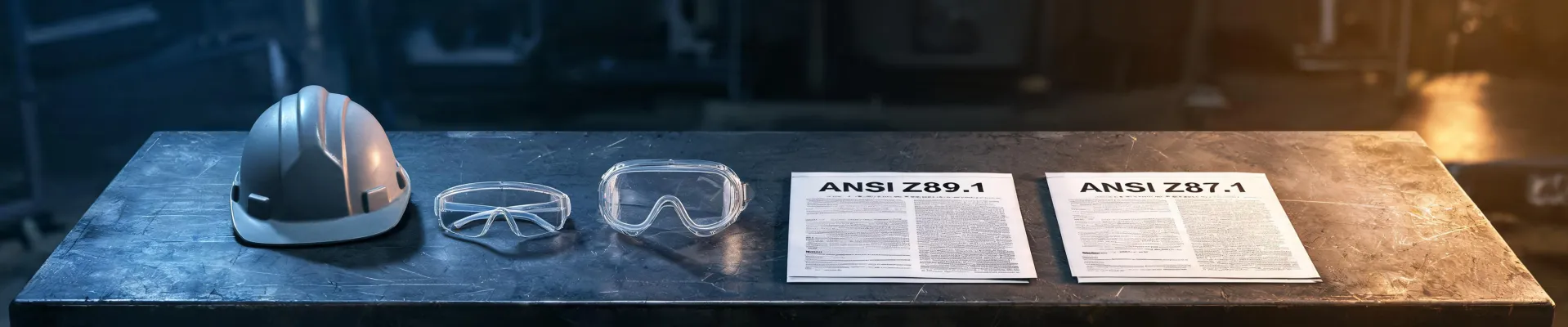
The difference matters because bump hats and hard hats protect against different hazards. A hard hat is designed to absorb the energy of falling objects from above. A bump cap is a shell over a foam liner that protects against hitting your head on a fixed object—a beam, a pipe, a low duct. Bump caps do not meet ANSI Z89.1, the standard for industrial head protection. Under OSHA's head protection rules (29 CFR 1910.135 for general industry, 1926.100 for construction), if a hazard assessment identifies a risk of injury from falling objects, workers need a compliant hard hat—not a bump cap.
So when is a bump cap acceptable? It fits a narrow set of tasks:
- Working under vehicles, inside mechanical rooms, or in crawl spaces where the main risk is hitting your head on something at your own height.
- Areas with no overhead work happening above you—no cranes, no scaffolding, no stacked materials.
- Tasks where a worker needs low-profile headgear to fit under equipment or ducts.
That said, the moment someone is working above your crew, or tools are being lifted overhead, the bump cap is not a substitute. On that rule I won't compromise.
Type 1 or Type 2: Don't Skip This Choice
Once you're on a hard hat, you're still not done deciding. Type 1 hard hats protect against blows to the top of the head. Type 2 hard hats protect against impacts to the top and the sides. I used to compare only price. Then I watched a worker clip the side of his head against a steel beam while wearing a Type 1 cap. He was fine, but the near-miss report made me reconsider lateral protection.
If your crew works in confined spaces, on ladders, or near low beams where lateral impacts are possible, Type 2 is the safer call. We now use vented Type 2 hard hats for most of our crews—the vents make a real difference in summer heat, which reduces the temptation to take the helmet off between tasks. Pyramex carries both Type 1 and Type 2 models, so you don't lose a supplier relationship when you switch categories.
Safety Glasses vs Safety Goggles: The Fog Factor
Eye protection was my first major failure. In my first year, I bought 200 pairs of no-name safety glasses because they were the cheapest SKUs with a Z87 marking. They fogged badly on a humid site, and workers took them off within the hour. Every single pair ended up in a bin in the trailer. That mistake cost $890 in wasted product plus a week of reordering—and it taught me a lesson no spec sheet explains: the best safety glasses are the ones workers actually keep on their faces.
The most frustrating part is how avoidable this is. You'd think a worker would tolerate foggy lenses because "safety first." But real crews don't work that way. Uncomfortable or impractical PPE ends up on top of the hard hat the second a supervisor walks away.
After about 120 orders, here's the pattern: for 80% of tasks on a typical construction site—drilling, cutting, material handling, inspection—a good quality safety glass with an anti-fog coating is the right eye protection. We standardize on Pyramex safety glasses Venture II models. They're lightweight, meet ANSI Z87.1+, and workers don't choose between seeing clearly and wearing them. When a crew member has a wider face or wants a different frame, the Pyramex Itek safety glasses cover that fit range.
Goggles are not a "safety upgrade" you apply to everyone. They're a different tool for a different hazard. You need sealed safety goggles when there's splash risk, chemical exposure, or dense dust that migrates around regular glasses. Concrete grinding, chemical mixing, pressure washing with chemicals—that's goggle territory.
Here's the counter-intuitive part: don't hand every worker a pair of goggles "to be safer." I tried that one season. It didn't increase safety; it increased the number of goggles perched on foreheads. People chose comfort over protection because the hazard wasn't obvious to them. What works is separating the two: one comfortable anti-fog safety glass as the standard, and a smaller stock of sealed goggles issued only for tasks that genuinely require them.
That approach also streamlined our inventory. We went from 15 eye protection SKUs down to 4. Our equipment order turnaround dropped from five days to two, and wrong-item deliveries nearly disappeared.
Brahma Work Boots: When Budget Makes Sense (and When It Doesn't)
I have mixed feelings about budget work boots. Brahma work boots are a legitimate option you'll see on the shelf at Walmart, and for some sites they're the right call.
We bought a dozen pairs for a temporary warehouse reshelving project. The crew was on flat floors, no electrical hazards, no significant falling object risk. The boots handled the four-week project without issue. When it wrapped, we didn't have to stress about retiring expensive boots that had taken a beating. For that narrow scenario, spending extra on premium boots would've been wasted budget.
But the scenario flips quickly. Road work, heavy equipment operation, chainsaw work, and sites with electrical or puncture hazards demand boots rated to ASTM F2413—composite or steel toes, electrical hazard protection, puncture-resistant soles. Some budget lines do carry ratings, so read the tongue label carefully. Put another way: match the boot to the surface and the hazard, not to the brand reputation. The mistake isn't buying budget boots; it's wearing budget boots in a scenario that exceeds their design intent.
One more boot-specific lesson from a $3,200 order: don't let ten workers pick from a catalog of forty boot models. We did that one year—twenty different boots, all arguably fine, but a tracking nightmare and a slow approval process. Now we keep three approved options: a budget-friendly boot for light interior work, a mid-range boot for general construction, and a top-tier rated boot for the heavy crews. Procurement runs faster, and the safety director can tell at a glance which boot protects which task.
Which Scenario Are You Really In? A 10-Minute Checklist
Here's the part where most people nod along and then order what they ordered last time. If you take one thing from this article, make it this: the hazard assessment decides the PPE, not the catalog.
I use the same four-step pre-check before any new PPE order. It's caught 47 potential errors in the past 18 months—most recently a request for Type 1 hard hats for a crew that spends half its shift working sideways in a tunnel.
- Head: Is there any risk of falling objects above? If yes → an ANSI Z89.1 hard hat; choose Type 2 for confined spaces or lateral-impact exposures. If the only risk is striking a fixed object at head height → a bump cap is acceptable.
- Eyes: Is the task producing splashes, sprays, or dense dust? If yes → sealed goggles with proper ventilation. If it's routine impact risk → anti-fog rated safety glasses like the Venture II or Itek.
- Feet: Are electrical, puncture, or heavy-impact hazards present? If yes → ASTM F2413-rated boots. Flat indoor surfaces and light duty → a budget boot can be a reasonable choice.
- Verify, don't guess: Check the ANSI/ASTM marking on the product detail page before confirming the PO. It sounds basic. I've still caught 47 errors in a year and a half using it.
Run every new item through that list, even if you've ordered it before. The person generating the requisition may have swapped a spec, or a supplier may have changed the SKU's certification. At least, that's been my experience—and it's exactly the kind of experience you don't want to pay for yourself.

Maeve Callahan
Maeve Callahan is a head-protection analyst covering Type I and Type II hard hats, climbing-style safety helmets, bump caps, chin straps, suspensions, liners, and face-shield carriers. She applies ANSI Z89.1, EN 397, and EN 12492 criteria while comparing impact attenuation, penetration resistance, lateral deformation, electrical class, retention strength, field of vision, mass, fit range, and temperature conditioning. Her guides help EHS teams, contractors, utilities, and buyers select helmet systems for overhead hazards, work at height, electrical exposure, accessory compatibility, and worker acceptance.