-
Is Pyramex good enough for real industrial use?
-
What should I check before bulk-ordering Pyramex hard hats?
-
Will a Milwaukee hard hat light fit a Pyramex hard hat?
-
Are Pyramex prescription safety glasses actually ANSI Z87 rated?
-
Are Nemesis safety glasses worth the hype?
-
Latex gloves vs nitrile: which should we stock?
-
What's the #1 PPE buying mistake nobody talks about?
I've been handling PPE procurement for eight years, and I've personally made—and documented—14 significant purchasing mistakes, totaling roughly $6,000 in wasted budget. Not exactly a resume bullet point. But it does mean I now run a pre-order checklist that has caught 47 potential errors in the past 18 months. This article covers the questions I get most often from teams evaluating Pyramex or expanding their PPE inventory. Some of it is brand-specific, most of it is general buying experience. All of it comes from mistakes I'd rather you not repeat.
In this article:
- Is Pyramex good enough for real industrial use?
- What should I check before bulk-ordering Pyramex hard hats?
- Will a Milwaukee hard hat light fit a Pyramex hard hat?
- Are Pyramex prescription safety glasses actually ANSI Z87 rated?
- Are Nemesis safety glasses worth the hype?
- Latex gloves vs nitrile: which should we stock?
- What's the #1 PPE buying mistake nobody talks about?
Is Pyramex good enough for real industrial use?
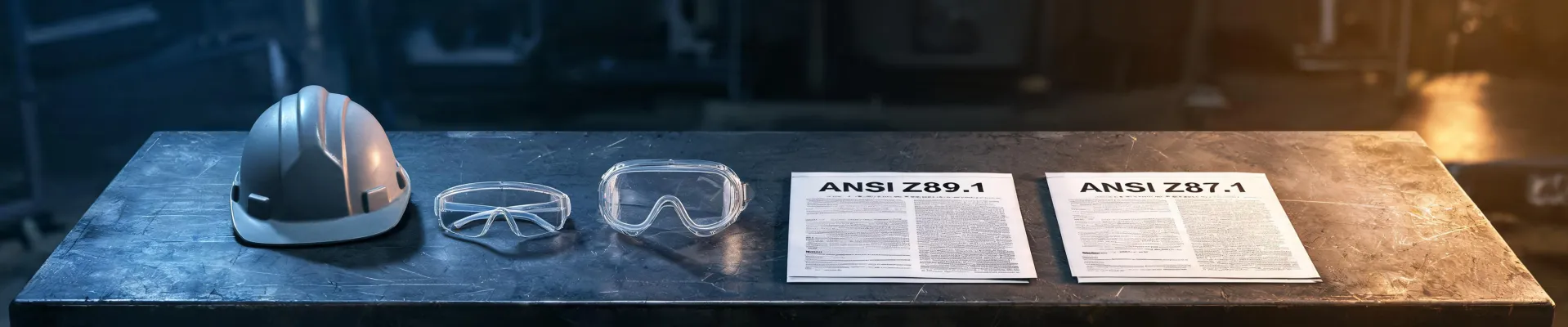
Honest answer: I wrote them off for years. The pricing seemed too good compared to the legacy brands, and I assumed "budget" meant "disposable." Then in Q3 2023, a veteran operator at our plant brought in a Pyramex hard hat he'd bought himself. I tested it against our internal spec sheet—ANSI Z89.1 Type 2, which covers impact protection plus lateral penetration resistance. It passed.
Since then, I've run through roughly 40 Pyramex SKUs across hard hats, glasses, and gloves. Most hold up fine for general industrial duty. (There have been a few misses—one goggle strap felt flimsy out of the box—but the core products have been solid.) Pyramex also has a wider product range than I initially realized: head-to-toe PPE from bump caps to hi-vis apparel. We've consolidated part of our spend with them, which simplified vendor management.
The caveat: always check the specific model's compliance marking, not the product listing summary. I've seen reseller pages state "Z87" where only certain lens styles actually carry the stamp. Look for the marking on the lens or frame itself. Per ANSI Z87.1, high-impact lenses carry the Z87+ marking.
What should I check before bulk-ordering Pyramex hard hats?
Here's my most expensive hard hat lesson. In early 2024, I approved a 300-unit order of Pyramex hard hats without validating compatibility with our existing accessory inventory. We had 150 ratchet suspensions and a box of hearing-protection mounts designed for our previous brand. The Pyramex models we ordered used pin-lock suspension. Nothing transferred.
That mistake cost about $600 in unused accessories plus a week of workaround solutions. The fix going forward—I now confirm three things before ordering any bulk hard hats:
- Suspension type (pin-lock vs. ratchet)—and whether your team has a preference
- Accessory slot compatibility for face shields and hearing protection mounts
- Replacement parts availability for the specific model
Pyramex publishes all of this detail in their spec sheet PDFs. The product page summary won't show enough. And if you're ordering through a distributor, ask them to confirm—it's their job to know.
Will a Milwaukee hard hat light fit a Pyramex hard hat?
This gets searched a lot, and I get why: you already own the Milwaukee light, and you don't want to buy a second one. From what we've tested across our crew, the strap-on and clip-on Milwaukee lights work fine on Pyramex hard hats. The magnetic mount version does not—Pyramex shells are thermoplastic, not metal.
Honestly, I'm not sure why more manufacturers haven't standardized accessory mounting. My best guess: nobody wants to give up their proprietary design. Rule of thumb: if a light says "universal" or comes with a strap, it'll likely work. If it's magnetic, it won't stick to a standard plastic shell. Also: test one unit before buying for the whole crew. The clamp can interfere with ratchet adjustments on some helmet models—worth knowing before you're 10 units deep.
Are Pyramex prescription safety glasses actually ANSI Z87 rated?
This one almost sank us during a safety audit. We ordered Pyramex safety frames with prescription lenses through a third-party lab. The frames carried Z87 markings, but the lab-processed prescription lenses didn't include documentation of Z87+ high-impact compliance. Our safety officer caught it during a spot check, and we had to reorder every lens through a lab that could provide written compliance documentation.
That mistake cost $450 plus about two weeks of the employee wearing bulky over-glasses. I should add that this isn't Pyramex-specific—it's a gap with third-party prescription processing in general. The fix: get the Z87+ certification paperwork in writing from the actual lab before you place the order. Not from the website copy. From the lab.
Are Nemesis safety glasses worth the hype?
The Nemesis line looks good, and that matters more than some safety managers like to admit. If workers won't wear the glasses, the rating means nothing. We started with 50 pairs in mirrored lenses for outdoor work. The outdoor crew loved them. The indoor crew hated them—too dark for dim production areas.
The fix was simple: a mixed inventory. Clear lenses for indoor, mirrored for outdoor, and anti-fog coating on both. There's something satisfying about seeing workers actually keep their safety glasses on without being reminded. But have a few people on the floor test the lenses before you commit to a bulk quantity. And ask yourself what environment your team actually spends most of the day in before choosing a tint. (Which, honestly, seems obvious in hindsight.)
Latex gloves vs nitrile: which should we stock?
Stock nitrile. Full stop.
Here's what convinced me: in 2022, two of our workers developed skin irritation from latex gloves. That triggered a deeper look into the risks, and the medical literature is consistent—natural rubber latex proteins can cause allergic reactions ranging from mild contact dermatitis to anaphylaxis. Nitrile eliminates that risk entirely.
Nitrile is also more puncture-resistant, which matters for anyone handling sharp parts or tools. The cost premium is roughly 15–20% per box (based on our Q3 2024 supplier quotes). But the math is simple: one allergic reaction and the resulting workers' comp claim outweighs a decade of glove cost differences. We keep a small latex stock for specific chemical compatibility scenarios. But nitrile is our default, and I'd recommend that for most operations.
What's the #1 PPE buying mistake nobody talks about?
Most people expect me to say "ignoring compliance documentation" or "not testing before you buy in bulk." Those are real problems. But the most expensive mistake I've personally made is ignoring storage conditions.
In 2024, we stored a pallet of safety glasses and a box of nitrile gloves near a warehouse heater vent. Summer heat degraded the elastic on the glasses and compromised the glove material. By July, a pair of gloves literally tore when one of our guys was pulling them on. $1,200 worth of PPE went straight into a disposal bin.
PPE is rated for specific storage conditions—temperature, humidity, UV exposure. The acceptable range is printed on the box. Read it. (I've since added "verify storage conditions" as an actual line item on our procurement checklist.)

Maeve Callahan
Maeve Callahan is a head-protection analyst covering Type I and Type II hard hats, climbing-style safety helmets, bump caps, chin straps, suspensions, liners, and face-shield carriers. She applies ANSI Z89.1, EN 397, and EN 12492 criteria while comparing impact attenuation, penetration resistance, lateral deformation, electrical class, retention strength, field of vision, mass, fit range, and temperature conditioning. Her guides help EHS teams, contractors, utilities, and buyers select helmet systems for overhead hazards, work at height, electrical exposure, accessory compatibility, and worker acceptance.