Let me start with a confession: I almost got it wrong. I'm the office administrator for a 150-person metal fabrication and assembly company. I manage PPE purchasing—about $60,000 to $80,000 a year across six vendors. I report to operations for delivery dates and to finance for invoices. In the fall of 2024, I was the one who ordered a batch of Pyramex full face shields. Two weeks later, the insurance consultant looked at one and asked, 'Where are the safety glasses underneath?'
That's the day I learned the difference between buying a product and buying protection.
The order that should have been boring
When I took over purchasing in 2020, our PPE stockroom was a mess. I had one supplier who could deliver quickly but couldn't produce a proper invoice. The first time I placed a large order with him, he showed up with a handwritten receipt. My finance department rejected it, and I ended up covering $240 out of our department budget (ugh). Another supplier was reliable but twice as expensive. I needed to consolidate.
By 2024, I had narrowed most of my orders to a handful of vendors I trusted. Pyramex kept showing up because their catalog covers just about everything we need: hard hats, safety glasses, face shields, gloves, hi-vis apparel. I appreciated not having to make three stops to outfit a new employee. But that convenience almost cost me.
Our metal shop needed new face shields. I typed 'Pyramex safety full face shield' into the search bar, found a model that looked right, and added it to the order. It had a clear window, a comfortable headgear strap, and the weight felt good when I opened the box. I saw the small 'Z87' marking on the lens and assumed that meant we were compliant.
I knew I should check the spec sheet more carefully. But I told myself, 'What's the worst that could happen? It's a face shield.'
Well, the worst that could happen is that someone treats a face shield as the only protection for their eyes. Because a face shield isn't a substitute for safety glasses. At least not according to the people whose job it is to count violations.
The moment the bubble popped
In October, our insurance provider's safety consultant did a walkthrough. He stopped at one of our welder's benches and pointed at a worker wearing a new face shield. 'Where are his glasses?' he asked.
I said, 'It's a full face shield.'
He nodded and turned the shield over. 'Z87, yes. But is it Z87+? And even if it were, a face shield is not your primary eye protection. You need something underneath.'
I felt my stomach drop. I had spent years managing orders for name-brand PPE and still managed to miss this.
The most frustrating part: the instructions were right there. The manufacturer's page for that model probably said 'use with primary eye protection.' I had skipped the details. I'd told myself that one purchase couldn't become a compliance problem. That was the one time it mattered.
We didn't get fined. The consultant didn't even write a violation. He just circled it in his notes and moved on. But I hated the feeling of being the person on the other side of a safety process she didn't understand. So I started over.
What I changed before the next order
I spent a week reading standards like they were suspense novels. Today, whenever I look for eye protection, I search 'Pyramex safety eyewear' first and then filter by Z87+.
Face shields: layered, not standalone
OSHA's eye and face protection standard (29 CFR 1910.133) requires PPE to be used according to the manufacturer's instructions and to meet an accepted consensus standard. In practice, that means ANSI/ISEA Z87.1. The standard makes a distinction between face shields and primary eye protection. A face shield can stop a lot, but it is not considered a stand-alone substitute for safety glasses or goggles.
So our next order was a two-tier purchase: a Pyramex safety full face shield with a Z87+ lens for tasks like grinding and chipping, plus Pyramex safety eyewear underneath. The combo felt redundant at first. Then I watched one of our operators go through a grinding station. The shield took the sparks, and the glasses caught the dust he didn't even see.
Heat Waves safety glasses: because workers actually wore them
The bigger challenge was eye protection for people who worked outside in the sun. Our guys hated wearing regular clear glasses in bright light; they'd just as soon squint and hope for the best. So I looked at Pyramex's Heat Waves safety glasses.
Heat Waves are tinted safety glasses with polarized lenses that still meet the impact requirements in Z87.1. I'll be honest: I chose them because they look like normal sunglasses. The operator who told me 'I don't care if I get written up; I'm not wearing those ugly things' now has a pair in his truck, another on his bench, and one that lives in his toolbox. A safety glass that isn't worn protects nobody. The Heat Waves line has been the closest thing to a fashion fix I've found for a B2B safety budget.
Bifocal safety glasses: the quiet winner
While I was in the catalog, I noticed bifocal safety glasses. At first I thought they were just reading glasses with impact lenses. They're more than that.
Our older mechanics kept taking off their safety glasses to read part numbers or check measurements up close. Sometimes they'd hold a tape measure at arm's length and squint. I ordered a few pairs of bifocal safety glasses with a 2.0 reading section. Then I reordered more with 2.5. The maintenance lead told me, 'We always knew the rest of the crew could see. Nobody wants to say they can't.'
That was a reminder that PPE should not treat 'the worker' as an average person. A guy who needs reading help is more likely to wear glasses that actually help him read.
Latex vs nitrile gloves: a decision we should have made years earlier
Now, the glove debate. If you're in any facility, you've seen it: a box of latex gloves next to a box of nitrile gloves, and people grabbing whichever is closer. I used to shrug. Then I noticed that one of our shipping workers had a faint rash on his arms and thought it was the weather. It wasn't.
The latex vs nitrile gloves question for a typical industrial setting has a pretty clear answer for most tasks: nitrile. Latex is strong and elastic, and some people still prefer it for certain food service or lab work. But natural rubber latex allergy is a real thing. NIOSH even put out a Latex Allergy Alert (DHHS Publication No. 97-135) identifying latex protein as a hazard for workers who become sensitized. Nitrile is made from synthetic rubber, so it doesn't contain those proteins. It also handles oil and greases better than latex for most shop tasks.
We standardized on nitrile for the shop floor. We kept a small box of latex gloves in the maintenance office for a guy who has used them for years without any reaction, but everywhere else, the dispenser says 'nitrile only.' The cost difference on our 2024 order was less than 5% (based on quotes from two distributors), and it was worth it to stop guessing.
When I called a specialty glove vendor to verify a chemical rating for one task, he told me, 'That particular glove isn't our strength. Here's who makes it better.' I appreciated that more than he probably knew. Later, I placed a larger order for the things he does well.
What I'd tell another admin buyer
If you're the person who puts together a PPE order because someone has to, here's what I'd say.
When I say 'know the standard,' I do not mean memorize a PDF. I mean know what the marking on the lens actually guarantees.
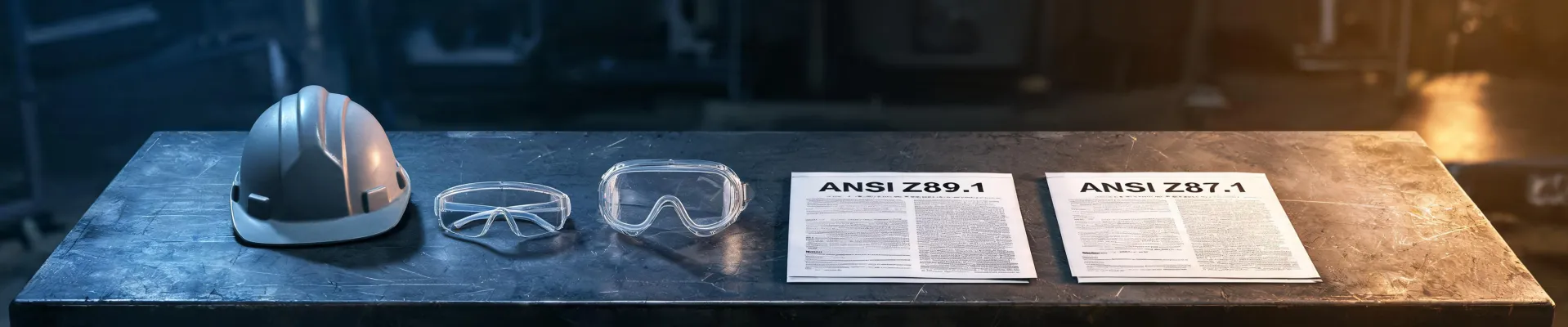
- Know the standard, not just the product category. For eye and face protection, that means ANSI/ISEA Z87.1 and OSHA 29 CFR 1910.133. For head protection, it's ANSI/ISEA Z89.1—and if someone offers you a vented helmet, check whether it's marked Type II for lateral impact, not just top impact. A product can look right and still not have the marking you need.
- Buy a system, not a single item. A full face shield protects your face. Properly rated safety glasses protect your eyes. You usually need both. The words 'full face shield' made me think the skin and eyes were covered, but that's not how the standard reads.
- Ask the supplier where their limits are. The vendor who says 'this is outside what we do best' is the one I'll call again. That honesty is hard to find. It's also the reason I still keep Pyramex at the top of our PPE list—they cover a wide range, but I make sure I need the range before I assume it.
The stockroom looks different now. The face shields are stored with the safety glasses, not as a replacement. The Heat Waves safety glasses live in the outdoor station. Bifocal safety glasses are on the standard issue list for the maintenance crew. The glove boxes are labeled, and the shipping worker's rash cleared up.
I still don't write safety regulations. I do know now that a purchase order is part of a safety program. The box might say 'safety glasses' or 'polycarbonate lens' or 'heavy duty,' but the real requirement is on the label. If you can't read it—or understand it—you're not done. I'm glad my wake-up call was a note in a boring checklist, not something worse.
And if you ever hear someone say 'it's just PPE, people can take it or leave it,' feel free to point them to the one time a missing pair of safety glasses under a face shield made an office administrator rethink everything.

Maeve Callahan
Maeve Callahan is a head-protection analyst covering Type I and Type II hard hats, climbing-style safety helmets, bump caps, chin straps, suspensions, liners, and face-shield carriers. She applies ANSI Z89.1, EN 397, and EN 12492 criteria while comparing impact attenuation, penetration resistance, lateral deformation, electrical class, retention strength, field of vision, mass, fit range, and temperature conditioning. Her guides help EHS teams, contractors, utilities, and buyers select helmet systems for overhead hazards, work at height, electrical exposure, accessory compatibility, and worker acceptance.