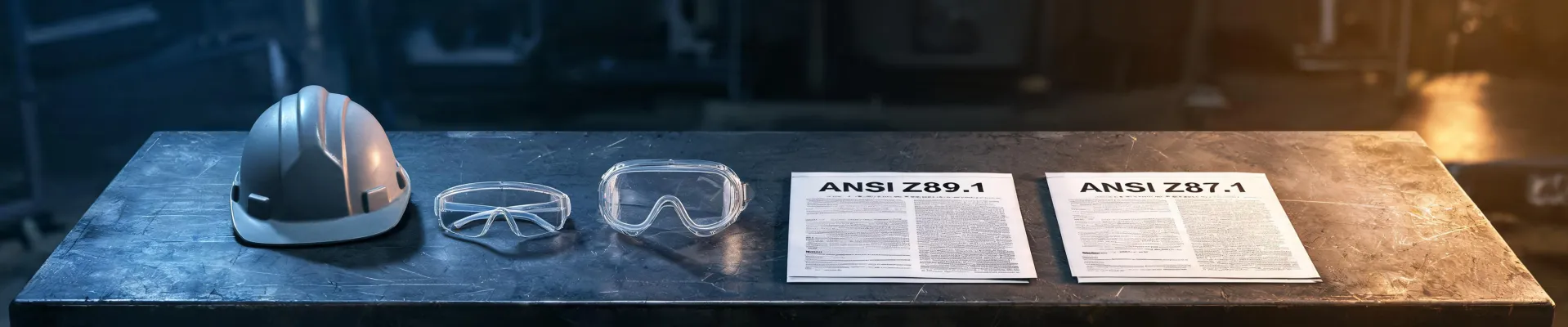
I review safety equipment for a living. Every week, I check shipments of hard hats, glasses, gloves, hi-vis apparel—roughly 200 items a month, against ANSI and ASTM specs. And here's my position, stated plainly: the idea that you need a corporate purchasing department to get serious PPE is wrong. Small buyers, individual workers, independent contractors—you are not second-class customers. The safety gear available at retail, in single-unit quantities, carries the same standards as anything shipped to a large company's safety manager.
I've been doing this for about four years. In that time I've rejected shipments with cracked hard hat shells, "hi-vis" vests whose reflective striping peeled after three washes, and safety glasses that failed impact testing. I've also approved thousands of items that passed every check. The pattern I've observed isn't about retail versus wholesale. It's about whether the buyer knew what to look for.
This article will use Pyramex as an example a few times, because it's a brand I see pass my checks regularly. But the point isn't the logo. It's that standard-compliant safety equipment is accessible—if you're buying to the standard, not just to a price.
The Standards Are the Same. Full Stop.
When I check a box of safety glasses pyramex ships out, I'm not grading "premiumness." I'm looking for one thing: the Z87 marking on the lens or frame. ANSI/ISEA Z87.1 is not a scale. It's a gate. Impact-rated eyewear either stops a quarter-inch steel ball traveling 190 feet per second, or it doesn't. That test doesn't care how many pairs you ordered.
Same story for hard hats. A Type 2 vented hard hat must pass the same vertical and lateral impact tests under ANSI/ISEA Z89.1 as any protective helmet in any industry. There's no "small customer clause." If the product carries the marking, it's been verified. If it doesn't, no purchase order can make it safe.
Hi-vis is the clearest example I deal with. A pyramex safety shirt with reflective striping has to meet ANSI/ISEA 107—that standard specifies how much reflective material is on the garment, where it's placed, and how it performs after repeated washing. The shirt sold to one worker online is held to the exact same specification as a shirt sold in bulk to a utility contractor. The standard doesn't know the difference. Neither should your willingness to pay for "premium."
According to ANSI/ISEA Z87.1, the marking "Z87+" specifically means impact-rated. It's pass/fail. What you're paying extra for in a higher-priced pair is frame design, lens tint, anti-fog coating, brand. Those are all legitimate features. But "protective level" is not one of the differences.
That's the part I push back on when I hear "you get what you pay for." It sounds wise. In safety, it's not true past a certain point—because certification is binary.
What "You Get What You Pay For" Gets Wrong
In 2022, I ran a blind test with my team. Same spec sheet, four different eyewear brands, prices from $8 to $26. The $8 pair passed every test. The $26 pair passed every test. The two in between passed too. At the compliance level, they were equal.
Did my team have preferences? Absolutely. Fit, weight, anti-fog performance—that's where the price difference shows. And honestly, those comfort factors matter. A worker who sets their glasses aside because they fog up is unprotected. That's a real safety issue. But the issue is comfort, not certification.
This matters for small businesses especially. You don't have a dedicated safety officer. You're buying pyramex gear and work boots the same way you buy everything else—on a consumer website, at the end of a long day, probably on your phone. That's fine. Here's what I recommend: check the labels. Look for the markings. That's the majority of the compliance work, and it costs you nothing.
Boots Are a Great Example. And a Warning.
Footwear is where I see quality thinking fall apart most often. People search for amazon safety shoes or work boots for men, compare toe caps, compare tread patterns, maybe check the ASTM F2413 rating. Good. Then the boots arrive—and the care stops.
I only believed in regular boot maintenance after ignoring it. They told me to clean and condition my boots; I didn't listen. Two wet seasons later, a $140 pair of work boots for men developed cracks right at the flex point. Not an old pair. Not worn-out soles. Just neglected leather. The waterproofing integrity is mostly irrelevant once the outer layer splits.
The upside of a nightly routine is obvious. The risk of skipping it, I can tell you directly: a wasted pair of boots and wet socks for a month. I kept telling myself the boots were "good enough" to handle some dirt. They weren't.
So here's the short version of how to clean work boots:
- Brush off loose dirt after every shift. Not deep cleaning—just two minutes of knocking the chunks off.
- Use warm water and saddle soap for the real wash. Skip detergent; it strips the natural oils.
- Air dry away from direct heat. Radiators and direct sun ruin the adhesives that hold the sole in place.
- Condition the leather every four to six weeks, or whenever it looks dry or dull.
- Check the tread periodically. Small rocks embed in the grooves, and on a ladder or wet deck, that costs traction.
Does this sound like fussing? Maybe. But I've seen identical boots fail in eight months when they should have lasted two years. Same brand, same model. The variable was maintenance.
To be clear, I'm not saying expensive boots are a waste. If I'm being honest, I buy quality leather boots and I care for them. But "I paid a lot" doesn't protect anything on its own. ASTM-rated safety toe caps, slip-resistant soles, electrical hazard ratings—those are the specs that matter at purchase. Cleaning and conditioning are the specs that matter afterward.
But Isn't Buying PPE Online Risky?
I can hear the objection: "Counterfeits. Amazon is full of fakes." It's a fair concern, so here's an honest answer: yes, counterfeit safety equipment exists, and it's dangerous. But the risk isn't the channel. It's the unknown manufacturer.
In 2023, I rejected a delivery of 1,200 work gloves bought through a traditional corporate supply contract. The markings looked wrong. We tested them. They didn't meet the cut-resistance spec we'd paid for. That wasn't a retail problem. That was a procurement failure from an established vendor.
Meanwhile, I've bought single pairs of Pyramex safety glasses through a standard online listing and tested them. Properly marked, traceable, compliant. The difference? I knew exactly who made them. The question isn't "Is Amazon safe for safety gear?" It's "Do you know who actually made it?" If the answer is a recognized brand and the product carries the correct markings, you've done the real due diligence. If there are no markings at all—walk away.
What I Actually Believe
I opened with a clear position, and I'll close with the same one: good safety equipment should be accessible. That's why I respect manufacturers who sell through retail channels, not only through corporate sales reps with minimum order quantities and net-30 terms. The worker buying one hard hat matters as much as the plant manager buying five thousand.
Do I believe every small purchase is perfect? No. Which is why I tell anyone who asks: inspect what arrives. Verify the markings. Test the fit. If you bought boots, maintain them. Safety isn't a single transaction. It's a system you run yourself, order by order, shift by shift.
Buy to the standard, not to the logo. And don't let anyone convince you that you need a corporate purchasing department to deserve PPE that actually protects.

Maeve Callahan
Maeve Callahan is a head-protection analyst covering Type I and Type II hard hats, climbing-style safety helmets, bump caps, chin straps, suspensions, liners, and face-shield carriers. She applies ANSI Z89.1, EN 397, and EN 12492 criteria while comparing impact attenuation, penetration resistance, lateral deformation, electrical class, retention strength, field of vision, mass, fit range, and temperature conditioning. Her guides help EHS teams, contractors, utilities, and buyers select helmet systems for overhead hazards, work at height, electrical exposure, accessory compatibility, and worker acceptance.