The Surface Problem: Choosing the Wrong Helmet by Accident
Honestly, when I first saw the phrase 'hard hat assembly' in a search spreadsheet, I almost scrolled past it. How much assembly can a hard hat need? I'm an office administrator, not a safety engineer. I manage purchasing for a 180-person facility, which means I'm the person who orders the Pyramex safety helmets, the gloves, the high-vis vests, and everything else that keeps people safe—or rather, everything except the stuff our part-time safety consultant handles. When I took over purchasing in 2021, my first PPE order was a mess. I compared prices by the unit, picked the cheapest hard hat that didn't look flimsy in the photo, and had no idea what I didn't know.
I process roughly 60 to 80 orders a year across eight vendors, so I'm not new to buying things. But PPE was a different animal. If you're searching for 'Pyramex hard hat assembly,' you're probably not wondering how to twist a ratchet. You're wondering why something so simple seems to cause so many problems. I get it. The question everyone starts with is which brand is better. The better question is what is the total cost of this helmet across its life? That's the part that isn't on the price tag.
The Real Problem: Assembly Is a Safety Feature, Not a Chore
Here's what I didn't understand for a long time: hard hat assembly isn't about putting pieces together. It's about whether the shell, the suspension, the headband, and the accessories work as one system. You can buy the best shell in the world and then assemble it wrong—or buy a helmet that is technically compliant but so uncomfortable that workers take it off.
From the outside, a $12 hard hat and a $25 Pyramex safety helmet look basically the same. The reality is different. The suspension is what actually keeps the shell off your head in an impact. If the suspension is too loose or set to the wrong height, the helmet can shift, wobble, or even come off. I saw this happen in 2023, when a worker told us his hard hat 'bounced' when he walked. He had replaced the sweatband and reassembled the suspension two notches too high. It seemed like a small mistake. But a helmet that moves isn't a helmet that protects.
I only believed this after ignoring it. A part-time safety consultant warned me to check the headband adjustment on every order. I didn't. Then we had a near-miss: a pallet fell from a rack, grazed a worker's helmet, and the whole shell twisted because the suspension wasn't seated correctly. No injury, but it scared me straight.
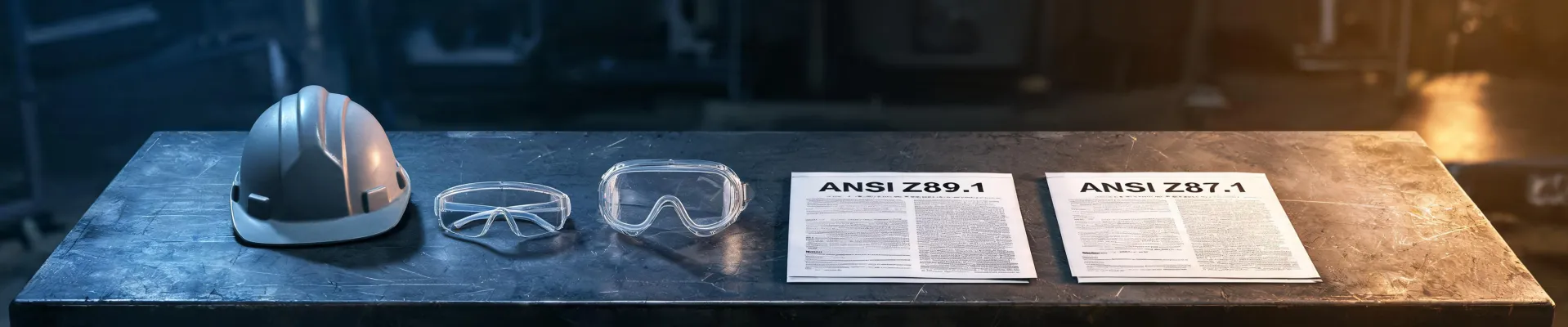
The standards part is not a suggestion. Under OSHA 29 CFR 1910.135, head protection must meet ANSI/ISEA Z89.1. But Z89.1 is not one style. A helmet can be Type 1, rated for vertical impact, or Type 2, rated for vertical and lateral impact. It can have different electrical classes and different accessory slots. I spent a lot of time trying to find one 'best' hard hat. There isn't one. There's only the right helmet for the hazard, the environment, and the person wearing it.
And the categories blur faster than you'd think. A Lincoln welding helmet is a great tool for welding—but it is not a hard hat. It's designed to protect against UV, sparks, and spatter, not falling objects. I get why people think a welding helmet should do double duty: it covers the head, right? But the design goals are different. That doesn't make the product bad. It makes it the wrong tool for overhead impact protection.
Then there are the accessories. A Milwaukee hard hat light is a perfect example. I ordered a batch of Milwaukee hard hat lights because the crew worked in a dim warehouse. Great idea, except I didn't check whether the mounting clip would fit our older helmets. It did not. Eleven out of thirty came back. The second time, I checked the spec sheets first and ordered a style that worked with the Pyramex helmets we use. That is a boring sentence. But it's exactly the kind of boring detail that stops small problems from becoming big ones.
What Ignoring This Actually Costs
Let's talk about money, because that's the part people use to justify buying cheap. My first cheap-hard-hat experiment looked like a win on paper. We paid $3.20 less per unit than the Pyramex safety helmet option. Forty helmets 'saved' us $128. Six months later, we had replaced 17 of them. Some had suspension clips that worked loose. One had a ratchet knob that sheared off in the back of a truck. And the bigger issue: no one wanted to wear them. They were stiff, sweaty, and hard to adjust. So they sat in a bin in the breakroom. The order cost us about $400 in replacements and a lot of my time answering complaints. That's not saving money. That's spending $128 to create a $400 problem.
When I compared the two options side by side, I finally understood what I was paying for. The cheap helmet had a basic pin-lock suspension and no real adjustment. The Pyramex safety helmet had a ratchet that clicked into place and a sweatband that felt like someone had thought about wearing it. Same job, completely different experience. The price difference was small. The willingness to wear it was not.
There's also the compliance side. OSHA can cite a company for a serious violation at over $16,000 as of 2024—the amounts are adjusted annually, so verify current numbers. But even if you never get cited, the cost of a workplace injury is enormous. A reportable incident eats hours of management time, raises insurance rates, and makes people trust you less. You can't see that on a purchase order.
The same thing applies to other PPE. Someone once asked me, 'Can I use nitrile gloves for food prep?' I had to look it up. The short answer is yes, if they're food-grade nitrile. But the cheap industrial nitrile gloves we ordered for the shop were not the right gloves for the breakroom. Food-contact gloves need to be labeled for food use and meet FDA 21 CFR 177.2600. The food-safe boxes cost a little more. That difference is compliance, not markup.
The Fix: Ask Two Questions Before You Order
So after all that, what do I actually do differently? Nothing dramatic. Before I order any PPE, I ask two questions: What is the standard? And what is the total cost to keep it working? If a product can't answer both, I don't buy it.
I'm not saying buy the most expensive thing. To be fair, I've seen premium PPE that wasn't any better than the mid-range option. But I've also seen a $10 difference turn into a $10,000 problem when workers stopped wearing the cheap stuff and one of them got hurt. Price is part of the equation. It's just not the whole equation.
For head protection, I keep coming back to the Pyramex hard hat assembly for a simple reason: it's predictable. The Pyramex safety helmet models I order are easy to assemble, have clear markings, and accept the accessories we need. I don't have to call anyone to figure out whether a Milwaukee hard hat light will fit. I check the spec sheet, check the lighting kit, and order once. (Should mention: I'm not a safety engineer. If you have an unusual hazard, ask someone who is, or use an independent safety consultant.) At least, that's been my experience with the models I've ordered.
If you already own a Lincoln welding helmet, keep it for welding. But also keep a hard hat in the same locker. And if you're responsible for gloves, don't assume all nitrile is food-safe. Ask for the certification. The label matters.
That's the lesson that took me five years and one bad order to learn: the goal isn't to pick the cheapest hard hat or the most popular brand. It's to pick the head protection that will actually be worn, assembled right, and rated for the hazard. Everything else is just a purchase order.

Maeve Callahan
Maeve Callahan is a head-protection analyst covering Type I and Type II hard hats, climbing-style safety helmets, bump caps, chin straps, suspensions, liners, and face-shield carriers. She applies ANSI Z89.1, EN 397, and EN 12492 criteria while comparing impact attenuation, penetration resistance, lateral deformation, electrical class, retention strength, field of vision, mass, fit range, and temperature conditioning. Her guides help EHS teams, contractors, utilities, and buyers select helmet systems for overhead hazards, work at height, electrical exposure, accessory compatibility, and worker acceptance.