-
What should I know about Pyramex as a safety brand?
-
How do I choose the right Pyramex hard hat?
-
Are Pyramex Goliath safety glasses worth it?
-
What's the Loop earplugs controversy, and do I need them for work?
-
Are transition safety glasses actually useful on the job?
-
Can I use nitrile gloves for cooking?
-
How do I evaluate total cost of ownership for PPE?
I'm a quality and brand compliance manager for a safety equipment supplier. I review PPE samples and spec sheets before they go to customers—roughly 300 SKUs a year. In 2024, I rejected about 12% of first deliveries for spec, labeling, or packaging issues. It took me about three years and 150-plus sample reviews to understand that a compliance certificate is only the starting line. Fit, worker acceptance, and total cost matter just as much.
Below are the questions I get most often about Pyramex hard hats, Pyramex Goliath safety glasses, transition safety glasses, Loop earplugs, and nitrile gloves in cooking. I'll answer them directly.
What should I know about Pyramex as a safety brand?
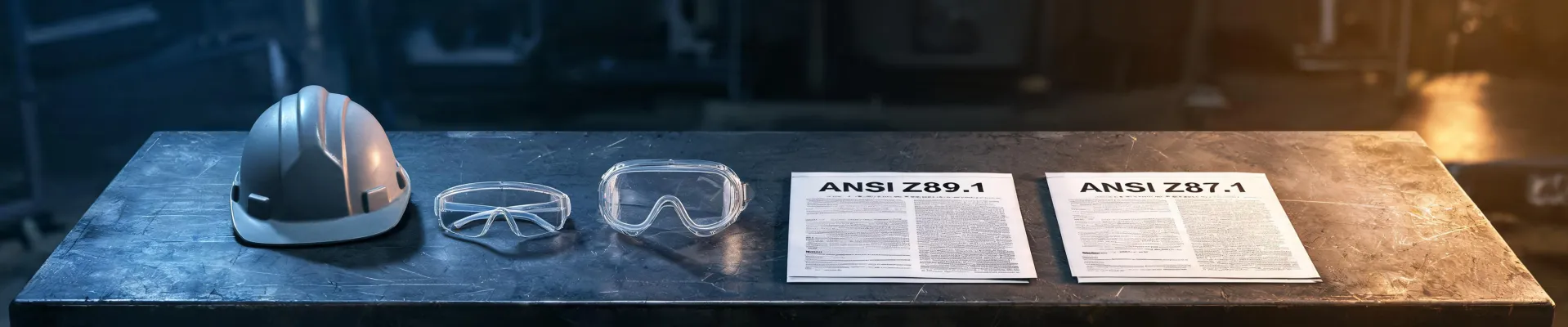
Pyramex is a broad PPE brand. The range covers head-to-toe: hard hats, safety glasses, goggles, gloves, hi-vis apparel, and accessories. That range is the appeal. You can often standardize multiple items from one source, which simplifies purchasing and training. But range doesn't replace model-level verification. 'Pyramex hard hat' isn't a single product. Pyramex makes cap style, full brim, vented, non-vented, and different suspension systems. For eye protection, check the ANSI/ISEA Z87.1-2020 mark. For head protection, check the hard hat's ANSI/ISEA Z89.1 type and class. As of January 2025, those are the marks I look for first. Spec sheets don't tell you if workers will actually wear the product. In 2023, we received a hard hat batch where the suspension webbing didn't match the approved spec. We rejected it. Now every contract includes a sample-approval step.
How do I choose the right Pyramex hard hat?
Start with the hazard, not the color. Type I protects against top impact. Type II protects against top and lateral impact. Class G, E, or C tells you the electrical rating; vented hard hats are often Class C, so they aren't for electrical work. Full brim sheds rain and sun. Cap style fits tighter spaces. Suspension matters too: ratchet vs pinlock, 4-point vs 6-point. Accessories like cooling liners, chin straps, and sweatbands can make or break summer compliance. Fit is personal. The shell should sit level, and the suspension should be adjusted so the hat doesn't move when you look down. OSHA 29 CFR 1910.135 covers head protection requirements. I went back and forth between vented and non-vented for a summer crew. Vented won on comfort, but we kept non-vented for electrical tasks. The upside was comfort. The risk was using the wrong class near live electrical work. That's total cost thinking: the best hard hat is the one that gets worn correctly.
Are Pyramex Goliath safety glasses worth it?
Pyramex Goliath safety glasses are one of the larger-lens options in the Pyramex line. They're worth a look if you want more coverage and a wraparound feel. Many versions offer anti-fog and scratch-resistant coatings plus UV protection. Look for the ANSI/ISEA Z87.1-2020 mark on the lens or frame. Does that make Goliath the best for everyone? No. Fit is personal. If you have a narrow face, the large lens may feel loose or slide. If you wear prescription glasses, check whether the Goliath fits over or under them—don't assume. I've run blind fit tests with crews: same lens, different nose pieces, and approval changes fast. Anti-fog coatings help, but they're not magic. Clean them with the right cloth, not your shirt. A cheaper pair that fogs and gets left in the truck costs more over a season.
What's the Loop earplugs controversy, and do I need them for work?
Loop earplugs are consumer hearing protection. The controversy isn't really 'do they work?' It's 'are they the right tool for every noise problem?' Some users love them for concerts, travel, and noisy offices. Some industrial users say they don't attenuate enough for high-noise workplaces. The key is the published NRR or SNR. OSHA 29 CFR 1910.95 requires hearing protection when exposure exceeds 85 dBA as an 8-hour time-weighted average, and the protection must match the noise level. If your workplace requires a specific NRR, use earplugs that meet it—or combine earplugs with muffs. Loop's design is comfortable for some people, but comfort isn't a rating. I've seen workers buy stylish earplugs and then double up with muffs anyway. That's fine. Just don't skip the noise survey or the fit check.
Are transition safety glasses actually useful on the job?
Transition safety glasses usually means photochromic lenses that darken in UV and lighten indoors. They're useful for outdoor-to-indoor work, as long as they carry the ANSI/ISEA Z87.1-2020 mark. But there are tradeoffs. In a car or truck, the windshield blocks most UV, so they may not darken while driving. They also may not lighten fast enough when you step into a dark warehouse. And 'Transition' with a capital T is a brand name; not every photochromic lens uses that technology. For constant indoor work, clear lenses are usually better. For constant bright sun, a fixed tint may be better. Photochromic is a compromise. It's a good compromise for some jobs, not all. Check the lens marking and the manufacturer's UV claims before you buy a crew a full set.
Can I use nitrile gloves for cooking?
Yes—if they're labeled food-safe. Food-grade nitrile gloves are common for food prep, handling raw meat, and avoiding cross-contamination. They're not heat-resistant. Don't use them to grab hot pans, oven racks, or fryer baskets. They won't protect you from cuts, either. For knife work, use cut-resistant gloves. Check the packaging for FDA food-contact compliance. For example, FDA 21 CFR 177.2600 covers certain rubber articles intended for repeated use—verify the specific glove's statement. Nitrile is a good option for latex allergies, but some people still react to accelerators. I went back and forth between cheap disposables and reusable nitrile for a catering client. The upside was lower unit cost. The risk was tears and contamination. The cheap ones tore constantly. The total cost was higher because of waste and contamination risk. Buy the right glove for the task, not just the lowest price per box.
How do I evaluate total cost of ownership for PPE?
TCO for PPE is more than unit price. Add fit-test time, replacement rate, comfort complaints, training, storage, and compliance risk. A cheaper hard hat that workers leave in the truck isn't cheap. A safety glass that fogs and gets wiped with a dirty rag isn't cheap. A glove that tears during food prep isn't cheap. I calculate TCO before comparing quotes: base price, minimum order, shipping, accessories, replacement frequency, and downtime if a product fails inspection. The lowest quote often isn't the lowest total cost. The goal isn't to buy the most expensive option. It's to buy the option that gets used correctly, every shift, without creating a new problem. That's the real spec.

Maeve Callahan
Maeve Callahan is a head-protection analyst covering Type I and Type II hard hats, climbing-style safety helmets, bump caps, chin straps, suspensions, liners, and face-shield carriers. She applies ANSI Z89.1, EN 397, and EN 12492 criteria while comparing impact attenuation, penetration resistance, lateral deformation, electrical class, retention strength, field of vision, mass, fit range, and temperature conditioning. Her guides help EHS teams, contractors, utilities, and buyers select helmet systems for overhead hazards, work at height, electrical exposure, accessory compatibility, and worker acceptance.