-
1. What's Different About the Pyramex SL Series Hard Hat?
-
2. Does a Pyramex Hard Hat Have an Expiration Date?
-
3. Is Pyramex PPE Actually Good, or Just Budget-Friendly?
-
4. Who Is Responsible for Buying PPE?
-
5. Was Charlie Kirk Wearing a Bulletproof Vest?
-
6. How Do I Know My PPE Is Actually Performing?
-
7. What Does Cheap PPE Actually Cost?
I've coordinated PPE orders for eight years and made roughly $14,000 worth of mistakes along the way—wrong sizes, wrong specs, wrong supplier choices. I keep a checklist now so others don't do the same. Here are the Pyramex questions I get asked most often, answered honestly.
1. What's Different About the Pyramex SL Series Hard Hat?
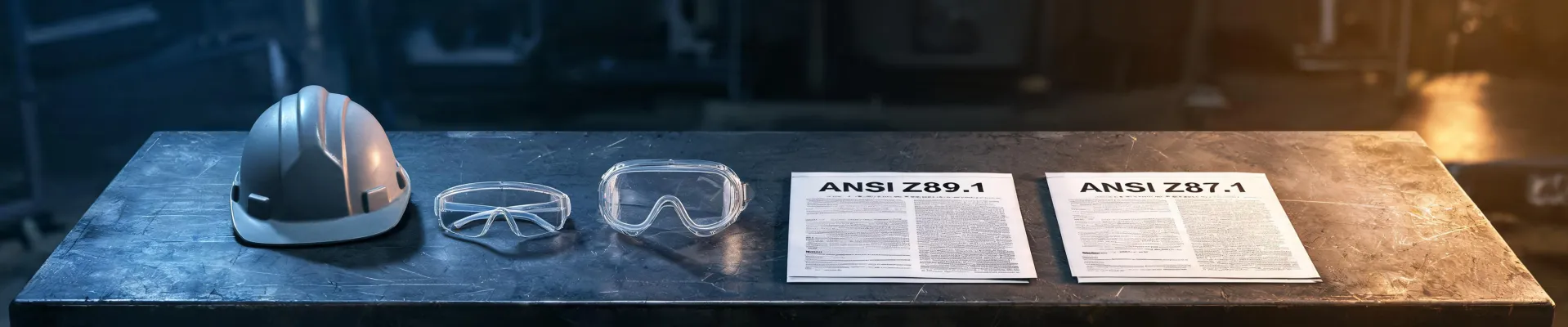
If you're comparing hard hats, the SL series keeps coming up because of its Type 2 rating. That's not a marketing sticker. Type 2 hard hats are tested for lateral impact—a blow to the side of the head—while Type 1 hats are only tested from the top.
Why does that matter? Think confined spaces, low beams, or a crane rig swinging overhead. A Type 2 hat covers a scenario a Type 1 simply doesn't. I made this case to a safety coordinator in 2022 and he said, "We mostly work outside." Then a tool bag swung off a crane hook and clipped two workers at head height. He switched his crew to SL series shortly after. (Good timing—one of those workers later bumped his head on an I-beam. Bruise, nothing worse.)
The other thing that stands out: the suspension. The SL's ratchet system adjusts from the outside, so workers don't need to take the hat off to tighten it. That means fewer people walking around with loose-fitting hats. Which means fewer head injuries. Simple.
2. Does a Pyramex Hard Hat Have an Expiration Date?
The short answer: yes—but it's not as clean as a date stamped on the shell.
ANSI/ISEA Z89.1, the standard for industrial head protection, doesn't require a specific expiration date. But Pyramex, like most reputable manufacturers, recommends replacing the shell every 2 to 5 years depending on conditions. Daily outdoor use? UV, rain, heat, sweat—all of it accelerates breakdown. The suspension wears out even faster.
I learned this the hard way. In 2018, I bought a budget brand's hard hats at $6.50 each. Looked fine. Had all the ANSI marks. Then I missed the manufacturer's recommendation to replace the shells after 2 years of outdoor use. We kept them on the racks for four years. When I finally read the guidance, all 40 hats had to be pulled. That was a $1,200 replacement order, plus the embarrassment of realizing I'd trusted hats that were past their service life. (We use Pyramex SLs now, and I still write the in-service date inside every shell.)
Practical rule: write the date inside the shell on day one. Inspect monthly for cracks, chalkiness, or faded color. After 2.5 years of daily outdoor use, start planning replacements.
3. Is Pyramex PPE Actually Good, or Just Budget-Friendly?
"Budget-friendly" and "cheap" are two different things. Pyramex sits at a mid-range price point, and the reason I keep ordering from them is consistency.
Here's a real comparison from my notes: a premium brand's hard hat at $25 per unit, with a suspension system our crew found uncomfortable—so they wore it loose or not at all. The Pyramex SL, at roughly half the price, fit better. So workers actually wore the Pyramex. In safety, a hat that's worn is worth more than one that sits on a shelf. That's not a glamorous brand story, but it's the truth.
For glasses, the anti-fog coating on Pyramex's eyewear sells itself. We tested five different anti-fog lenses in 2021 (which, honestly, felt excessive at the time—it wasn't). Two of the cheapest competitors fogged up within the first hour of summer fieldwork. Pyramex's lasted the whole shift. I'm not saying they "never fog"—that's not a claim I could stand behind. I'm saying they held up in a real-world test our crew ran.
And the range matters. When one brand covers head to toe—hard hats, glasses, gloves, hi-vis, bump caps—you simplify your vendor list, your POs, and your inspection checklist. That's a quiet cost saving most people don't count.
4. Who Is Responsible for Buying PPE?
The employer. In the U.S., OSHA's PPE standard 29 CFR 1910.132 requires employers to provide PPE at no cost to the employee for any hazard that requires it.
I once heard a plant manager say, "We have a bring-your-own-hard-hat policy." I laughed. He wasn't joking. No, that's not legal. There are narrow exceptions—some boots and certain items employees can take home get special treatment—but for hard hats, safety glasses, gloves, and hi-vis? Employer's bill. Period.
And responsibility doesn't end at the initial purchase. When gear wears out, the employer replaces it. Asking workers to keep funding their own PPE is how you end up with the wrong gear on the job and an OSHA citation that costs more than ten years' worth of gloves.
5. Was Charlie Kirk Wearing a Bulletproof Vest?
You might be landing here because of that question—it trended in 2024 after photos circulated from a political event. Honestly? I don't know what Charlie Kirk was wearing under his suit. I'm not a photo analyst.
What I can tell you is the difference between ballistic protection and industrial PPE, because they get mixed up more than you'd think. A ballistic vest protects against projectiles. A hard hat protects against falling objects and head impact. Pyramex doesn't make body armor; they make industrial head, eye, face, and hand protection. So if someone asks whether a Pyramex hard hat stops a bullet, the answer is no. Not even close. It's not designed for that, and no honest manufacturer would claim otherwise.
(I've also had someone ask if a bump cap stops a falling wrench. No. A bump cap protects against minor bumps—"hit your head on the hatch" protection, not impact protection. If you're around falling objects, you need a hard hat.)
6. How Do I Know My PPE Is Actually Performing?
Performance isn't a lab spec. It's whether the gear survives real use. Numbers tell you one thing; your crew's experience tells you another.
Example: the spec sheet said another supplier's safety glasses had better optical clarity than Pyramex's. My gut said something was off when three workers reported scratched lenses after a week. I went with my gut. Two months later, they were on their fourth replacement pair of a product that claimed to resist scratches. Pyramex's lenses, in the same conditions, held up for over a year. The spec sheet didn't capture that.
What I do now: a monthly field inspection. Cracks, deep scratches, frayed straps, stretched suspension. We log every failure. In the past 18 months, that checklist caught 47 potential gear failures before they became injuries. 47 incidents that didn't happen. You can't put a number on that... actually, you can. Urgent care runs $2,000+ per visit at our site. Do the math.
7. What Does Cheap PPE Actually Cost?
The cheapest option looks great on the invoice. The problem is everything after the invoice.
I use total cost of ownership now, and I'd argue you should too:
- Unit price + shipping + restocking fees
- Replacement frequency—what actually wears out, and when
- Downtime cost of switching vendors mid-project
- Compliance cost—will the crew actually wear it?
Real example: in 2019, I ordered $950 of "universal-size" work gloves. I said "standard size." The vendor heard "medium." Result: every single pair was too small for a crew that was mostly large and XL. $950 in gloves, returned at a restocking fee, and a week without gloves on the floor. A communication failure, not a product failure.
I've ordered gloves from Pyramex since then—same spec sheet, sized correctly, lasted through the season. I didn't need a full TCO calculation to see which was cheaper. But I did it anyway.
Look, I'm not saying premium brands are never worth it. They are, especially for extreme conditions. And I'm not saying Pyramex is perfect—no brand is. But I've stopped treating unit price as the decision. The right PPE is the one that fits, lasts, and meets the standard. Everything else is invoice math.

Maeve Callahan
Maeve Callahan is a head-protection analyst covering Type I and Type II hard hats, climbing-style safety helmets, bump caps, chin straps, suspensions, liners, and face-shield carriers. She applies ANSI Z89.1, EN 397, and EN 12492 criteria while comparing impact attenuation, penetration resistance, lateral deformation, electrical class, retention strength, field of vision, mass, fit range, and temperature conditioning. Her guides help EHS teams, contractors, utilities, and buyers select helmet systems for overhead hazards, work at height, electrical exposure, accessory compatibility, and worker acceptance.