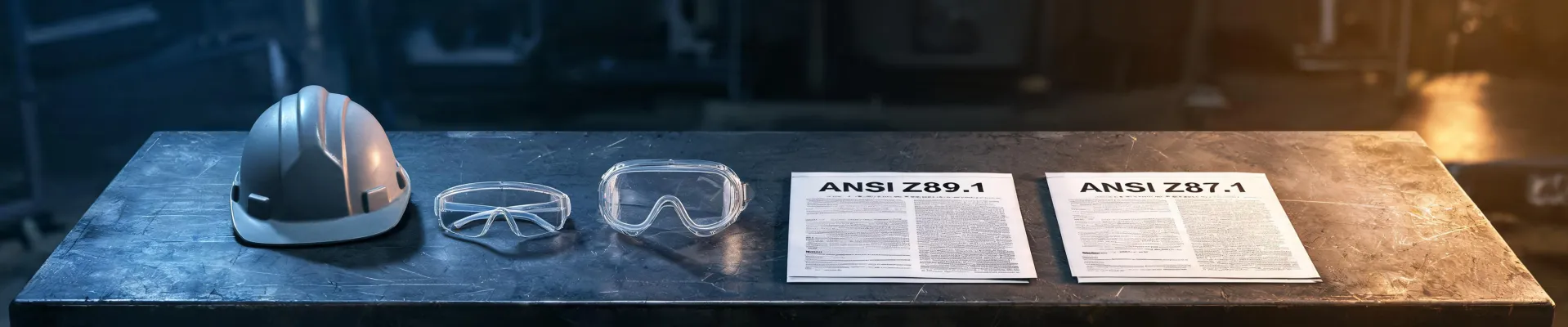
“Certified” and “right for the work” are two different things. Certification matters—you can’t skip the label and hope for the best. But I’ve also seen crews store a fully compliant face shield away because it fogged, or leave a hard hat in the truck because the ratchet dug in. The real selection question isn’t “Is this brand good?” It’s “What is the task asking for?”
I coordinate PPE orders for crews that often find out about a project on Friday and start on Monday. In that world, the expensive mistake isn’t usually a visual mismatch. It’s picking a product that checks a box but doesn’t match the hour-to-hour job. So here’s the way I sort it out, scenario by scenario.
Falling objects, dust, and packed schedules
Start with head protection if the site has overhead work, beams, scaffolds, or anything that could fall or be struck. A hard hat needs an ANSI Z89.1 label, but the label alone doesn’t tell you whether it fits for 10 hours. The Pyramex Ridgeline hard hat is one example of a style that people tend to forget they’re wearing; many Ridgeline models include ratchet suspensions and cooling vents. That sounds like comfort fluff until you see workers loosen a rigid suspension to the point where the helmet is useless. Adjusted suspension plus a chin strap matters more than the color.
For the eye side of that same workday, keep the default at Z87+ impact-rated safety glasses. Pyramex’s PZ87 safety glasses are a common choice for a reason—polycarbonate lenses, minimal cost, easy to replace. The detail I’d pay extra for is anti-fog coating if your site moves between warm and cold areas. Fog is a safety problem in disguise.
Here’s the counterintuitive part: in light-dust work, a sealed goggle is not always the safest option. If it fogs every few minutes, people take it off. A Z87+ anti-fog pair may not look as serious as a goggle, but its survival advantage is that it stays on the face. Save the fully closed goggles for splash or heavy particle tasks where nothing else makes sense.
Sparks, arcs, and “are my safety glasses enough?”
No. Ordinary Z87 glasses provide impact protection; they don’t necessarily filter welding light. If the work involves cutting, brazing, or staying near an arc, you need welding-specific eyewear with a marked shade plus impact protection. That’s what the phrase “welding safety glasses” means in practice. Don’t reach for tinted sunglasses from the gas station.
If you’re the one doing the main weld, you should be in an approved welding helmet with the proper filter shade for the process, not just a pair of tinted glasses. Welding safety glasses are useful for people working close to sparks or doing grinding and light cutting where a full helmet is too heavy. Look for a lens marked with a shade number—Shade 5.0 is common on welding glasses, but verify the recommendation on the ANSI Z87.1 or AWS chart that came with your product. Unmarked tinted lenses are a gamble, and hot work is not the place to gamble.
Can nitrile gloves be used for food? Yes—with an asterisk
The short answer is yes, if the gloves are actually food-grade nitrile. Nitrile gloves are popular in food work because they don’t trigger latex allergies and they hold up better than vinyl in many greasy or wet tasks. But the keyword is food-grade. Every industrial nitrile glove is not automatically safe for contact with food.
Check the box for a food-contact statement or FDA 21 CFR 177.2600 language. That citation covers rubber articles intended for repeated food-contact use, and it’s the kind of marking I look for before ordering a case for a kitchen or food plant. Powder-free is also the safer choice because powder can carry residue and contaminate ready-to-eat items. And even with food-grade gloves, crews should change them when moving from raw meat or poultry to produce, bread, or cooked food. The glove is a barrier, not a substitute for hand-washing.
One more thing: don’t use chemical-resistant industrial gloves on one task and then touch food in the same pair. If a glove has touched solvents, degreasers, or metal shavings, it belongs in the work area, not the break room.
Why lace-up work boots are still the workhorse
People often think of boots as last on the list because they’re not as exciting as a high-tech hard hat or a new lens tint. But foot protection can shut down a crew faster than almost any other equipment failure. Lace-up work boots earn their place on long shifts because they can be snugged around the heel and ankle, which keeps the foot from sliding inside the boot on stairs, slopes, or wet surfaces.
If the site calls for toe protection, look for footwear marked under ASTM F2413. For many warehouse and construction workers, a lace-up boot with a composite toe is a practical balance: the composite toe is lighter than steel in cold weather, though steel is still fine when weight isn’t a concern. The boot doesn’t make you safer just because it looks industrial. The label does.
And a quick correction to the “lace-up boots take too long in an emergency” argument. If boots are untied or loose, you lose traction when you need to move fast. Laced boots stay connected. The real problem is trailing laces, so train people to tuck them in. Around rotating shafts or machinery that can grab a loose lace, a slip-on or zip-side style may be the better engineering choice, but on an ordinary work site, properly laced boots are hard to beat.
The “I do a bit of everything” decision
Most real jobs don’t fit one neat category. The way I handle that is to set the hierarchy early:
- Find the task with the worst possible consequence first—arc flash, falling load, chemical splash, food contamination—and buy for that hazard.
- Then make sure the chosen product still works for the less severe tasks. If you need both welding float and grinding sparks, get a face shield or helmet system that can switch shades instead of carrying two incompatible setups.
- If two hazards point to different gloves or boots, don’t compromise on the one that protects against the severe risk. Change gloves between tasks or choose the higher-rated boot.
- Finally, treat comfort as part of compliance. Gear that hurts, fogs, or pinches will find its way onto a truck dashboard.
Rush orders: the cost of “probably”
In March 2024, I had a client call on a Thursday afternoon with fourteen workers scheduled to start Monday morning. Normal supplier lead time was eleven business days. Standing up that crew would have cost the client roughly $18,000 per day, and nobody could point to a reliable delivery date on the standard shipping option.
We paid a freight premium. I want to say it was around 35% over ground shipping, though I don’t remember the exact number. What I remember is that I didn’t compare that premium to the discounted shipping rate. I compared it to the cost of “probably sometime next week.” We also stocked spare lenses and an extra pair of gloves so the small stuff didn’t cause a second emergency.
That’s the part people miss about urgency. The point of a rush order isn’t the speed. It’s the certainty. When your deadline is fixed, paying extra for a product that is in stock, conforms to the standard, and arrives on time is not an unnecessary fee—it’s coverage against a much larger loss. So in emergency PPE buying, stick with known, certified models that you can verify quickly. Pyramex is one of the brands I keep on the short list because the Ridgeline hard hat and PZ87 safety glasses line up with common scenarios without requiring a custom spec. But no brand should be trusted just for the name. Check the marking, confirm the model, and order with enough buffer for the unexpected. That’s how you turn a scramble into a normal workday.

Maeve Callahan
Maeve Callahan is a head-protection analyst covering Type I and Type II hard hats, climbing-style safety helmets, bump caps, chin straps, suspensions, liners, and face-shield carriers. She applies ANSI Z89.1, EN 397, and EN 12492 criteria while comparing impact attenuation, penetration resistance, lateral deformation, electrical class, retention strength, field of vision, mass, fit range, and temperature conditioning. Her guides help EHS teams, contractors, utilities, and buyers select helmet systems for overhead hazards, work at height, electrical exposure, accessory compatibility, and worker acceptance.