-
Why I Started Questioning the 'Big Brand Only' Approach
-
Round 1: Price — But Not the Way You'd Expect
-
Round 2: Compliance & Certifications — Closer Than I Expected
-
Round 3: User Experience — Where Pyramex Won Over the Crew
-
Round 4: Supply Reliability & Vendor Experience
-
When to Choose Pyramex — and When to Stick with Big Brands
Why I Started Questioning the 'Big Brand Only' Approach
I've been managing PPE procurement for a mid-sized construction services company since 2020. Roughly $45,000 annually, spread across 8 vendors. When I took over, the default was simple: 3M for hard hats and respirators, MSA for head protection, and a few others for specialty items. Pyramex wasn't even on the list.
Then in early 2023, our operations director asked me to cut PPE spending by 15% without sacrificing compliance. That's when I started looking beyond the big names. Everything I'd read said premium brands always outperform budget alternatives. In practice, for our specific mix of trades, I found something different.
This isn't a review that declares one winner. It's a comparison across four dimensions that matter to someone like me—price, compliance, user feedback, and supply reliability. If you're managing PPE orders for a team, here's what I've learned ordering both sides.
Round 1: Price — But Not the Way You'd Expect
The obvious starting point: Pyramex is cheaper. A Pyramex hard hat typically runs $8–12, compared to $18–28 for comparable 3M or MSA models. Pyramex Highlander safety goggles? Around $6–9 per unit versus $12–18 for equivalent big-brand models. Based on pricing I've accessed through major distributors as of January 2025, the gap is consistent across most product lines.
But here's what surprised me: the savings weren't always worth it. On some items, the price difference was small enough that brand familiarity mattered more. On others—particularly safety shoes—the gap narrowed to within 10–15%, and worker complaints about fit and durability made the switch less appealing.
The surprise wasn't the price difference itself. It was how much hidden value came with the 'expensive' option on certain categories—better sizing ranges, faster replacement parts, and more consistent quality across batches. I only realized this after pushing too hard on cost reduction and getting pushback from the field.
Round 2: Compliance & Certifications — Closer Than I Expected
This was the dimension where I expected Pyramex to fall short. It didn't—at least not in ways that mattered for our use cases.
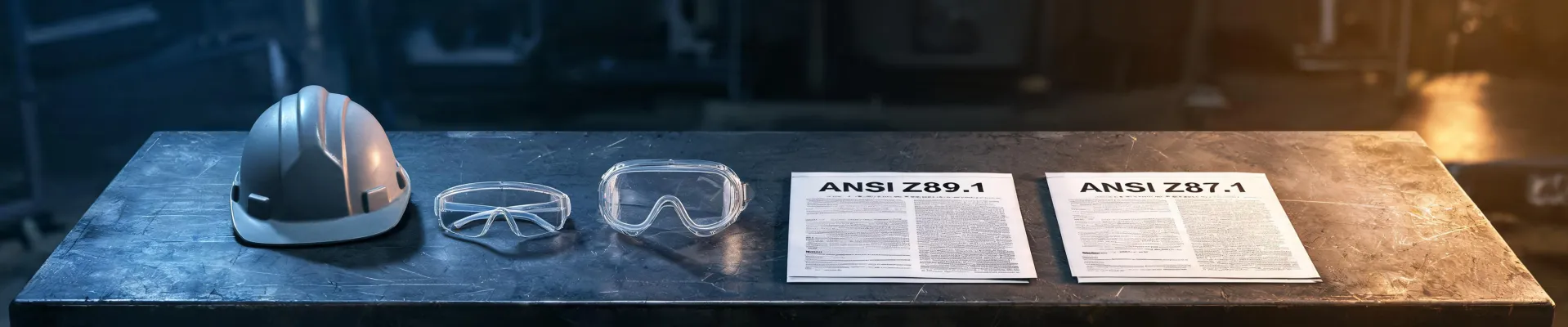
Pyramex hard hats meet ANSI Type 1 and Type 2 standards, depending on the model. Their safety eyewear carries ANSI Z87.1 certification. I've spot-checked certificates and verified with our safety officer. The documentation is there.
That said, there's a nuance. Big brands like 3M and MSA often have broader third-party testing history—meaning if a regulator asks questions, there's a longer paper trail. In practice, for our OSHA audits over the past 3 years, we've never had an issue with Pyramex products being questioned. But if you work in an environment with extremely rigorous compliance requirements, that testing history might matter.
Per OSHA 29 CFR 1910.135 (effective March 2024 revision), hard hats must comply with ANSI Z89.1. Both Pyramex and 3M models we've ordered meet this. I verify this by checking the certification label inside each unit before approving invoices.
Round 3: User Experience — Where Pyramex Won Over the Crew
I was most skeptical about this one. Our workers are used to certain brands. They have preferences. I figured the cheaper option would get complaints.
Turns out, I was wrong—at least partially.
The Pyramex Highlander safety goggles got positive feedback from our welding and grinding crews. The anti-fog coating performed better than the 3M model we'd been using. Workers reported less lens fogging during temperature shifts, which meant fewer interruptions to clean them. I've had guys specifically request the Highlander by name—that never happened with the previous brand.
On the hard hat side, the Pyramex hard hat with the cooling liner insert was actually preferred by our outdoor crews during summer months. They said it breathed better than the MSA V-Gard models. I wasn't expecting that.
But it wasn't all positive. On safety shoes, Pyramex didn't stack up. Workers reported faster sole wear and less consistent sizing. We switched back to a mid-range brand after a 4-month trial. And on high-vis apparel, the big brands offered better breathability for hot-weather work—Pyramex's hi-vis jackets were durable but ran warm.
The most frustrating part: inconsistent feedback. Some crews loved the Pyramex products. Others rejected them outright. You'd think a standard specification would produce consistent reactions, but real-world preferences vary wildly.
Round 4: Supply Reliability & Vendor Experience
This is the dimension that matters most to me as a buyer, and it's where Pyramex surprised me again—both positively and negatively.
On the positive side: Pyramex stock availability through major distributors like Grainger and McMaster-Carr has been solid. We've had maybe 3 stockouts in 2 years, and those were resolved within a week. For contrast, we experienced more frequent delays on certain 3M respirator cartridge models during the same period.
On the negative side: Pyramex's direct customer service for order inquiries was slower. I had a question about is nitrile gloves food safe for a client's kitchen refurb project—their response took 4 business days. The info was correct (yes, their nitrile gloves are FDA-compliant for food contact), but the delay was frustrating. With 3M, I'd typically get an answer within 24 hours.
Overall, I'd say Pyramex's supply chain is reliable enough for standard orders, but if you need rapid technical support or custom specifications, the big brands still have an edge.
When to Choose Pyramex — and When to Stick with Big Brands
After 200+ orders and feedback from hundreds of workers, here's how I've split our purchasing:
- Standard hard hats for general construction — Pyramex. The cost savings are real, compliance is solid, and the cooling liner is genuinely popular with crews.
- Highlander safety goggles for grinding/welding — Pyramex. Better anti-fog performance than comparably priced competitors, and workers actually request them.
- Safety shoes for heavy-use roles — Not Pyramex. The durability gap was noticeable in our trial.
- Hi-vis apparel for hot outdoor work — Mixed. Pyramex jackets for cooler months, big-brand breathable vests for summer.
- Nitrile gloves for food-adjacent work — Pyramex works fine. Just verify the FDA compliance documentation if your auditor asks.
- Respiratory protection — Still using 3M. The certification history and fit-testing support matter more here.
The way I see it, Pyramex is a strong option for standard PPE where compliance is straightforward and user preference isn't highly variable. For specialized applications—especially where regulatory scrutiny is intense or worker comfort is critical—the big brands still earn their premium.
If you're managing procurement, my advice: don't default to either extreme. Test Pyramex on a subset of your orders, get real feedback from the people wearing the gear, and build a split strategy. That approach cut our PPE costs by about 12% overall without sacrificing compliance or satisfaction.
And if your finance team asks for the numbers—I've got the spreadsheets to back it up.

Maeve Callahan
Maeve Callahan is a head-protection analyst covering Type I and Type II hard hats, climbing-style safety helmets, bump caps, chin straps, suspensions, liners, and face-shield carriers. She applies ANSI Z89.1, EN 397, and EN 12492 criteria while comparing impact attenuation, penetration resistance, lateral deformation, electrical class, retention strength, field of vision, mass, fit range, and temperature conditioning. Her guides help EHS teams, contractors, utilities, and buyers select helmet systems for overhead hazards, work at height, electrical exposure, accessory compatibility, and worker acceptance.