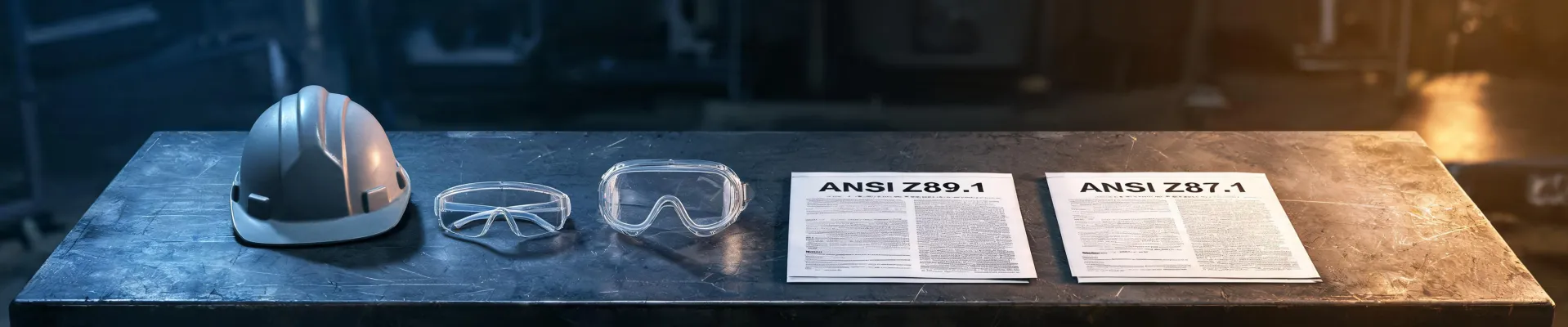
Last July, Don from maintenance stood at my desk and typed “how to change water filter cartridge” into his phone. I thought it was an interruption. We were in the middle of a rollout of new safety gear for the warehouse, and the last thing I had time for was the office cooler. It turned out to be the same problem I was trying to solve with a 400-pair safety glasses order.
I’ve been the office administrator for a distribution company since 2020. Most of my job can be summed up in the “everything else” category: office supplies, restroom fixtures, safety gear, and occasional maintenance manuals. It’s roughly 60 to 80 orders a year across eight vendors, and I report to both operations and finance. When I order safety glasses, I’m not buying for my own face. I’m buying for people who stand on concrete floors for ten hours.
The $1.89 Sample
Earlier that month, finance sent me a quote from a new supplier. They could sell us safety glasses for $1.89 per pair. We were paying about $8 per pair for what our regular PPE vendor had in stock: the Pyramex Endeavor Plus foam padded safety glasses.
The finance manager made a fair point: both products said Z87. Both said polycarbonate. Both were safety glasses. Why spend four times as much?
My answer was, “Let’s see the samples.”
The cheap sample arrived in 48 hours. I put a pair on for about ten seconds. Right away, something pressed against the top of my ear. I have a large head, though, so I didn’t want to trust my own reaction. I gave ten pairs to people in the warehouse and asked them to wear them through a normal shift. The instruction was simple: tell me if this is something you’d keep wearing at the end of the day.
Half of the testers didn’t make it to lunch.
That should have ended the conversation. But the problem got clearer when I asked for paperwork. The supplier’s rep sent a screenshot of a spec sheet that said “ANSI Z87” at the top. The product itself had no model number, no manufacturer code, and no batch number. When I asked for the test report, they sent a generic PDF from 2016 that didn’t match the product. Per FTC advertising guidance, a performance claim should be substantiated. The phrase “Z87 compliant” is not flavor text. It is a claim.
“You can’t identify this product in the field,” I told the rep. “If something goes wrong, there’s no way to trace what it was or who made it.”
That call didn’t go well.
Testing for Real Tasks
The Pyramex samples came in the same week. We looked at two versions. For general warehouse use, we tried the Pyramex safety glasses PZ87 first. They were lightweight, easy to store, and fit most of our crew well. The lens markings were legible from the moment we opened the box. That matters when you need to confirm a product actually meets the standard you paid for.
For the people who spent more time on a forklift, in dusty trailers, or moving between the warm dock and cold storage, we compared those with the Pyramex Endeavor Plus foam padded safety glasses. The foam layer cushions the brow and closes the gap where dust and cold air sneak in. It also made a real difference in comfort. When you wear a pair from 6 a.m. to 2 p.m., padding matters.
Before that test, I assumed “same specification” meant the same result. It doesn’t. Frames flex differently. Lenses fog differently. Foam padding can be soft or can press into your skin. A cheap product can meet the minimum letter of the standard and still fail where it counts: whether people actually wear it.
Don, meanwhile, was doing his own version of product research. He found the water cooler manual and pointed to the section on how to change water filter cartridge. The filter was supposed to be replaced every six months. Nobody had flagged it because the cooler still worked. It wasn’t until the water started tasting off that anyone noticed. That conversation made me think about all the other things we only notice after they break.
Not Everyone Needs the Same Thing
The final order wasn’t one-size-fits-all. We bought a mix. Office staff and occasional visitors got the Pyramex safety glasses PZ87 because they only needed eye protection for short periods. Warehouse crew got the Pyramex Endeavor Plus foam padded safety glasses because the job means continuous wear, perspiration, and changing temperatures. For the maintenance team working with grinders, we didn’t buy glasses at all. Don sent me a safety goggles drawing—a photocopy of a catalog page with the frame dimensions he cared about circled. That drawing stopped me from ordering the wrong thing.
This is something I wouldn’t have caught if I had simply picked the cheapest option. The difference between the cheap pair and the Pyramex pair looked like a one-time saving of about $2,400. But we would have spent more than that in complaints, returns, and do-overs within three months. In my experience, the lowest quote has been more expensive in roughly six out of ten purchases. It’s rarely because of the unit price. It’s because the cheap version arrives with hidden gaps: missing documentation, no traceability, or no one willing to answer questions after the sale.
The Earplug Version of the Same Story
A little later, someone in the office asked if we could replace our standard earplugs with Loops earplugs. I wear Loops earplugs myself when I travel or work in a noisy coffee shop; they’re genuinely useful. But they weren’t chosen for our building. A product designed for a business trip is not automatically suitable for a distribution floor. That doesn’t mean Loops earplugs are bad. It means I need to check the rating, the fit, and the task before spending money.
The $1.89 safety glasses were the same idea. A good product in the wrong context can still be a bad purchase. And a bad purchase means the protection doesn’t stay on. The price at checkout is the smallest part of the real cost. The largest part is whether a worker will actually keep the thing on their face for an entire shift.
Same Lesson, Two Different Filters
A few weeks after the glasses order, I walked through the warehouse and saw people still wearing them. Not because they were told to, but because they didn’t feel the need to take them off. That was the moment I understood what we had actually paid for.
Don also put the water filter on a schedule. The spare filter is now in the maintenance closet. He printed the instruction page titled “how to change water filter cartridge” and taped it inside the cabinet.
It sounds small, but it’s the whole point. A $20 filter doesn’t look like a serious purchase. A $90 service call definitely does. If you ignore the first one long enough, you’ll meet the second one.
The same logic applied to safety glasses. The cheap glasses didn’t fail in a dramatic way. They just got left in break rooms, on truck dashboards, and in toolboxes. That is how people end up with no eye protection when they finally need it.
I still buy on price. I’d be lying if I said I didn’t. But I compare the price of the product, the cost of the problem, and the time of the people affected. That last item still shows up on no purchase order, but it’s often the most expensive line of all.
Pyramex wasn’t the cheapest quote. It wasn’t the most expensive either. It was the option that came with details I could verify, comfort that lasted, and a supplier who didn’t act like I was annoying for asking basic questions. That’s the real reason the order went the way it did.
The next time someone asks me to save money on something safety-related, I don’t say no. I ask to see the sample and the test report. Then I let the crew decide if it’s wearable for a full shift. If it doesn’t survive the crew, it doesn’t get a purchase order number.
Don fixed the cooler in about ten minutes. The replacement water filter cartridge cost less than lunch. And the cheaper safety glasses would have saved us a few thousand dollars on paper. In practice, they would have cost us more than the Pyramex pair—every single time.

Maeve Callahan
Maeve Callahan is a head-protection analyst covering Type I and Type II hard hats, climbing-style safety helmets, bump caps, chin straps, suspensions, liners, and face-shield carriers. She applies ANSI Z89.1, EN 397, and EN 12492 criteria while comparing impact attenuation, penetration resistance, lateral deformation, electrical class, retention strength, field of vision, mass, fit range, and temperature conditioning. Her guides help EHS teams, contractors, utilities, and buyers select helmet systems for overhead hazards, work at height, electrical exposure, accessory compatibility, and worker acceptance.