-
It started with a box of rejected glasses
- The Pyramex Endeavor Plus foam padded safety glasses passed the test that mattered
-
The Green Devil hard hat won the group over for an unexpected reason
-
Brown work boots earn their spot in the PPE budget
-
The food-safety question: are black nitrile gloves food safe?
-
PPE is evolving, and the checklist should evolve too
-
The bottom line
It started with a box of rejected glasses
In March 2024, I was doing a routine Q1 quality audit at a manufacturing campus with about 500 workers. I review PPE specifications for a living: safety glasses, hard hats, gloves, boots, all of it. Roughly 200 unique items pass through my review every year, and I have rejected around 4% of first deliveries in the last two years. That audit is why I now start every PPE conversation with the same question: so what happens after 90 days?
I found the first clue on a shelf in the fabrication area. A box of returned safety glasses, maybe twelve pairs, with the anti-fog coating bubbling off the lenses. Some had rubber bands holding the temples together. The vendor had marked the box as ANSI Z87.1 compliant. From the outside, that seemed fine. The reality was that nobody can wear a pair of goggles when the coating makes the world look like a windshield in a downpour. So they stopped wearing them.
The Pyramex Endeavor Plus foam padded safety glasses passed the test that mattered
Around the same time, I had a field sample sitting on my desk: the Pyramex Endeavor Plus foam padded safety glasses. I handed out fifteen pairs to the welding cell, the grinder station, and the loading dock team. The instruction was simple: wear them next to the old ones and tell me which you hate less.
What I saw after six weeks changed the spec sheet. The foam padding around the temples made the glasses sit still enough that workers did not need to push them up with a glove every few minutes. The lenses stayed clear after welding and grinding smoke. After 90 days, none of the returned pairs had the bubbling delamination we saw in the old stock. They were not indestructible: one pair got scratched, and another took a spark burn to the frame. But the lens coating held up.
That is the part people miss. Buyers focus on unit price and the ANSI Z87.1 mark. The better question is what the lens looks like after three months of real work. The Endeavor Plus is not the cheapest pair in the catalog, but the replacement interval looks closer to 12 months than 3. That changes the math more than the sticker price.
One small replacement part: the Pyramex Safety OTS filter lens
I also got a sample of the Pyramex Safety OTS filter lens. It is a replacement lens that clips into the frame, so you do not throw away a whole pair of glasses when one lens takes a hit. I want to say the kit came with five lenses, but do not quote me on that.
At first it sounded like a minor convenience. Then a grinder and his partner both scratched their eyewear in the same week. Instead of writing off two pairs, we swapped the lenses in about four minutes. It sounds small, but it keeps usable frames out of the dumpster and makes it easier to keep spare lenses on site.
The Green Devil hard hat won the group over for an unexpected reason
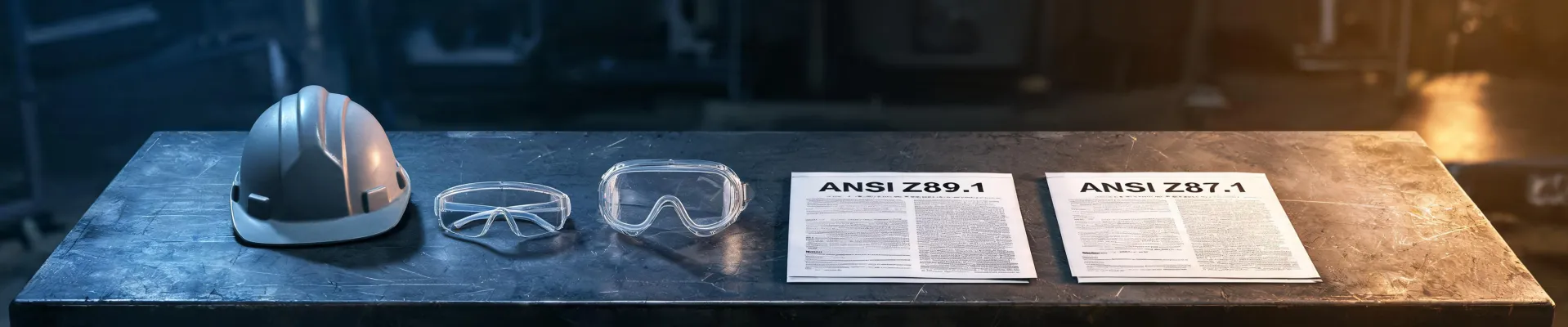
The Green Devil hard hat went to our distribution center as part of a trial. I am not going to pretend everyone loved it on day one. The bright green color drew jokes, and a few veterans refused it because they were used to their old white bump caps. But the spec sheet said something we do not see enough: Type 2 certification under ANSI/ISEA Z89.1.
For anyone who has been buying hard hats for a long time, Type 1 is the default. It handles impact from the top. Type 2 adds lateral impact protection, which is now common in facilities with forklifts, overhead racks, and conveyor systems. The Green Devil hard hat also has a four-point ratchet suspension and a cooling liner. After about two weeks, I checked back with the crew. The same guys who made jokes were asking when the next batch would arrive.
The trend has shifted under our feet. Five years ago, Type 2 hard hats were heavier and hot. Today, the good ones are comfortable enough that workers actually keep them on. If you are still specifying Type 1 because that is what you always bought, it is worth a second look. Check the label on the shell: some vented hard hats are still rated Type 1.
Brown work boots earn their spot in the PPE budget
I cannot leave out footwear. Most of our welders and grinders wear brown work boots, not black. Brown leather holds up better around hot sparks and slag; black leather tends to show heat damage and crack sooner in those conditions. We specify an ASTM F2413 rated toe and a puncture-resistant plate for anyone working around heavy parts and grinding debris.
They are not stylish. They do not need to be. A pair of good brown work boots still looks acceptable after 18 months in a welding bay, and the soles do not turn into slicks when oil drips on them. If you buy only one pair of safety shoes per year and your job involves heat, brown leather is a practical choice.
The food-safety question: are black nitrile gloves food safe?
Here is where the audit turned from routine to uncomfortable. A production supervisor added a rush request for black nitrile gloves. The packaging line was handling food product, and the supervisor assumed black nitrile was automatically safe for food contact because it was nitrile. I had to stop and look at the certificate before approving the order.
Are black nitrile gloves food safe? Sometimes. Nitrile itself can meet FDA food-contact requirements under 21 CFR 177.2600. But the black gloves that come out of an industrial supply cabinet might not be the same as the black gloves sold for food service. The colorants and processing additives also need to be compliant. Without a clear FDA food-contact statement on the package or a letter of declaration from the manufacturer, I do not assume anything.
In this case, I asked the supplier for a compliance document. They could not provide one. With about four hours before the production shift, we returned the unopened boxes and ordered a food-service nitrile glove with an explicit FDA 21 CFR 177.2600 declaration. Did it cost more? Yes. Did it avoid a much worse conversation about contaminated product? Absolutely.
Looking back, I should have put food-contact requirements into our master glove specification from day one. I had a standard, but I had not written it into the contract language. If you buy gloves for food areas, do not rely on the packaging color or the sales rep. Put 'FDA food-contact compliant' in the purchase order and ask for the document before the first case arrives.
PPE is evolving, and the checklist should evolve too
The lesson from this whole audit is not that one brand is bulletproof. It is that old assumptions age badly.
- For safety glasses: look for soft temple padding, an anti-fog coating, and replaceable lenses. A replacement lens system like the Pyramex Safety OTS filter lens pays for itself.
- For hard hats: consider Type 2 rated products, but check the label. Ventilation holes do not automatically mean Type 2.
- For gloves: confirm food-contact compliance in writing when the application involves food. The phrase 'FDA compliant' without a citation means nothing.
- For boots: choose based on the work environment. ASTM F2413 rating, puncture-resistant soles, and the right leather matter more than brand logos.
The fundamentals of PPE have not changed: protect the head, eyes, hands, and feet. The execution has changed, though. Today, you can get a Type 2 hard hat with a cooling liner, safety glasses that stay fog-free through a shift, and gloves with documented food-contact compliance. The function is the same; the standard is higher.
The bottom line
After roughly 200 product reviews a year, I still do not make sweeping claims like 'never fogs on anyone.' I make claims I can verify from field failures and paperwork. The Pyramex Endeavor Plus foam padded safety glasses lasted longer in our work conditions than the previous brand. The Green Devil hard hat got worn, which is the highest compliment for a safety product. And we learned that black nitrile gloves need the same proof as any other food-contact material.
That is my version of a quality win: a spec sheet that survives real work, and a purchase order that does not depend on someone's good intentions.

Maeve Callahan
Maeve Callahan is a head-protection analyst covering Type I and Type II hard hats, climbing-style safety helmets, bump caps, chin straps, suspensions, liners, and face-shield carriers. She applies ANSI Z89.1, EN 397, and EN 12492 criteria while comparing impact attenuation, penetration resistance, lateral deformation, electrical class, retention strength, field of vision, mass, fit range, and temperature conditioning. Her guides help EHS teams, contractors, utilities, and buyers select helmet systems for overhead hazards, work at height, electrical exposure, accessory compatibility, and worker acceptance.