-
Certification & Standards: Both Say Z87, But That's Not the Full Story
-
Durability: What Actually Survives a Real Work Week
-
The Compliance Paradox: Workers Actually Wore the Heat Waves More
- Total Cost Per Worker: The Number That Matters Most
-
The Welding Helmet Question Everyone Asks
-
So, Pyramex or Heat Waves? My Buying Recommendations
Back in March 2022, I signed off on what seemed like a smart fix for our biggest compliance headache. Fifty pairs of Heat Waves safety glasses at about $35 per pair. The crew had been leaving their standard-issue eyewear on the break room table. Not maliciously—they just hated the look and feel. I told myself the higher price was worth it. "You can't put a price on compliance," I said.
By the end of the year, that decision had cost us nearly $3,800. Replacements, lost pairs, and one panic expedite before a client site audit.
I'm the operations manager handling PPE purchasing for two construction crews. Not a safety engineer, not a procurement specialist. Just a guy who's personally made and documented over a dozen purchasing mistakes in four years—totaling roughly $20,000 in wasted budget. In my opinion, the "which safety glasses are better" question usually gets asked the wrong way. It's not about which brand wins in a vacuum. It's about how they compare on the dimensions that actually affect your safety program: certification, durability, compliance, total cost, and ecosystem fit.
Here's how Pyramex Z87 safety glasses and Heat Waves actually stack up.
Certification & Standards: Both Say Z87, But That's Not the Full Story
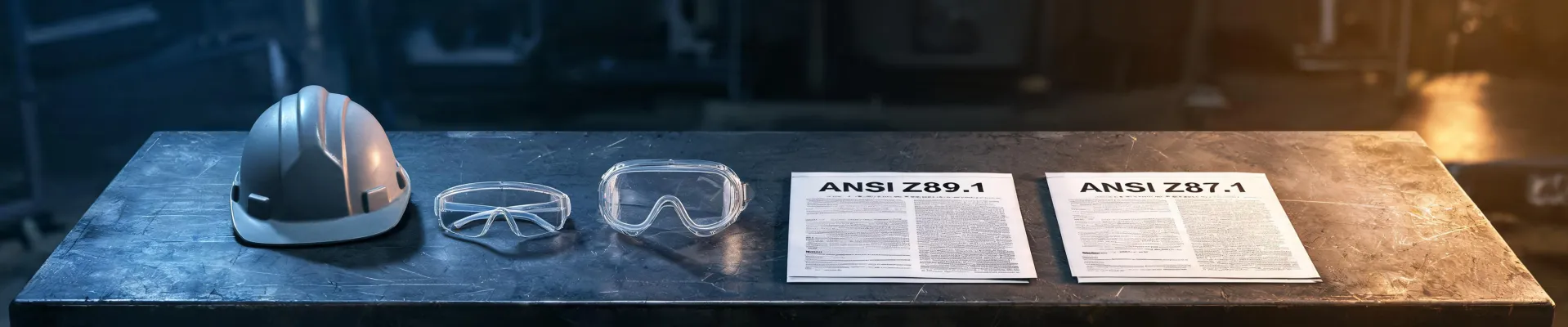
Both brands offer lenses that meet ANSI Z87.1+, the high-impact standard OSHA references under 29 CFR 1910.133. So from a legal baseline, either choice gets you compliant. That's where the similarity ends.
According to the CDC, more than 2,000 U.S. workers experience job-related eye injuries every day. That's why the baseline standard matters—but it's also why I'm suspicious of any decision that ends at "compliant" without asking what specific hazards we actually face.
Pyramex builds eyewear for industrial environments first. Their Z87 range goes from basic clear-lens models all the way to full-coverage goggles and frames with heavy-duty side shields. If your crew is grinding, cutting, or working under falling debris, Pyramex has a model engineered for that specific exposure.
Heat Waves are designed differently. They look like premium sunglasses because that's their entire pitch, and it's a legitimate one. But that design priority comes with trade-offs. The slim temples and narrower lens profile are fine for general construction or site walking. They're not what I'd issue for work that throws hot sparks or fast-moving particles.
It's tempting to think that since both are Z87, they'll protect equally in every situation. That's an oversimplification. The Z87 standard sets a minimum impact threshold. It doesn't measure whether a lens shape blocks debris coming from awkward angles, whether the frame stays sealed on the face during impact, or whether the design holds up when a worker leans into a grinding wheel. My advice: check the lens markings, evaluate the coverage your tasks require, and buy based on your actual hazard profile.
Durability: What Actually Survives a Real Work Week
Here's what I documented after a year of switching between both brands on two crews:
Our Heat Waves accumulated scratches from normal wear—truck dashboards, toolboxes, pocket clips—within two or three weeks. Three pairs had nose bridge fractures. One mirrored coating peeled after six weeks. Twelve pairs got replaced in the first year due to damage. Roughly $350 in replacement cost.
Our Pyramex Z87 glasses, by comparison, lasted. Eight pairs replaced in the same period, mostly from genuine accidents—dropped under a truck, run over by a pallet jack—not from cosmetic wear. The polycarbonate lenses feel denser. The frames have less flex. They're not indestructible, and I've seen a few come back mangled. But the failure rate was maybe a third of what we saw with Heat Waves.
Honestly, I'm not sure why cheaper glasses held up better. My best guess is that lens geometry plays a role—the Pyramex lenses are thicker and less curved, which gives them more structural rigidity. Whatever the cause, the effect was clear. For durability, Pyramex won decisively in my records.
The Compliance Paradox: Workers Actually Wore the Heat Waves More
Here's the dimension I didn't expect, and the one that made me question my assumptions.
For the first month after the Heat Waves order, our voluntary compliance was the best I've ever seen. During random site walkthroughs, roughly 40% more workers were wearing eye protection compared to the quarter before. A couple of guys even forgot they were wearing them at lunch. From the outside, this looked like the perfect outcome.
The reality was more complicated.
Heat Waves looked like personal sunglasses, so workers treated them like personal property. Pairs went home. They went into trucks. They got lent to buddies. By month two, they were disappearing at a noticeable rate. One guy left his pair in a hotel room during a remote site visit, and we never saw them again.
Workers issued Pyramex frames, meanwhile, treated them like the tools they are. The routine was already established: designated storage spot on the truck, replacement process when broken, no emotional attachment. Compliance was less dramatic, but steady. Predictable. Auditable.
I've never fully understood why some workers bond with safety equipment and others don't. If a behavioral scientist has insight, I'd genuinely like to hear it. My guess is it has something to do with identity—wearing equipment that looks like your own choice feels different from wearing something that looks like a uniform.
Here's my conclusion: Heat Waves can be a powerful short-term tool for improving compliance in a crew that actively resists eye protection. But that effect fades. You can't build a safety program on novelty.
Total Cost Per Worker: The Number That Matters Most
Let's talk money. From what I've paid over the past few years:
Pyramex Z87 safety glasses: $5–12 per pair. Heat Waves: $25–50 per pair depending on style.
Unit cost matters, but the real gap showed up when I tracked expenses per worker per year:
- Heat Waves: $75–90 per worker in year one when you add replacement pairs, lost pairs, and the initial purchase spread across the crew.
- Pyramex: Under $12 per worker per year, sustained over two years.
That's a 6x difference. And no, it's not because Heat Waves is a ripoff. It's because treating stylish glasses as disposables gets expensive. Workers treat them like they cost $40—so they lose them, scratch them, and forget them.
The Ecosystem Factor
There's another cost dimension that's less obvious: supplier consolidation.
Pyramex makes head-to-toe PPE. Headwear, eyewear, gloves, hi-vis apparel, welding helmets, you name it. When I need a pyramex hard hat liner replacement, I order it from the same manufacturer as the glasses. When the crew needs kevlar gloves or a replacement suspension system, it's one purchase order, one vendor relationship, one inventory tracking system.
Heat Waves makes glasses. Nice ones, but just glasses. That's fine if you already have a stable PPE supply chain. But if you're building one from scratch, adding a separate eyewear vendor for style reasons adds friction that your future self will resent.
The Welding Helmet Question Everyone Asks
Some version of "what is the best welding helmet" shows up in every safety forum I read. The answer is always the same: it depends on the welder, the process, and the environment.
A fixed-shade helmet that costs a third of an auto-darkening model is the right answer for some shops. An auto-darkening helmet saves time and reduces neck strain for others. The same logic applies to safety glasses. The right pair for your crew is the one that meets the required standard, fits your actual hazard profile, and gets worn consistently. That last part is one you can't solve with a spec sheet.
So, Pyramex or Heat Waves? My Buying Recommendations
If you take nothing else from this, here's the decision framework I wish I'd had:
Make Pyramex your baseline if:
- Your work involves grinding, cutting, welding, or airborne debris
- You need predictable Z87+ coverage across a range of tasks
- You want one supplier for hard hat liners, safety glasses, gloves, and other PPE needs
- Sustainable per-worker cost is part of your safety program metrics
Add Heat Waves as a supplement if:
- Your crew actively resists wearing eye protection—the novelty factor works for a season
- Most tasks are general site duty with low impact risk
- You have budget tolerance for higher replacement rates
- You understand that style is a tool, not a strategy
And if you have the budget, running both is a legitimate approach. Some of the best-run crews I've seen issue Pyramex for high-hazard tasks and keep a small inventory of Heat Waves around for general site wear, client visits, and team morale. The key is being intentional about it rather than defaulting to whatever looks cool on the rack.
As someone who learned this the hard way, I do not recommend treating the decision as a brand loyalty question. Don't spend $3,800 to discover that "cooler" doesn't equal "better fit." Ask your crew what they'll wear. Look at your hazard list. Run the per-worker math. That's the formula I wish I'd used from day one.

Maeve Callahan
Maeve Callahan is a head-protection analyst covering Type I and Type II hard hats, climbing-style safety helmets, bump caps, chin straps, suspensions, liners, and face-shield carriers. She applies ANSI Z89.1, EN 397, and EN 12492 criteria while comparing impact attenuation, penetration resistance, lateral deformation, electrical class, retention strength, field of vision, mass, fit range, and temperature conditioning. Her guides help EHS teams, contractors, utilities, and buyers select helmet systems for overhead hazards, work at height, electrical exposure, accessory compatibility, and worker acceptance.