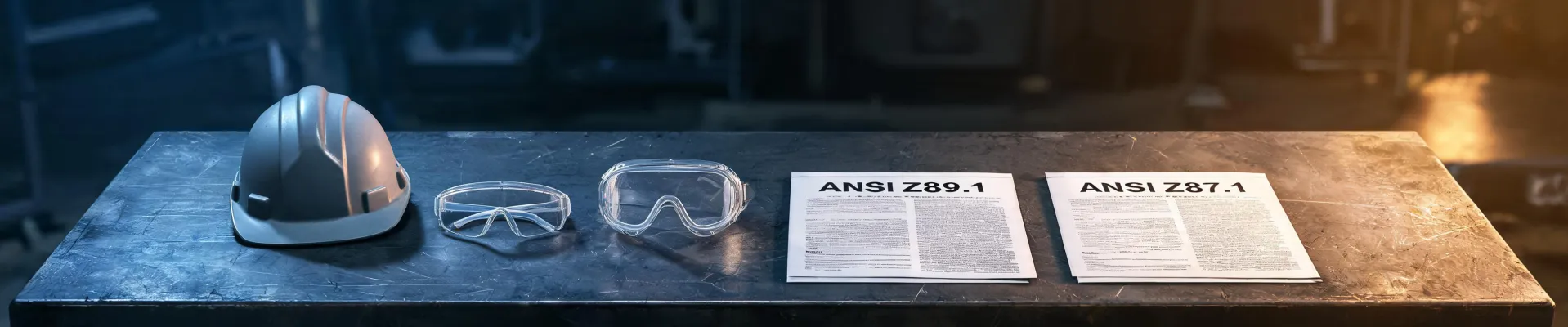
In Q2 2024, I pulled our PPE spend report and nearly choked on my coffee. Our safety eyewear line was running 34% over budget — and we had spent the previous 18 months deliberately buying the cheapest ANSI Z87.1 pairs we could find.
For context: I'm the procurement manager at a 400-person metal fabrication shop. I've owned our PPE budget (about $60,000 a year across all categories) for six years, negotiated with 20-plus vendors, and logged every order in our cost tracking system. I'm not a safety guy. I'm the guy who has to explain the variance to the CFO.
So the overrun was on me, and I assumed it was a pricing problem. It wasn't.
What I thought the problem was
My logic went like this: safety glasses are safety glasses. They all carry the Z87.1 stamp, they all look roughly the same, and the difference between a $4 pair and a $14 pair is marketing. So we standardized on the low end, set up a reorder point, and moved on.
That's a clean theory. It's also wrong, and the data proved it in about ten minutes once I actually looked.
When I broke our eyewear spend down by cost per worker-year instead of cost per pair, the cheapest SKUs weren't cheap at all. They were the most expensive thing in the category. The reason is boring and obvious in hindsight: cheap lenses scratch faster, anti-fog coatings fail sooner, and workers who can't see through a pair throw it away and grab a new one. We were buying $4 glasses four or five times a year instead of a $14 pair once or twice.
Bottom line: we'd optimized the invoice line, not the cost.
The deeper problem: we were buying units, not outcomes
1. Replacement frequency is invisible on a purchase order
A purchase order only records what you bought. It doesn't record that Miguel in welding went through six pairs last quarter because the coating fogged up by 10 a.m. every day. Replacement rate is a behavior, and behavior doesn't show up in procurement software unless you go looking for it.
We started tracking issue rate per department — how many pairs each foreman pulled from the crib each month. The delta between the best and worst departments was wild: 2.1 pairs per worker per year versus 5.8. Same job, same dust, same heat. The variable was the lens.
2. Anti-fog is a premium feature until you price out the alternative
This was true maybe 15 years ago, when anti-fog coatings were inconsistent and often flaked off after a few washes. A lot of buyers my age still carry that reflex: anti-fog is a nice-to-have, not worth the upcharge. That's changed.
Our welding and wash-down crews were the test case. We trialed the Edge Eyewear Zorge G2 safety glasses with the smoke lens for the outdoor grinding bays — glare plus sparks plus humidity is about the worst combination for fogging. Issue rate dropped from 5.8 pairs per worker-year to 2.4. The per-pair price was roughly double. The per-worker-year cost was lower. Not by a little — by about 18%.
The Brazeau safety goggle from Edge did something similar for the chemical wash stations, where splash is the main hazard and fogging is constant because of the humidity. I'll be honest: I was on the fence about goggles because the old ones were sweaty and guys hated wearing them. The trial fixed that. Compliance went up, which is the part that doesn't show up in any spreadsheet but absolutely shows up in your incident rate.
3. Every PPE category had its own little kingdom
Here's the part that genuinely surprised me. Once I started auditing, I found that we were buying eyewear, hard hats, hearing protection, and body protection through four different buyers with four different standards and zero coordination.
Example: the hard hats. We'd been sourcing a mix — some Pyramex hard hats for the field crews, a couple of generics for visitors, no real spec. Fine, nobody got hurt. But we had no idea what the actual standard was, so we couldn't compare anything or negotiate from a real position.
Worse was the hearing protection. I walked the floor one afternoon and counted two guys wearing Uggs-style earmuffs — the soft, fleece, consumer ones people wear in cold weather. They had a noise reduction rating of basically nothing. They weren't being lazy. Nobody had ever explained the difference between a fashion earmuff and a hearing protector with an actual NRR.
And then there was the "tactical vest" incident. One of our newer buyers got a requisition for a tactical vest and quietly asked me what is a tactical vest, exactly — because the requester meant a cut-resistant utility vest for the material handling crew, and my buyer had been picturing body armor. That's a $400 mistake waiting to happen every time someone uses a word that means three different things depending on who's saying it.
What it actually cost us
The direct overrun was real: about $9,400 in unexpected eyewear spend that year. But that's the small number.
OSHA notes that roughly 2,000 U.S. workers sustain job-related eye injuries requiring medical treatment every day — and estimates that the right eye protection could prevent the vast majority of them. Source: osha.gov, Eye and Face Protection standard (29 CFR 1910.133).
We didn't have an eye injury that year, and I'm grateful for it. But I did have three near-misses in Q3 — all involving workers who had taken off fogged-up glasses right before doing something stupid. Two of those involved the cheap lenses we'd been buying. One of them ended with a guy getting a metal shard removed at urgent care. That's a $600 bill, a half-day of lost production, and an incident report that took me two hours to fill out.
Then there's the compliance exposure. 29 CFR 1910.133 requires employers to provide eye and face protection "whenever necessary" and to make sure it fits and is worn. If a worker takes his glasses off because he can't see through them, that's not his fault. It's a supply decision. An OSHA inspector is going to ask what standard the PPE meets (ANSI/ISEA Z87.1-2020 is the current consensus reference, and the Z87+ mark indicates high-velocity impact rating) and whether it's suitable for the task. "We bought the cheapest thing that had a stamp on it" is not a great answer.
The other hidden cost is time. Every time a foreman has to walk to the crib and pull another pair, that's 10 minutes of a supervisor's day. Multiply a replacement rate of 5.8 pairs by 400 workers and a $4 savings looks like a rounding error next to the labor it throws away.
What I changed — and what I'd do differently
Two changes, honestly. Neither was complicated.
First, I switched the metric. Eyewear is now budgeted and bid on cost per worker-year, not cost per pair. Vendors who can't talk in that unit don't get a second meeting. It took about three months to build the baseline, and it immediately killed the "cheap is cheap" illusion.
Second, I standardized across categories. One spec, one annual review, one buyer for the whole PPE bundle — eyewear, hard hats, hearing protection, hand protection. The tactical vest question gets asked once at the spec stage now, not at the PO stage.
Looking back, I should have run the department trial before we standardized on the low-end SKUs. At the time, standardizing on one cheap model felt like discipline. It was actually just speed. The two-week trial would have cost us maybe $300 in samples and saved us most of that $9,400.
If you're auditing your own PPE spend this year, start with one number: pairs issued per worker per year. If it's above three, you don't have a pricing problem. You have a product-fit problem. The price is just where it shows up.

Leila Mansouri
Leila Mansouri is a respiratory protection and air-monitoring analyst covering N95 and FFP respirators, reusable half and full-face masks, PAPR systems, cartridges, fit-test kits, and portable multi-gas detectors. She uses EN 149, ISO 16975-3, and IEC 60079-29-1 while comparing assigned protection factor, fit factor, filter penetration, breathing resistance, service-life limits, sensor range, alarm response, cross-sensitivity, and calibration interval. Her work helps industrial hygienists, confined-space teams, emergency planners, and buyers match respiratory and detection controls to contaminant type, concentration, task duration, and atmospheric uncertainty.