-
The hard hat lesson: weight and suspension beat specs
-
Safety glasses: Z87 is the floor, not the full answer
-
That hard wired smoke detector beeping: a maintenance cue we ignore
-
Men's work boots: buy for the job, clean them like you mean it
-
The checklist that saved our budget
-
What this checklist doesn't cover
Buying better safety gear is easy. Maintaining it is not. In eight years of handling PPE orders, I've made six documented mistakes that totaled roughly $12,000 in wasted budget, and nearly all of them came from ignoring maintenance, storage, and context. I'm the guy who now keeps the team's checklist. This is what I wish someone had given me before I started.
I don't work for Pyramex. I just buy their stuff more often than any other brand because the price-to-performance ratio holds up. But this isn't a sales pitch. It's a field guide to the failures that a purchase order can't solve.
The hard hat lesson: weight and suspension beat specs
In my first year (2017), I ordered a pile of basic hard hats because they were cheap. They met the standard. They also got left in the truck because they were hot and heavy. A hard hat that isn't worn is just a plastic fruit bowl.
That's when I switched to a Pyramex carbon fiber hard hat for our crew. It's noticeably lighter than the older fiberglass models, and the Type 2 vented options make a real difference on warm days. (Honestly, if you've never tried a vented shell, you'll be surprised how much heat escapes.) The carbon fiber shell is also easier to inspect—there are no painted coatings to hide stress lines. Not that painted shells are bad; they're just harder to read.
A lot of the "hard hats are heavy" thinking comes from an era before carbon fiber and ratchet suspensions. That changed. Find a shell your crew will actually keep on their heads, then spend the rest of your budget on replacement suspensions and chin straps. That's where the system usually breaks.
One more thing: a bump cap is not a hard hat. I know that sounds obvious, but I've watched crews use bump caps on sites where falling objects were a real risk. A bump cap protects you from hitting your head on a low beam; it does not protect you from a falling wrench.
Safety glasses: Z87 is the floor, not the full answer
Safety glasses are the item I get asked about most. "Do these meet Z87?" is the wrong question. The real question is: "Will they still be Z87-compliant after six months of being shoved in a pocket, wiped with a dirty shirt, and dropped on concrete?"
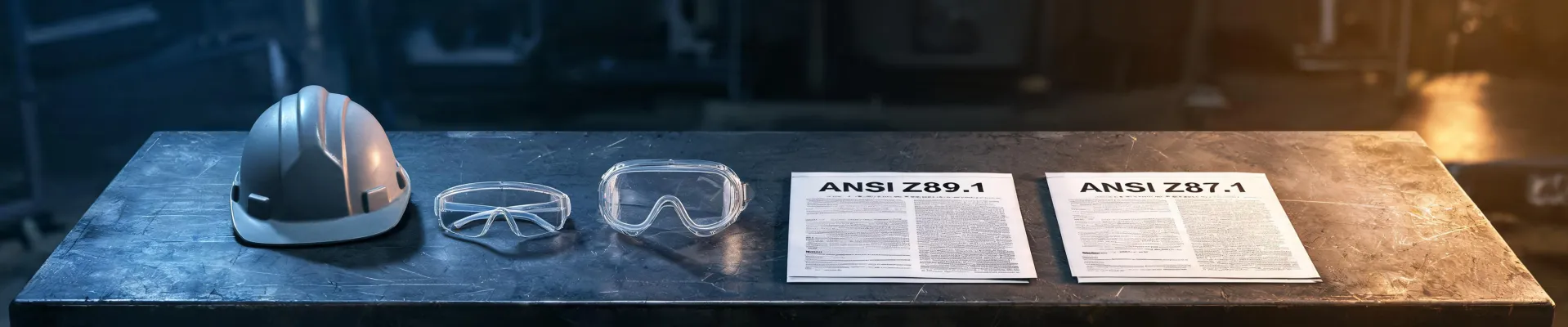
We use Pyramex z87 safety glasses with anti-fog coatings in our everyday kits. The Z87.1 mark is important—it means they've been tested to ANSI's impact standards—but the mark doesn't prevent fogging. It doesn't prevent scratches. And it doesn't tell you whether the lens is right for your task.
Here's what I learned the expensive way: buy anti-fog lenses for humid environments and tinted lenses for outdoor work, but don't assume one pair can do everything. We once ordered 200 pairs with no anti-fog coating because they were on sale. On a humid metal building retrofit, the crew took them off more than they wore them. Nobody got an eye injury, but it was luck. The "deal" ended up costing about $1,800 in reorders and downtime. That was Q2 2019, and my spreadsheet still remembers.
That hard wired smoke detector beeping: a maintenance cue we ignore
Stick with me here. The most annoying safety device in your crew's lives is also the most useful: the smoke detector.
Last year, a guy on my crew told me he couldn't sleep because his hard wired smoke detector beeping every few minutes. He was planning to take it down. I asked a stupid question: "When did you last change the backup battery?" Silence. The unit was older than his kids. According to NFPA (nfpa.org), smoke alarms should be replaced every 10 years, and hard wired alarms still have backup batteries that need annual attention. We changed the battery and replaced the unit. The beeping stopped.
I use that story in every safety training now. Why? Because the same mental move that leads you to ignore a beeping smoke detector is the move that leads you to ignore a scratched lens, a cracked hard hat shell, or a frayed boot lace. It's not a noise problem. It's a maintenance-cue problem. If you hear a beep, trace it. If you see damage, tag it out. That process is worth more than any product spec.
Men's work boots: buy for the job, clean them like you mean it
Boots are the one piece of PPE that people overbuy and under-maintain. I see it all the time.
Good mens work boots are an investment. But the price tag doesn't protect you. A $220 boot with the sole delaminated because it was dried next to a heater is still a $220 boot in the trash. I know because I did it to a very good pair of logger boots in 2020. The leather looked fine from the outside. The sole came off because I'd baked the adhesive.
Here's the simple how to clean work boots routine I now put in our onboarding:
- Knock off dry dirt with a stiff brush before it works into the leather or stitching.
- Use warm water and a mild soap—not saddle soap every time, just a gentle cleaner.
- Air dry at room temperature. No dryer, no direct heat. Ever.
- Condition the leather once the boots are dry, especially if you work in mud, salt, or concrete dust.
That routine takes about five minutes. The boots will still wear out eventually, but they'll wear out at the right time, and you won't be wrestling with a sole that gave up early.
The checklist that saved our budget
We didn't have a formal PPE inspection process before 2021. That cost us when a cracked hard hat shell was found on a scaffold—the worker had swapped it with a visitor's hat from the truck, and nobody had checked it after it had been dropped. I don't know how many of our total mistakes came from that gap, but I know the line in my spreadsheet that says 'inspection process' is the one that fixed the rest.
Now we do a five-minute field check:
- Hard hats: check shell and suspension for cracks, fading, or deformation before each work week.
- Safety glasses: look for scratches that block vision and coating failure that causes fogging.
- Boots: check sole separation, torn stitching, and exposed toes.
- Smoke detector at home? Yes, I tell them to check that too, because safety doesn't stop at the gate.
The exact brand doesn't matter as much as the routine. That said, I keep coming back to Pyramex because their hard hats and glasses make the inspection easy—no fussy straps, clear labels, and anti-fog coatings that have held up better than brands that cost twice as much. (Not that I've tested every brand; I've only tested the ones my budget allowed.)
What this checklist doesn't cover
This was accurate as of April 2025. Safety standards and product lines change, so verify current ANSI/OSHA requirements before you buy. Also, this is one manager's system, not a substitute for a site-specific hazard assessment.
If you're shopping for Pyramex products, check the exact model's compliance marks. Not every hard hat is Type 2. Not every lens is Z87. The good news is that the brand is serious about labeling, so the info is usually easy to find.
And if you're dealing with a hard wired smoke detector that won't stop beeping, don't just pull the battery. Check the replacement date, vacuum the vents, and test the circuit. That beep is information. Treat it that way.

Maeve Callahan
Maeve Callahan is a head-protection analyst covering Type I and Type II hard hats, climbing-style safety helmets, bump caps, chin straps, suspensions, liners, and face-shield carriers. She applies ANSI Z89.1, EN 397, and EN 12492 criteria while comparing impact attenuation, penetration resistance, lateral deformation, electrical class, retention strength, field of vision, mass, fit range, and temperature conditioning. Her guides help EHS teams, contractors, utilities, and buyers select helmet systems for overhead hazards, work at height, electrical exposure, accessory compatibility, and worker acceptance.