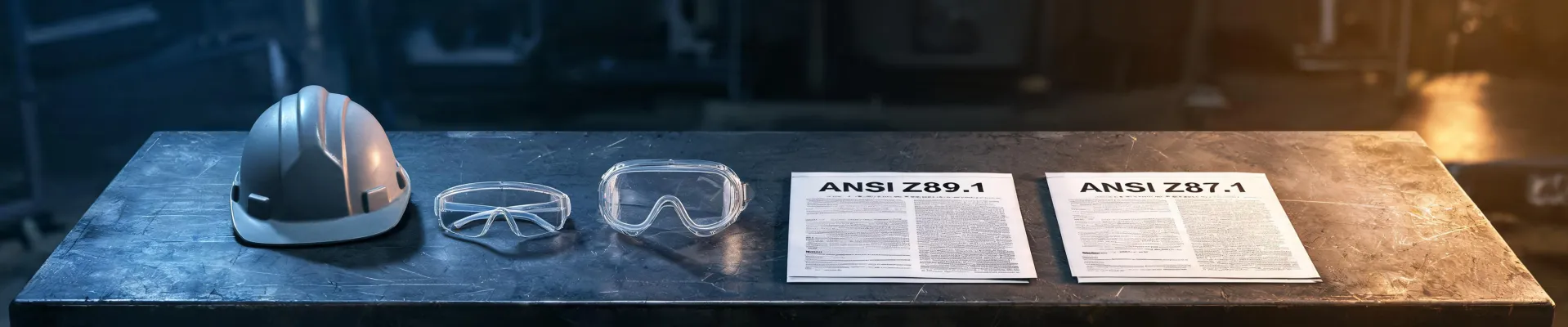
The call came in on a Tuesday in March 2024, just after lunch. One of our maintenance techs had taken his safety glasses off because they wouldn't stop fogging. He picked up a grinder for what he figured was a ten-minute job. A sliver from the wire wheel caught him in the eyelid. Four stitches and a whole lot of "you're lucky" conversation later, I went down to the shop and asked him to show me the glasses.
That's when the bottom fell out. They were a budget pair I'd ordered in bulk from a maintenance supply catalog. No Z87 marking. No lot number. I'd saved maybe $200 on that order by picking the cheaper option, and I'd been handing out glasses that were useless in the exact situation they were supposed to handle.
I should back up. I'm the office administrator for a facilities maintenance company with about 130 employees across three states—maybe 125 back in March, I'd have to check the org chart. PPE ordering has been my job since 2020. That means I manage roughly $40,000 a year in gloves, glasses, hard hats, high-vis gear, and hearing protection across eight vendors. I report to both operations and finance. My job is to keep people equipped without blowing the budget.
When I took over, I treated PPE like any other office supply. Price per unit. Case quantity. Shipping speed. It never occurred to me that a product could be labeled "safety glasses" and not meet the impact standard behind that label. Everybody tells you to check specs. I only believed that after ignoring it and eating the consequence.
The Turning Point
Here's what I keep replaying: those glasses didn't fail an obvious test. They fit fine and looked the part. The problem was they had no actual impact rating behind them. If you'd handed me a pair and asked whether they were safety glasses, I would have said yes without thinking. In my head, "safety glasses" just meant "glasses we buy for work."
The repair tech was the one who told me later that he'd been complaining about fogging for months, and I'd shrugged it off as a comfort gripe. It wasn't. He was taking them off because they physically interfered with his work. That combination—unverified spec and an uncomfortable product—is the worst place to be.
So now I had two problems: the next pair I ordered had to be properly rated, and my crew had to actually want to wear them. The first one is easy to solve with a spec sheet. The second one is harder.
What Are Safety Glasses, Actually?
If you've ever typed "what are safety glasses" into a search bar, you probably already know more than I did. In the U.S., the term means the glasses meet ANSI Z87.1, the American National Standard for eye and face protection. It covers impact resistance, optical clarity, and coverage. For high-impact ratings—the Z87+ marking you see on serious work glasses—there's a ballistic impact test on top of the basic drop test. The OSHA standard for eye and face protection, 29 CFR 1910.133, requires employers to make sure workers use eye protection that complies with ANSI Z87.1.
In practice, that means a compliant pair of safety glasses has lens and frame markings you can look up. If it doesn't, it's a fashion accessory with a safety-looking shape. No matter how reassuring the catalog photo looks, the marking is the only thing that matters.
That was the first real lesson. I can cite the standard now from memory, but what actually changed my behavior was the cost of not reading it.
How We Ended Up With Pyramex OTS Safety Glasses
After the near miss, I asked our main safety vendor to send samples. I asked for anti-fog options specifically, because that's the complaint that nearly cost one of our guys his eyesight.
The Pyramex OTS safety glasses showed up in that sample box. Two things stood out. First, they're designed to fit over prescription glasses. That solved a years-long problem with crew members who wear Rx frames and refused to add another layer because nothing fit over them. Second, the lenses have a serious anti-fog treatment, and there's venting built into the frame to keep humid air moving. That's exactly what you need for the conditions our crews actually work in—a warm machine shop, a damp parking garage, holding a torch up close, then walking out into cold air.
We tested them for three weeks. The fogging complaints on that shift went away. Not "never fogs forever"—they're glasses, and anything fogs if you mist it directly—but the temperature-swing fogging our guys dealt with daily just stopped being a thing. I almost missed the ANSI Z87.1 marking on the lens during my first look, because I was too busy checking the lens color. My fault. The marking was right there.
I'll be honest: the OTS pair isn't going to win a fashion contest against sporty wraparound safety glasses. The fit is different because the purpose is different. But for crews where people complain about wearing safety glasses over their personal eyeglasses, that purpose matters more than looks.
The Hard Hat Conversation
While we were fixing eye protection, the same crew started pushing on something else: hard hats. Since 2020, we'd bought the same full-brim thermoplastic hats. They worked, technically. But our welders and electricians avoided wearing them whenever they thought nobody was looking—they were hot, bulky, and got in the way in tight spaces.
I started looking at cap style options. For readers who don't buy this stuff, cap style means the hat has a short front brim like a baseball cap, versus a full-brim hat that looks like a wide sun hat. The Pyramex Ridgeline cap style hard hat kept coming up in conversations with our vendor. It meets ANSI Z89.1, it's available in vented and non-vented versions, and it's built with accessory points, which meant our guys could mount lights and face shields properly instead of improvising.
That last part matters more than you'd think.
Hard Hat Lights: The Small Fix That Stops the Improvising
Our techs work in boiler rooms, mechanical rooms with low ceilings, and parking garages where the lighting is nowhere near task level. They need hands-free light. Before this year, they were doing dangerously creative things: holding a phone in their teeth, wedging a pocket flashlight between their ear and the suspension, or—the worst one—drilling holes through a hard hat to zip-tie a light in place. Drilling through a hard hat voids the ANSI rating. The guy doing the most improvising was the one ending up with the least protection.
The fix was treating "hard hat light" as a real budget line instead of an afterthought. We picked two simple, durable headlamp-style lights and used the Ridgeline's accessory slots to mount them. No drilling. No duct tape. Just a click, and a light that stays put. It sounds small, but we stopped losing lights in ceiling plenums, and we stopped the phone-flashlight improvisation entirely.
OSHA's construction lighting standard—1926.56—sets minimum foot-candle levels for work areas. I walked around two of our client sites with a light meter and found they were below the minimum in parts of the mechanical rooms. Nobody had measured in years. That was a scary moment for a different reason: the fix wasn't hard, but we had to know to look.
The Hearing Protection Side Quest
Once we started down this path, it was hard to stop. Hearing protection was next. And here's a sentence I didn't expect to write: the term "hearing protection act" gets searched a lot, but it actually refers to federal legislation about firearm suppressors, not a workplace safety rule. If you're a small company trying to figure out when you need a hearing conservation program, the words that matter are OSHA 29 CFR 1910.95. The trigger is noise exposure at or above 85 decibels averaged over an eight-hour shift.
We measured our shop for the first time since 2020. The shearing station hit about 88 dB during cutting runs, which made a hearing conservation program a legal requirement, not a nice-to-have. We put up a barrier between the shearing station and the maintenance benches, added hearing protection for the affected areas, and ordered proper earplugs and muffs through our safety vendor.
That's my clearest memory of the prevention-over-cure shift: the noise survey cost about $350 and took one afternoon. If we'd skipped it and ended up with a noise-related hearing loss claim later, the claim would have covered the survey hundreds of times over.
The New Purchasing Checklist
Since March, I've rebuilt the way we buy PPE. It's not complicated and it doesn't take more time. It just takes a different first step:
- Check the standard before checking the price. Z87.1+ for glasses and goggles, Z89.1 for hard hats, 1910.95 for hearing protection triggers.
- Let the crew test samples. We order one of each candidate and put it on real workers for a week before buying case quantities.
- Budget for accessories as part of the PPE line item. Hard hat lights, chin straps, face shield brackets, anti-fog wipes. If it's not in the budget, people improvise.
- Keep a spec sheet or a photo of the marking for every product you order, so you can prove what you bought meets the standard.
I wish I'd had this checklist in 2020. Five minutes of verification beats five days of correction, and I have the paperwork to prove it.
Where We Landed
At our September safety audit, the compliance report came back clean on eye and head protection for the first time in my tenure. The same tech who got the stitches was the first one to sign out the Pyramex OTS glasses when they arrived. And the crew leads stopped hiding the hard hats in the van; they grab the Ridgeline on the way out because it takes up half the space in the toolbox.
This won't be the right answer for every company, and I should say that plainly. I'm only speaking to our context: a facilities maintenance operation with a mix of field and shop work and a purchasing process that needed a rewrite. If you run a foundry or an electrical utility, your equipment needs are different, and you should be working with a specialist who understands them.
But the core lesson—verify before you buy, and make sure the people wearing the gear actually want to wear it—holds in just about any context. It costs a little more time on the front end. It saves a lot more on the back end, in both dollars and things that don't show up on a budget.
The real win isn't the audit result. It's that our crew stopped treating PPE as something to get past so they can do their jobs. That's the shift I'm proudest of.

Maeve Callahan
Maeve Callahan is a head-protection analyst covering Type I and Type II hard hats, climbing-style safety helmets, bump caps, chin straps, suspensions, liners, and face-shield carriers. She applies ANSI Z89.1, EN 397, and EN 12492 criteria while comparing impact attenuation, penetration resistance, lateral deformation, electrical class, retention strength, field of vision, mass, fit range, and temperature conditioning. Her guides help EHS teams, contractors, utilities, and buyers select helmet systems for overhead hazards, work at height, electrical exposure, accessory compatibility, and worker acceptance.