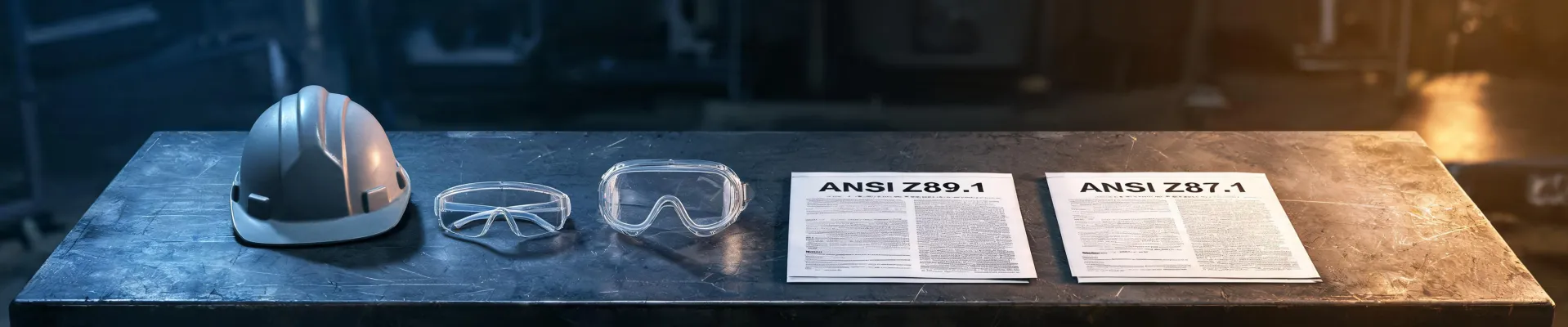
Let me get the controversial part out of the way: Pyramex is not the best PPE brand on paper. If you buy by spec sheet alone, there are more expensive options in almost every category. But after five years of ordering safety supplies for a 180-person company, I've learned that "best" means nothing if the gear ends up in a locker instead of on a worker. Pyramex has become our default because the stuff actually gets worn.
To be clear, I'm an office administrator, not a safety engineer. I manage purchasing for our field crews, warehouse staff, and maintenance team—roughly $40,000 a year in safety supplies across six vendors. I know enough about ANSI standards to be dangerous, and I know exactly what it sounds like when a foreman calls and says the new glasses are "foggy again" and the crew refuses to wear them.
The first thing I had to unlearn: cheap is expensive
When I took over purchasing in 2020, the old process was simple: buy the lowest-priced items that met the minimum standard. The result? We had 300 pairs of safety glasses nobody wanted to wear. They fogged up, scratched easily, and sat in a bin until someone eventually threw them away.
The "budget safety gear is fine" thinking comes from an era when PPE was a commodity and compliance was something you had to force. That's changed. Switching to Pyramex anti-fog glasses cut our replacement orders by maybe 40%. The anti-fog coating doesn't last forever—nothing does—but the complaints I used to hear about foggy lenses are mostly gone.
The Pyramex safety vest that didn't come back
Our road crews have a habit of "forgetting" their safety vests in the truck. It's not outright defiance; it's that the older vests felt like wearing a trash bag. The Pyramex safety vest we order now is breathable enough that people actually leave it on. I don't have a lab test to prove that. I have a foreman who said, "At least these aren't the sticky ones." That matters more than a spec sheet.
We order the ANSI/ISEA 107 Class 2 model for most crew members. Class 2 covers road work in moderate traffic. For our flaggers, we buy Class 3. It costs more, but the crew is more visible, and the vests don't look like they're falling apart after two washes.
What I wish someone had told me about Pyramex prescription safety glasses
When someone asks about "pyramex prescription safety glasses," I tell them to slow down. You don't order Rx glasses like you order a case of work gloves. We buy the Rx-compatible frames through our supply house and work with a local optical lab to fit the lenses. The frame is solid, and it's stamped with the Z87.1 impact standard that OSHA's eye protection rule references. But the lens warranty depends on the lab, not the frame maker.
If your company has 30+ people who need prescription protection, you'll probably want a vendor who handles the whole process for you. For our 8-person maintenance crew, the split purchase works fine.
When Pyramex doesn't cover it—and what we do instead
Here's the part that surprises people in vendor meetings: I don't expect every safety brand to make everything. Pyramex hasn't solved our boot problem, so we buy Georgia work boots for the field crew. They hold up to mud and hot asphalt, and I'd rather buy best-in-category for specialized items than force one brand to do everything.
The question I get a few times a year is, "can nitrile gloves be used for food?" The answer is yes, but only if they're labeled for food contact. I still kick myself for the time we bought a case of nitrile gloves without checking. They were fine for paint and solvent cleanup, but I couldn't verify they were food-safe, so the case went to the warehouse instead.
Nitrile gloves are generally better than latex gloves for food prep because latex allergies are a real liability, and some latex gloves have powder that can contaminate food. But "nitrile" alone means nothing. Look for a food-contact statement on the box, often keyed to FDA 21 CFR 177.2600. I've seen it on Pyramex glove boxes, but I still check every shipment.
"But Pyramex isn't premium" — right, and that's the point
I can hear the pushback already: "If you bought a premium brand, you wouldn't have these problems." Maybe. But I've also seen high-end gear get locked in a cabinet and "reserved for special jobs." For our operation, we need gear people can wear every day without worrying about daylighting it. Pyramex fits that niche: consistent quality, clear ANSI labels, and pricing that lets me replace items before they become a hazard.
I can only speak to our operation: 180 employees, light industrial, no arc flash or molten metal exposure. If your workplace has hazards that need specialized protection, buy the specialist. That's not a criticism of Pyramex—it's a boundary.
The bottom line
So here's my bottom line: Pyramex is my default for the PPE that gets worn every day. Not because it's the most exciting brand in the catalog, but because it's reliable, affordable, and doesn't end up in the trash. For boots, wait—buy those from someone who actually makes boots. And if you're ordering prescription safety glasses, plan extra lead time.
Don't let anyone pressure you into one brand for everything. Know your hazards, verify your compliance labels, and test the gear on the people who actually wear it. If you do that, Pyramex will probably earn a place in your inventory. If it doesn't, at least you'll know why.

Maeve Callahan
Maeve Callahan is a head-protection analyst covering Type I and Type II hard hats, climbing-style safety helmets, bump caps, chin straps, suspensions, liners, and face-shield carriers. She applies ANSI Z89.1, EN 397, and EN 12492 criteria while comparing impact attenuation, penetration resistance, lateral deformation, electrical class, retention strength, field of vision, mass, fit range, and temperature conditioning. Her guides help EHS teams, contractors, utilities, and buyers select helmet systems for overhead hazards, work at height, electrical exposure, accessory compatibility, and worker acceptance.