-
What makes the Pyramex SL Series cap style hard hat different?
-
What does "Type 2" mean on a Pyramex hard hat?
-
Do single-use earplugs really require professional fitting?
-
What are Loop earplugs? Can my crew use them instead of industrial ones?
-
Should I buy DeWalt work boots for my crew?
-
How do I verify a hard hat actually meets ANSI standards?
I review safety products for a living as a quality compliance manager at a PPE manufacturer. In a typical year I go through 200+ unique SKUs—factory samples, post-production batches, and customer returns. In 2024 I rejected about 8% of first deliveries. Shell thickness inconsistencies. Strap rivets that loosened after ten insertions. Labels that didn't match what was in the box.
When buyers ask me PPE questions, I answer them as somebody paid to be suspicious. Here's what they want to know.
What makes the Pyramex SL Series cap style hard hat different?
First, the jargon: "cap style" means the brim is short and only extends forward, like a baseball cap. A full-brim hard hat has a brim circling the whole shell. Cap-style hats fit better under welding hoods and face shields, which is why they're the default for many crews.
The SL Series is Pyramex's lightweight cap-style line. "SL" stands for Super Light, and the base model comes in around 12 ounces with a six-point nylon suspension. That's about two ounces lighter than a typical Type 1 cap-style hat. Doesn't sound like much until your crew wears them for ten-hour shifts. I've watched workers pick up a heavier helmet and set it right back down—they can feel it in their neck by day two.
It's not the most feature-rich hard hat Pyramex makes. Higher-end models add ratchet adjustment, accessory slots, cooling liners. The SL keeps things simple. That's not a criticism. I've seen ratchet mechanisms get brittle and fail in cold weather (ugh, plastic), and the SL's lean design has less to go wrong.
Is it the best helmet in the catalog? No. Is it the one I'd buy for a general crew that needs to stop complaining about head protection? That's a different question. The safest helmet is the one that stays on your head. (Pricing as of early 2025—verify current quotes before you budget.)
What does "Type 2" mean on a Pyramex hard hat?
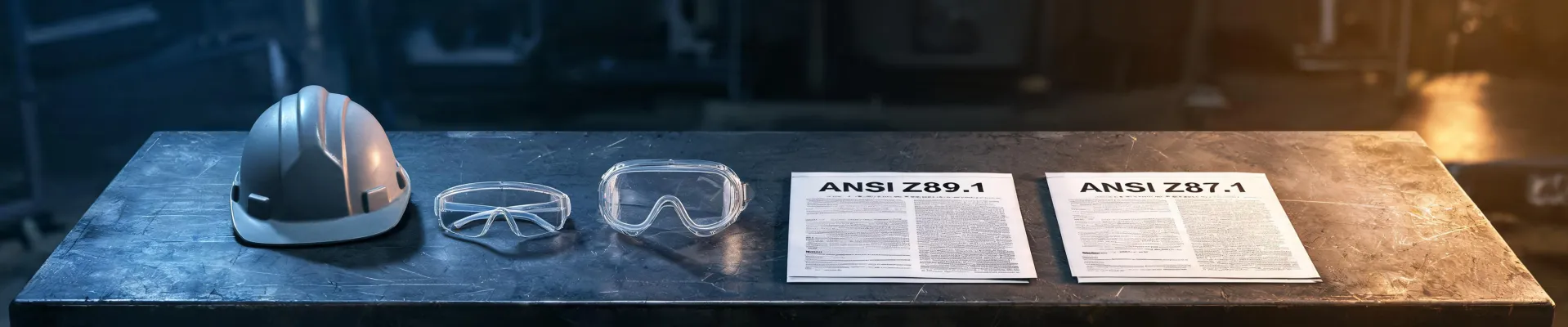
Type 2 refers to ANSI Z89.1-2014 impact classification. Type 1 helmets are tested for vertical impacts to the crown. Type 2 helmets are tested for impacts to the crown and the sides—front, back, left, right.
Why does this matter? Not everything falls from above. You back into an I-beam. A pipe swings sideways. A tool gets kicked off a scaffold at head height. Type 2 accounts for that lateral contact.
Pyramex makes Type 2 helmets in both cap-style and full-brim versions—the Trail (cap style) and Zephyr XL (full brim) are the two I get asked about most. They run heavier than the SL Series. That's physics: more foam, more shell, more protection.
From the outside, buying everyone a Type 2 helmet looks like the safest possible move. What you don't see is the behavioral cost. Heavier helmets end up on the tailgate instead of on heads, and a tailgate helmet protects nobody (note to self: I should put that on a poster).
My answer: don't buy Type 2 because "it's safer." Buy it because your hazard assessment shows lateral impact risk—common in confined spaces, around swinging loads, or near moving machinery. If the hazard is purely overhead, a Type 1 helmet saves weight and money, and that's a legitimate total-cost decision.
Do single-use earplugs really require professional fitting?
Yes. And if you haven't been fit-testing, your hearing protection program isn't doing what you think it's doing.
A single-use foam earplug (the orange or yellow cylinders you roll down and insert) carries a rated NRR around 30 dB. That rating assumes a perfect seal. In other words: single-use earplugs require a professional fitting before they can be used as rated. Real-world attenuation, when workers insert them without training or a fit check? Closer to 7-12 dB. That gap isn't my opinion—NIOSH has documented it for years.
Fitting takes about ten minutes per worker. Measure the ear canal, teach the roll-and-pull technique, insert, hold, verify the seal with a fit-test system. Some workers have tricky anatomy. One ear might need a different plug size than the other. You adjust and retest.
I had 2 hours to choose a hearing protection approach for a new plant in 2023. Normally I'd run fit-testing on a sample of the crew first. There was no time—the purchase order had to go out that day. We went with pre-molded reusable plugs because they're less sensitive to insertion technique. In hindsight, I should have pushed back on the timeline. But with the plant launch locked in, I made the best call I could with incomplete information.
Here's the total-cost math. A box of 200 foam plugs costs around $30. A fit-test kit runs something like $1,500-$3,500 (don't hold me to exact pricing—it varies by vendor). A single hearing loss claim, by the time you count medical, legal, and lost productivity, runs into five or six figures. The $30 box was never the cheap option. It just looked like it.
What are Loop earplugs? Can my crew use them instead of industrial ones?
Loop earplugs are the consumer brand you've seen all over social media—colorful loop-shaped plugs in a silicone case, marketed for concerts, sleep, and focus. They reduce volume while keeping sound reasonably natural.
Can your crew use them for work? Honest answer: sometimes, but it's more complicated than the packaging suggests.
Consumer models are designed for listening comfort, not occupational noise protection. Some newer Loop models have moved toward labeled NRR ratings in the U.S. market—the company is clearly pushing into that space. But I'm not 100% sure every model currently carries an NRR label, and the lineup changes often. If it doesn't say NRR on the package, it's not hearing protection for an OSHA hearing conservation program. Period.
There's also a physical issue. The loop sits partially outside the ear. That's fine at a concert. Under a welding hood, behind a face shield, or under earmuffs that need to seal against the head? The loop breaks the seal.
To be fair, Loop makes a good product for what it's designed for. I own a pair for travel. But when I'm specifying PPE for a workplace, I need labels I can verify, training I can standardize, and fit-testing I can document. Lifestyle engineering doesn't have a column for that.
Should I buy DeWalt work boots for my crew?
Ask me instead: what safety rating does the boot carry? The brand is secondary to that.
Our company doesn't make boots, so I don't have a horse in that race. But foot protection comes down to a few verifiable specs:
- ASTM F2413 — impact-resistant toes and puncture-resistant soles. No F2413 label, no protective boot.
- A slip-resistance test (often ASTM F2913) — the difference between a boot that grips and a boot that sends someone to the ER on wet steel.
- Electrical hazard (EH) rating — non-conductive soles for anyone near live equipment.
DeWalt boots can be decent. They're produced by an independent footwear manufacturer under license from the DeWalt brand—which doesn't make them bad, but it does mean you're evaluating the boot, not the power-tool engineers. So check the label inside the tongue. Look for the ASTM marking. If it's not there, it's fashion, and I say that regardless of which logo is stitched on the side.
From the outside, a $60 boot looks smart for the budget. What you don't see at the register is sole delamination at month four and feet aching by hour six—which leads to sitting down, which leads to lost time. The $60 boot that lasts three months costs more per month than the $160 boot that lasts 18 months. Cost-per-wear isn't close.
How do I verify a hard hat actually meets ANSI standards?
Look at the label. It's the fastest check, and the one most buyers skip.
Every ANSI-certified hard hat sold in the U.S. has a label inside or molded into the shell. It states "ANSI Z89.1-2014," the type (1 or 2), and the class (C, G, or E). The Pyramex SL Series carries it on the internal label. So does every other legitimate hard hat on the shelf.
If an online listing says "safety helmet" but the photo shows no standard marking, ask the seller for a label photo. I've seen listings get corrected after buyers called out missing certifications (I keep a folder of these—it's a hobby). If the seller can't show the label, don't buy.
Once the helmets are on site, inspect them every six months or after any significant impact. Look for cracks, stress whitening, dents, frayed straps, suspension sag. And know the service-life rule: most manufacturers and safety organizations recommend replacing hard hats 3-5 years after the manufacture date, even if they look fine, because UV light breaks down the shell over time. The date is stamped inside the shell as a week/year code.
This was accurate as of early 2025. ANSI standards get revised on their own schedule, so when you write your next procurement spec, double-check that you're referencing the current revision.

Maeve Callahan
Maeve Callahan is a head-protection analyst covering Type I and Type II hard hats, climbing-style safety helmets, bump caps, chin straps, suspensions, liners, and face-shield carriers. She applies ANSI Z89.1, EN 397, and EN 12492 criteria while comparing impact attenuation, penetration resistance, lateral deformation, electrical class, retention strength, field of vision, mass, fit range, and temperature conditioning. Her guides help EHS teams, contractors, utilities, and buyers select helmet systems for overhead hazards, work at height, electrical exposure, accessory compatibility, and worker acceptance.