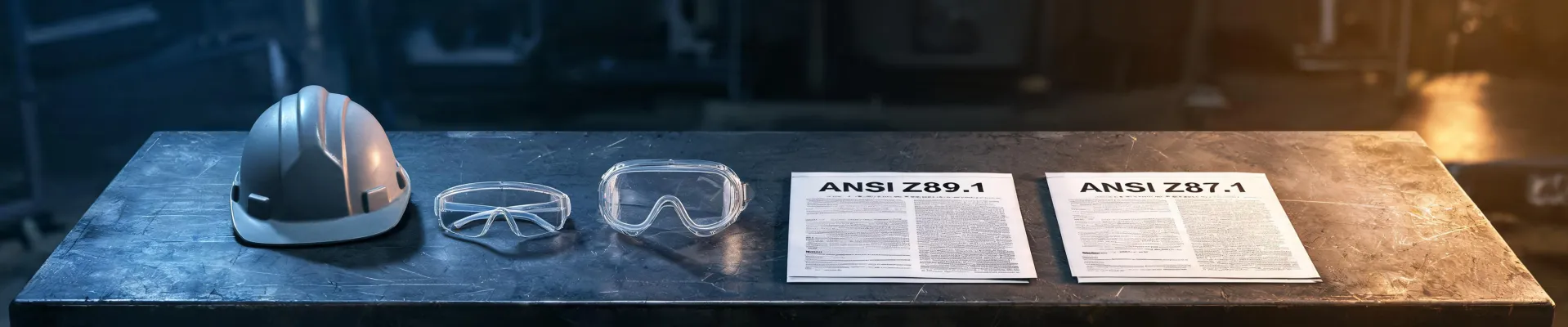
At 7:14 a.m. last March, a maintenance supervisor called me in a panic. A technician had been hit in the face by a fragment from a grinder—and his safety glasses were in the cup holder of his work truck. That's where they'd been sitting for three weeks.
The supervisor wanted 50 new pairs of glasses delivered faster than any distributor had ever managed. But as I was packing the order, I kept coming back to the real question: why did the glasses come off? The answer wasn't laziness. It was fogging.
We Treat PPE Like a Product Problem. It's a Behavior Problem.
It's tempting to think workers don't wear PPE because they're careless, or because the company buys cheap equipment, or because "safety culture" hasn't arrived. Those factors matter. But after years of handling emergency PPE orders and incident response, I can tell you: most PPE failures are caused by a mismatch between the equipment and the task.
People often assume that expensive or well-known gear will automatically be worn. The reality is the opposite—workers reject any gear that interferes with their ability to do the job, no matter how well it's built. The bad outcome isn't caused by a bad product. It's caused by a selection process that ignored the human being wearing the gear.
The Deep Cuts: What's Actually Going On
Let's walk through the protective equipment categories I get asked about most—safety glasses, head protection, hearing protection, and specialty vests—and look at what actually determines whether they get worn.
Safety Glasses: Fog Might Be the Real Safety Hazard
The job is grinding steel. The technician needs protection from flying debris. The safety glasses meet Z87.1, they're impact-rated, they look like proper industrial glasses. (Every safety manager knows this exact scene.) But after 10 minutes of working, they fog up. The worker can't see. He pulls them off to wipe them, gets distracted, doesn't put them back on. That's how fragments reach the eye.
The Pyramex Venture 3 safety glasses are one of the most-requested items in my warehouse for a simple reason: the anti-fog treatment works, and the lens is vented well enough for warm environments. It's not that other brands are bad. It's that the specific problem—fogging—is the reason the safety program was failing. Solve that, and compliance follows.
If your workers don't complain about fogging, you might not need the fancy lens. But I've yet to meet a shop floor where fogging wasn't an issue at least somewhere.
Bump Caps vs. Hard Hats: Know Your Impact Hazard
The most common head protection question I get is: "should we use a bump cap or a hard hat?"
Here's the honest answer: it depends on what kind of impact you're protecting against.
A bump cap protects the wearer from bumping their head into fixed objects—pipes, low beams, machinery frames. It's a worker's best friend in tight areas because it's lightweight and fits close to the head. It will not protect you from falling tools or overhead debris. That's the job of a full hard hat.
Pyramex makes both. The bump cap is a popular choice for maintenance crews, warehouse workers, and anyone working under conveyors. Pyramex hard hats—especially the vented models with cooling liners—get reordered for construction sites and plants where overhead hazards are real. In my experience, workers tolerate a hard hat much better when the helmet is vented and has a liner that doesn't cook their head in summer.
Here's where I went back and forth with a client last year. They had a job site with both low overhead obstructions and suspended loads. They wanted bump caps because the crew kept taking off their hard hats. I pushed back. You need a Type II hard hat if there are falling objects, no matter how hot it gets. So we got them vented hard hats, and we used cooling packs for the worst days. It wasn't the easy answer, but it was the right one.
Hearing Protection: The NRR Number Is Not the Answer
"What should you consider when choosing the type of hearing protection you use?"
This is one of those questions that seems simple until you realize that half the earplugs you hand out are not being worn. The most commonly cited number—the Noise Reduction Rating (NRR)—measures how much noise can be blocked in a lab. It doesn't measure what actually happens on a worker's head.
Well-fitting earplugs deliver, on average, about half of their labeled NRR. And that's if they're inserted correctly. OSHA's practical derating—(NRR - 7) / 2 for many styles—already tells you that the lab number is not the field number.
Comfort matters even more. If the plugs irritate the ear canal, if the muffs clash with the hard hat suspension, or if the wearer can't hear the forklift beep, they'll remove the protection at the worst moment. Over-protection is also a real issue: an NRR 33 plug in a moderate 88 dB workshop can make workers feel isolated from colleagues and safety signals, which leads to riskier behavior.
The right approach: measure actual noise levels, match the protection to the exposure (aim for a protected exposure around 75–80 dB), and let workers try several types. If the earplugs come back at the end of the shift unused, you've made a costly mistake.
What Is a Tactical Vest, Actually?
Every now and then, a safety manager asks me about tactical vests. Let's clear up the confusion.
A tactical vest is not just a military-looking vest with pouches. It's a piece of protective equipment designed for specific security or operations roles. It may carry ballistic panels, stab-resistant inserts, radios, or tools. Its primary job is to distribute that equipment across the torso without restricting movement.
If you're considering a tactical vest, the question is not "what brand should I buy?" The question is "what threat am I facing?" Ballistic vests are rated under the NIJ standards (Level IIA, II, IIIA for handguns; Level III and IV for rifles). Stab-resistant vests are tested differently. A vest with no protective insert is just a load-bearing carrier—useful for carrying gear, but it won't stop a blade or a bullet. And a vest that's too heavy for the task will get taken off and hung on a chair, just like a pair of foggy glasses.
"What is a tactical vest?" is one of the most searched questions in this space for that reason. People want a simple answer, but the real answer is: it's a specialized tool, and it has to be matched to the job like any other PPE.
The Real Price of Getting This Wrong
Let's be blunt about the consequences.
Every time a worker removes their PPE, they're exposed to the exact hazard the company bought it to prevent. A fragment in the eye. A falling tool on the skull. A permanent hearing shift that shows up on an audiogram years later. I've seen the aftermath of all three: the OSHA citations, the insurance premium increases, the lost-time hours, the paperwork, and the guilt of the supervisor who knew the gear wasn't being worn.
The uncomfortable truth is that when an injury happens, the first question everyone asks is "why weren't they wearing their PPE?"—as if that's the end of the investigation. It should be the beginning. Why was the glasses case empty? Because the lens kept fogging. Why was the hard hat in the car? Because it was a sweatbox in a warehouse that hit 33°C. Why were earplugs in the worker's pocket? Because they made him feel like he was working underwater.
These aren't discipline problems. These are clues.
Honest Advice: How to Choose PPE Workers Will Actually Wear
I'm going to give you the same honest caveat I give every client: there is no "best" PPE. There's only PPE that fits the task, the environment, and the person wearing it.
If you're dealing with fogged eyewear, try the Pyramex Venture 3. If you're dealing with heat headaches under hard hats, look at Pyramex's vented hard hats with cooling liners. If you only need protection from low-hanging objects and not falling objects, a bump cap will work—and it's the one workers will keep on their heads. If the hazard is falling objects, no bump cap or vented shell replaces a proper ANSI Z89.1 helmet.
Just remember: workers don't skip gear because they don't care. They skip gear because the gear doesn't work for them in the moment. Once you fix that, you'll stop buying PPE to hang on hooks—and start buying PPE that actually gets worn.

Maeve Callahan
Maeve Callahan is a head-protection analyst covering Type I and Type II hard hats, climbing-style safety helmets, bump caps, chin straps, suspensions, liners, and face-shield carriers. She applies ANSI Z89.1, EN 397, and EN 12492 criteria while comparing impact attenuation, penetration resistance, lateral deformation, electrical class, retention strength, field of vision, mass, fit range, and temperature conditioning. Her guides help EHS teams, contractors, utilities, and buyers select helmet systems for overhead hazards, work at height, electrical exposure, accessory compatibility, and worker acceptance.