When to use this checklist
Use this when you're doing a pre-shift check, before a larger order, or after anything has been dropped or exposed to heat, water, or chemicals. It's not a replacement for manufacturer instructions, but it covers the items that get ignored.
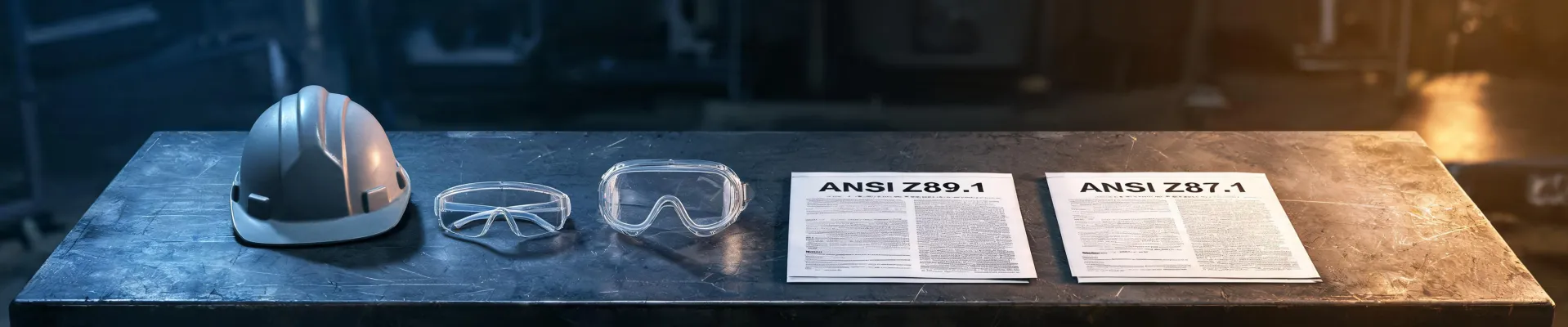
Step 1: Hard hat and Pyramex hard hat accessories
Start with the shell. Look for cracks, gouges, chalky spots, or sun damage. If it's been hit hard, replace it. Even if it looks fine, a shell with impact history should be retired. That's not being dramatic; that's how the standard works.
Then check the suspension. This is the step most people skip. If the suspension is brittle, cracked, or doesn't lock into the shell's slots, the helmet won't stay put when you need it. I learned this in 2020 when I ran a drop test with a fresh suspension vs a two-year-old one. The old one let the shell come off. That changed how I inspect.
Look for the date on the suspension. ANSI Z89.1 leaves the replacement schedule to the manufacturer, but most say every 12 months. In our Q1 2024 audit, 23% of hard hats we collected had a suspension past that point. A hard hat with a dead suspension is basically a hat.
Accessories: Pyramex hard hat accessories include ratchet upgrades, sweatbands, chin straps, cooling liners, and earmuff clips. They're easy to get, but don't assume every accessory fits every shell. The clip or bracket has to line up with the slots. If it presses on the shell in an odd spot, it can make stress marks over time. Use the right parts for vented or solid shells. When I specify for our 50,000-unit annual order, I write the accessory part numbers and the shell model down to the last digit.
Step 2: Eye protection: safety glasses vs goggles
Here's the main difference. Safety glasses give you front impact protection and some side coverage. Goggles create a sealed area around your eyes. That seal is what matters for dust, splash, and chemical spray. If you're grinding or using a chisel, glasses are usually okay. If you're spraying chemicals, cutting concrete, or doing anything with loose dust, goggles are better.
Look for the lens marking. ANSI/ISEA Z87.1 covers eye protection. The '+' means high impact. If I don't see Z87+ on a lens, I won't let it near a grinder. The 'just look for Z87' thinking comes from an era before high impact was a separate rating. That's changed.
Check the lens condition. A scratched lens is not just annoying. It scatters light and makes you squint. If you're tilting your head to see around a scratch, the lens has to be replaced. Anti-fog coatings help, but 'anti-fog' doesn't mean 'never fogs.' Pyramex safety glasses with anti-fog are pretty good, but they still need proper care. Use the microfiber cloth, not your shirt.
One more thing: don't wear safety glasses for welding. That's a different standard. And if you're working with lasers or radiation, that's a whole other world. Know the hazard before you pick the lens.
Step 3: Pyramex work gloves
Look at the palms and fingers. A thin spot or a worn patch is where a tear starts. Turn them inside out if you need to. Check seams, coating condition, and chemical damage. If the glove has a cut-resistant rating and the coating is peeling, the rating doesn't mean much.
Know the rating. ANSI/ISEA 105 grades cut resistance from A1 to A9. General work is often A2 or A3. Glass handling, metal stamping, or anything with sharp edges should be A4 or higher. If you don't know what you need, ask someone. In 2022, I specified an exact cut level for an $18,000 glove order. The vendor almost sent a similar product without the same rating. I caught it. Now every contract includes the standard, not just the word 'cut resistant.'
Pyramex work gloves cover a lot of tasks—foam nitrile for grip, PU coated for dexterity, leather for heat and abrasion. But the right glove depends on the task. A general-purpose glove won't protect you from chemicals or hot surfaces. Use the chart, not the packaging.
Step 4: Hearing protection
Earplugs are small and easy to screw up. Roll foam plugs into a thin crease, pull your ear back, and hold them in until they expand. If you skip that, the NRR drops fast. I've watched people insert foam plugs halfway and think they're protected.
Check the NRR on the package. OSHA's hearing conservation rules kick in around 85 dBA average over 8 hours. A higher NRR gives more protection, but only if the fit is good. Don't push plugs in halfway, and don't reuse disposable plugs that are dirty.
About the 'Loop earplugs coupon code' searches: I get it. Loop makes a nice reusable plug, and everyone wants a discount. But those are aimed at concerts, sleep, and focus, not necessarily industrial noise. For a plant or construction site, use earplugs that clearly show an NRR and are designed for occupational noise. To be fair, Loop has a place. In my experience, that place isn't replacing a foam earplug for an 8-hour shift with a chipping hammer.
Step 5: Footwear and the Nike work boots question
Boots aren't Pyramex's lane. I'm not a footwear expert, and I'm not going to pretend to be one. But I review enough shipments to know this: if you're searching for 'Nike work boots' because you like the brand, don't let that name replace the label. A real safety toe boot should carry an ASTM F2413-18 marking for impact and compression. If it doesn't, it may be a nice boot, but it's not necessarily a protective boot.
Check the soles for separation, worn tread, exposed toe caps, and damage from oil or heat. If the toe cap is showing through, replace. If the sole pattern is smooth, replace. Don't try to save a pair of boots that are falling apart.
I'd rather you buy a boot from a footwear specialist than trust me on sizing. That's outside my lane. But a boot without a rating is just a boot.
Common mistakes I keep seeing
Here are the ones that come up over and over:
- Skipping the suspension check.
- Wearing safety glasses when goggles are needed.
- Assuming 'cut resistant' covers everything.
- Using consumer earplugs for high-noise work.
- Picking boots for the brand name instead of the safety spec.
That last one is maybe the most expensive, because good boots aren't cheap. Neither is hand surgery.
Bottom line
The best PPE is the one with the right standard marking, in good condition, and actually worn. This was accurate as of Q1 2025. Standards change, so verify the current ANSI, ASTM, and OSHA versions before you place an order.
Once, with two hours to decide before a deadline, I approved a rush shipment based on a manufacturer's data sheet instead of waiting for an independent test. The data sheet was wrong, and I had to rework the whole thing. In hindsight, I should have said no to the rush and done my job. The checklist helps. It doesn't replace being careful.

Maeve Callahan
Maeve Callahan is a head-protection analyst covering Type I and Type II hard hats, climbing-style safety helmets, bump caps, chin straps, suspensions, liners, and face-shield carriers. She applies ANSI Z89.1, EN 397, and EN 12492 criteria while comparing impact attenuation, penetration resistance, lateral deformation, electrical class, retention strength, field of vision, mass, fit range, and temperature conditioning. Her guides help EHS teams, contractors, utilities, and buyers select helmet systems for overhead hazards, work at height, electrical exposure, accessory compatibility, and worker acceptance.