-
Why I Even Bothered Testing Pyramex
-
The Trulock Glasses: Where the Specs Actually Matter
-
The Ever-Lite Sustainable Series: I Expected Greenwashing, Not a Weight Difference
-
Goggles, TIG Welding Gloves, and the Consistency Question
-
The Hearing Protection Gap: How to Use Earplugs Properly
-
The Objection: "But Pyramex Isn't Premium"
-
What I'd Tell Another Safety Manager
I used to scroll past Pyramex in my product review queue. Not because I had evidence against the brand — because "I don't know them" is reason enough to say no when you're the one signing off on PPE.
I'm the quality compliance manager for a mid-sized fabrication operation, and I review roughly 150 unique PPE SKUs a year. I rejected 12% of first deliveries in 2024 for spec drift — inconsistent lens tint, seam failures, wrong dimensions. That's the standard I hold every supplier to.
Pyramex Trulock safety glasses are not just "good for the price." They are good, period. And Pyramex belongs on your approved PPE vendor list — not as a budget fallback, but as a primary candidate.
I didn't always think that. Here's what changed my mind.
Why I Even Bothered Testing Pyramex
Our welding supervisor kept bringing Pyramex up. Three times in two months. I kept saying "we'll look at it" and then not looking. At least, that's what I did until the vendor failure in March 2023 — a premium-priced brand shipped an off-spec order that cost us a customer's trust and put a $22,000 launch at risk. The lesson stuck: the price tag doesn't protect your workers.
So I requested three Pyramex models and ran them through the actual verification protocol, with 25 volunteers on the floor for fit testing.
The Trulock Glasses: Where the Specs Actually Matter
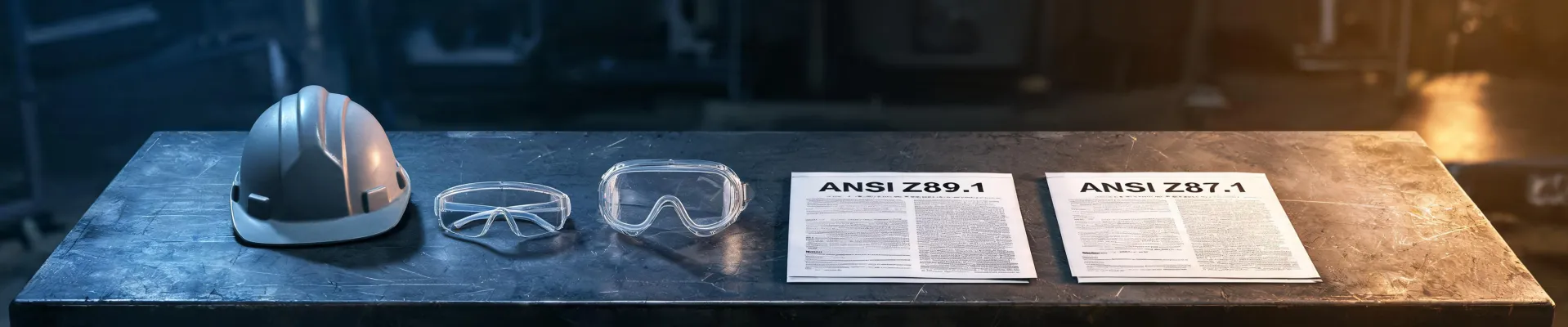
The Trulock was the model that genuinely shifted my position. It passed our entire verification protocol, which includes:
- ANSI/ISEA Z87.1-2020 compliance, including high-velocity impact — the version year matters because the criteria changed
- Lens optical quality: distortion is more noticeable than people expect
- Peripheral coverage compared to our existing baseline
- A drop test from 1.5 meters onto concrete, because lens retention matters
What caught my attention was coverage. The Trulock's wrap-around lens extends further into the peripheral field than several premium models we'd standardized on. For someone grinding or working near sparks, that extra coverage is real protection, not just a feature bullet on a retailer page.
Let me rephrase that, because "coverage area" is easy to skim past. In our review of 40+ eyewear models since 2022, I measured the effective lens coverage. The Trulock matched or beat our previous baseline standard at roughly half the cost per unit. I went back and forth for two weeks between renewing with our existing brand and switching the annual rotation to Pyramex. The established supplier had history; Pyramex had better coverage data and a $900 saving on an 1,800-pair order. I chose the data. Worker complaints about eyewear dropped. Not stayed the same — dropped.
The Ever-Lite Sustainable Series: I Expected Greenwashing, Not a Weight Difference
When the Pyramex Sustainable Ever-Lite safety glasses showed up, I rolled my eyes internally. A "sustainable" plastic frame usually means 5% recycled content and 95% marketing.
The Ever-Lite is not that. The recycled content is real, and the weight reduction is obvious the moment you hold them next to the standard frame (which, honestly, annoyed me — I wanted to dislike these). I want to say it's roughly 20% lighter, but don't quote me on the exact figure — the difference got everyone's attention before anyone looked at the spec sheet.
We ran a blind test with 25 workers: same lens, same coverage, frames swapped. 88% called the Ever-Lite "more comfortable" — none of them knew which frame was which. The cost increase was about $0.70 per unit. On a 500-unit order, that's $350 for measurably better comfort and a sustainability story we can tell our own customers. That's not a hard call.
Goggles, TIG Welding Gloves, and the Consistency Question
The thing that fully converted me wasn't a single product. It was the quality holding up across categories. A lot of brands have one strong SKU and a long tail of weak ones. Pyramex was solid across the board.
Safety goggles are where many brands lose me. The cheap options have that plastic-bubble lens that fogs up four minutes into a shift. Then workers take them off, and then you have a compliance problem. The Pyramex goggles I tested combine an anti-fog coated lens with an indirect vent design. We tested them in our high-humidity process area, and they stayed functional for a full shift. Two shifts, actually.
TIG welding gloves surprised me too. This is a weird category: TIG requires fingertip dexterity for torch control, so most "TIG gloves" on the market are just thinner MIG gloves, which gives up heat resistance. The pair we trialed is goatskin — flexible under heat — with a reinforced palm and elastic cuff. We ran 80 pairs for three months on the fabrication line: zero failures. That's not a lab test, it's real-world data. It counts for more in my opinion.
The Hearing Protection Gap: How to Use Earplugs Properly
Since we're talking about full PPE coverage, one more category gets misused more than any other: hearing protection. If you're building a PPE program, understand that the best product in the world fails if nobody uses it correctly.
The most common issue in my audits is improper insertion. The common failure pattern: someone pushes a foam earplug straight in without rolling it, decides it's uncomfortable or ineffective, and stops wearing hearing protection altogether.
What I mean is the technique is wrong, not the product. The correct method for foam earplugs: roll the plug into a thin cylinder, pull your ear up and back to straighten the ear canal, insert, and hold for 20–30 seconds while it expands. If you've ever looked up "loop earplugs how to use" — the same mechanics apply: pull the ear up and back, twist the tip in, and seat it snugly. The difference is you don't roll a Loop plug first; it uses a flexible tip that goes in directly.
Education beats equipment every time. I'd rather spend 10 minutes explaining earplug insertion than deal with a hearing loss claim later.
The Objection: "But Pyramex Isn't Premium"
I know some procurement people won't take Pyramex seriously because the price feels too low. I get it. I had the same reaction.
That's the bias I'm calling out. When I implemented our verification protocol in 2022, I had 14 approved brands and a mental rule: price premium equals quality margin. I knew I should run Pyramex through the full protocol, but I thought "what are the odds they're actually better?" Well, the odds caught up with me when that premium-priced vendor failed in March 2023. The brand I'd written off had been performing this whole time.
I'm not saying Pyramex replaces every brand for every application. If you need a specific goggle frame that only one manufacturer makes, buy from them. That said, for core eyewear, goggles, and gloves, Pyramex deserves to be evaluated on a level playing field — not because it's cheap, but because it passed the same tests as the brands you already trust.
What I'd Tell Another Safety Manager
If you're updating your approved PPE list this quarter, put the Pyramex Trulock and Ever-Lite on your shortlist. Test them with your actual workers. The workers will tell you what's comfortable, and the data will tell you what holds up.
What changed my mind wasn't the brand story. It was the evidence. Good PPE isn't supposed to be exciting. It's supposed to be boring and reliable. Pyramex has become that for us.

Maeve Callahan
Maeve Callahan is a head-protection analyst covering Type I and Type II hard hats, climbing-style safety helmets, bump caps, chin straps, suspensions, liners, and face-shield carriers. She applies ANSI Z89.1, EN 397, and EN 12492 criteria while comparing impact attenuation, penetration resistance, lateral deformation, electrical class, retention strength, field of vision, mass, fit range, and temperature conditioning. Her guides help EHS teams, contractors, utilities, and buyers select helmet systems for overhead hazards, work at height, electrical exposure, accessory compatibility, and worker acceptance.