It was a Tuesday in March 2023 when our warehouse supervisor walked into my office holding a pair of safety glasses that looked like they'd survived a demolition project. One arm was held on with electrical tape. The lens was scratched enough that I could barely see through it.
We need new ones, he said. All of them.
I was the office administrator for a 150-person industrial distribution company with three locations. I managed all PPE ordering—roughly $60,000 a year across six vendors. I reported to both operations and finance, which meant I got pulled between making things cheap and making things safe. That tape-covered pair of glasses started a six-month project that changed how we bought everything.
The Problem With Just Reordering
When I took over purchasing in 2022, I used the same safety supply distributor the previous guy had used. The orders went through, and the invoices were clean. Not great, not terrible. Serviceable.
But over the winter, complaints started stacking up:
- Workers who wear prescription glasses said the safety glasses fogged and slid off.
- The warehouse crew said the hard hats were heavy and the ratchet mechanism stripped after a few months.
- A few people in shipping complained about itchy hands after wearing the standard gray gloves.
- Someone from maintenance typed 'ppe diesel' into our internal safety request log—meaning gloves that don't dissolve when handling diesel fuel.
To be fair, our old supplier wasn't bad. They just weren't solving the right problem. They gave us a catalog and a price list. I needed someone who thought about whether a 45-year-old guy wearing bifocals would keep his eye protection on past lunch.
What OTG Actually Means
I started where most of our team started: a Google search for Pyramex OTG safety glasses.
OTG stands for over-the-glass. The lenses have enough room inside to fit over prescription frames without pressure points. I didn't know this at the time, and neither did the workers who kept borrowing our old pair.
The most obvious issue was fogging. Our warehouse isn't temperature controlled, so workers go from a hot trailer to a cold dock and instantly can't see. One guy said, 'I don't need anti-fog. I need anti-fog-then-go-back-out-again.' I get why people think anti-fog is a gimmick—it can be on cheap lenses. But there's a real difference with a quality lens coating.
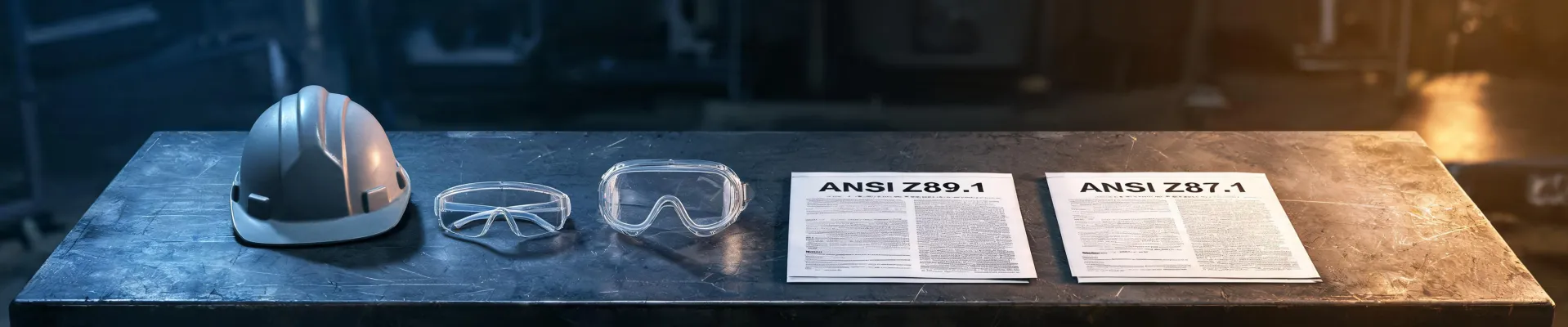
What I learned is that not all eye protection is created equal, even if everything has Z87 stamped on the arm. The version we buy now is ANSI/ISEA Z87.1-2020 (verify current requirements before ordering). The plus sign—Z87+—means the lens survived high-impact testing. For our environment, I only buy Z87+. Not every job needs it, but I'd rather not have to sort that out after an incident.
Pyramex OTG safety glasses have been surprisingly popular with our crew. Not just because they fit over prescription frames, but because the temples don't pinch and the anti-fog coating actually holds up for a full shift. I can't say they never fog—that would be a lie—but the complaints dropped dramatically.
From Hard Hats to Safety Helmets
The next issue was head protection. Our guys wore traditional cap-style hard hats. They worked, but the suspension wore out, and some workers in tight spaces kept hitting the brim against low beams. We also had confusion over bump caps versus actual hard hats, which is exactly the kind of mix-up that saves money right up until it doesn't.
I looked at Pyramex safety helmet options because they offered models with venting and a ratchet suspension. Some of their helmets carry a Type 2 (ANSI Z89.1 Type II) rating, which means protection against lateral impacts, not just top impacts. For workers moving around steel racks and forklift masts, that made sense.
This is where my finance brain and my safety brain started arguing. The Type 2 helmets cost more than the basic hard hats we used before. But the unit price difference was only a few dollars. And when a guy wears a helmet because it's comfortable, that isn't a cost—it's a discount on future injuries.
The Nitrile Glove Question
Every few months, someone asks me: is nitrile gloves latex free?
Yes. Nitrile is a synthetic rubber, and it doesn't contain the natural latex proteins that cause allergic reactions. But that's not the whole story.
We had employees who thought all nitrile gloves were the same because they all passed the same basic tests. In reality, thickness, tensile strength, and chemical resistance vary a lot. A 4-mil exam glove is not the same as a heavy industrial glove for diesel fuel handling. That 'ppe diesel' request from maintenance eventually led us to a separate nitrile glove with better chemical splash resistance and a thicker coating. Same base material, different purpose.
Also—and this surprised me—nitrile gloves can still cause skin irritation for some people. It's usually caused by chemical accelerators in the gloves, not by latex. So latex free doesn't automatically mean hypoallergenic. Nobody told me that until we started paying attention.
The Loop Earplugs Side Quest
Somewhere in the middle of all this, our safety coordinator asked if I could find a Loop earplugs promo code.
I had to explain the difference. Loop earplugs are fine for concerts, studying, or noise sensitivity. For a workplace hearing protection program, we need earplugs with a noise reduction rating (NRR) that matches the exposure, and ideally something the safety program can distribute and train people on. A promo code isn't a compliance strategy.
I'm not saying consumer earplugs are worthless. I use foam earplugs for mowing, and I know comfort matters. But for our warehouse, we need compliance documentation, not a discount.
What Actually Changed
In June 2023, I placed a trial order: Pyramex OTG safety glasses for 35 people across three shifts, Type 2 vented helmets for the warehouse crew, a few sizes of nitrile gloves, and a handful of hi-vis vests.
Then I waited. The real test was whether anyone would complain.
They didn't. Not a single these-are-garbage email. That has never happened with a PPE order.
By the fourth quarter, I moved the bulk of our eye and head protection to Pyramex. We still buy other brands for specialty items like fall protection, welding gear, and chemical suits. But everyday glasses, helmets, bump caps, and gloves? Pyramex is on the approved vendor list, and getting onto that list was harder than getting approved by finance.
What I Would Do Differently
The biggest mistake I made was assuming safety glasses were a commodity. It's tempting to think you can compare prices and pick the cheapest pair carrying the same standard. But the standard is a floor, not a ceiling. Fit, fog resistance, comfort, and venting are what determine whether someone actually wears the gear.
The other lesson is total cost. The lowest quote looked great on the spreadsheet. But when workers swap out gear early because it's uncomfortable, or when the company pays for expedited shipping because the first pair failed, the cheap option stops being cheap. Under OSHA's PPE standard (29 CFR 1910.132), employers also have to select PPE that fits and is appropriate for the hazard. Handing someone the cheapest available option doesn't always satisfy that.
If you're evaluating Pyramex, don't judge it by the spec sheet alone. Order a small batch and give it to your most skeptical worker. If they come back with a complaint, listen. If they don't, you're probably onto something.
Honest Bottom Line
I'm not going to tell you Pyramex is the safest PPE on the market. 'Safest' is a meaningless word in this industry—everyone has a version of a standard on their label. What I can tell you is that Pyramex works well for our kind of company: medium-sized, mixed climate, no-nonsense workers who want equipment that doesn't get in the way.
There's something satisfying about ordering gear you know will actually get worn. After a year of chasing fogged lenses and stripped ratchet straps, I'll take that. This time, I'd call it exactly what we needed.

Maeve Callahan
Maeve Callahan is a head-protection analyst covering Type I and Type II hard hats, climbing-style safety helmets, bump caps, chin straps, suspensions, liners, and face-shield carriers. She applies ANSI Z89.1, EN 397, and EN 12492 criteria while comparing impact attenuation, penetration resistance, lateral deformation, electrical class, retention strength, field of vision, mass, fit range, and temperature conditioning. Her guides help EHS teams, contractors, utilities, and buyers select helmet systems for overhead hazards, work at height, electrical exposure, accessory compatibility, and worker acceptance.