-
Is the Pyramex SL T2 Safety Helmet Worth the Upgrade?
-
Full Brim Hard Hat or Cap Style — Which Should You Get?
-
Are Pyramex Intruder Safety Glasses Actually Good, or Just Budget?
-
Klein Hard Hat vs Pyramex — How Do They Compare?
-
Latex vs Nitrile Gloves — What's the Real Difference?
-
Can I Place a Small Order or Test Samples First?
-
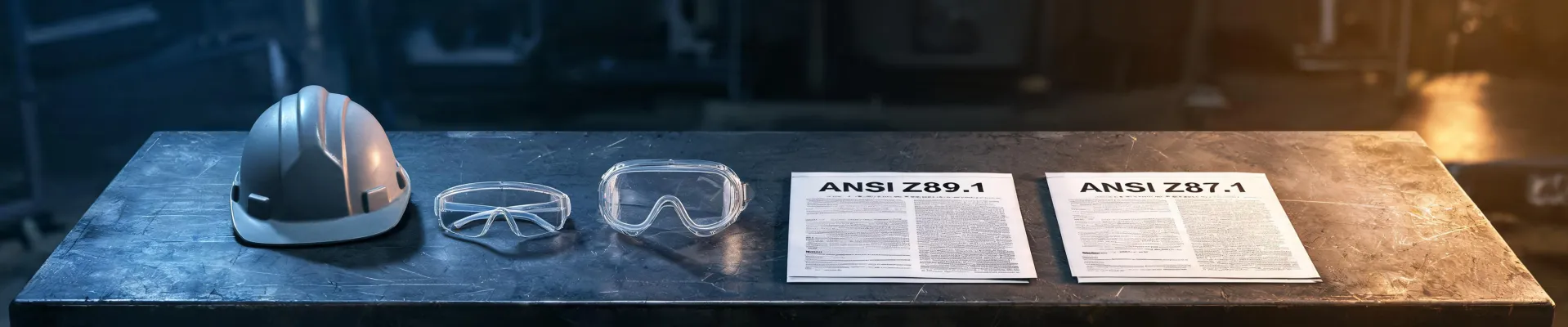
What Safety Standards Should I Check Before Buying?
Every week I get calls from safety managers who need PPE — and usually need it fast. I'm the person at Pyramex who coordinates expedited orders. When a distributor calls at 3 PM on a Friday asking for 120 hard hats to be on site by Monday morning, I'm the one who figures out if it's possible. I've handled more than 400 rush orders in the last four years, and most of those calls have one thing in common: the person on the other end asks the same questions.
Here are the ones that come up most — whether it's a first-time buyer or a safety manager who's been doing this for fifteen years.
Is the Pyramex SL T2 Safety Helmet Worth the Upgrade?
The SL T2 is the helmet I recommend when a client needs Type 2 protection. And to understand why, you need to know the difference between Type 1 and Type 2.
ANSI/ISEA Z89.1 sets the baseline for industrial head protection. Type 1 helmets protect against impacts to the top of the head. Type 2 adds protection against lateral impacts — from the sides, front, and back. That's a bigger deal than most people realize. A lot of head injuries on worksites come from swinging loads, moving equipment, or falling sideways into fixed objects. Not just from things dropping from above.
The SL T2 also has two features I care about more than the marketing copy: an 8-point suspension and a cooling liner. The suspension spreads impact forces across a wider area, which means less pressure on any single point. For a worker wearing a helmet eight hours a day, that translates into fewer headaches and less neck fatigue.
The cooling liner sounds like a gimmick until you've had a crew working outside in July. It creates airflow between the liner and the shell. And workers who are comfortable in their helmets are workers who actually wear them.
Is it worth the upgrade? If your risk assessment says Type 2, absolutely. If you're doing overhead protection only, a good Type 1 helmet might be all you need. Start with the standard. Then look at comfort features.
Full Brim Hard Hat or Cap Style — Which Should You Get?
This one is easier. It depends on where the work happens.
Full brim hard hats have the brim all the way around. They're the better choice outdoors because rain runs off the brim instead of down the back of your neck, and the shade keeps the sun off your face. That's the main difference, honestly. Simple.
Cap style sits lower profile and lighter. It gets into tight spaces — under machine guards, inside tanks, in crawl spaces — and it pairs more easily with welding hoods and ear muffs.
We make both at Pyramex, so I genuinely don't have a reason to push one over the other. Well, that's not entirely true. I'll steer outdoor crews toward full brim and confined-space crews toward cap style. The full brim also plays nicely with a rain jacket hood, which is one of those small details that matters on a long shift.
Are Pyramex Intruder Safety Glasses Actually Good, or Just Budget?
I get this question because a lot of budget safety glasses have earned their bad reputation. Let me give you an honest answer.
From the outside, the Intruder looks like a utility-priced pair of glasses. The reality is the lens and coating work are better than what most people expect at that price point. The Intruder uses polycarbonate lenses and is rated ANSI Z87.1+. That "+" means it passed the high-impact test, not just the basic one. I've seen what happens when a lens fails on impact. Take the "+" seriously.
The anti-fog coating is the other thing. And I want to be clear: "anti-fog" doesn't mean "never fogs." No coating does that. What it means is the coating holds up much longer than the cheap treatments that degrade after a few washes. For someone moving between a warm break room and a cold work area, that's the difference between wearing the glasses and leaving them in the truck.
The lens shape also minimizes the blind spot at the bottom edge. That sounds like a spec-sheet detail, but I've had workers comment on it without being prompted. For eye protection, the best product is the one your crew actually keeps on their face.
Klein Hard Hat vs Pyramex — How Do They Compare?
This one comes up because Klein has a solid reputation. And I'm not going to tell you they make bad helmets. They don't.
If your team is already wearing Klein and it fits your budget and risk profile, you don't need me to convince you to switch. Buy what works.
Where Pyramex deserves a place on your shortlist is in the Type 2 category. The SL T2 offers Type 2 protection, an 8-point suspension, and the cooling liner without jumping into the premium price tier that other Type 2 helmets occupy. When you're equipping a crew of 50 or 100, that cost difference adds up fast.
After years of watching purchasing decisions, here's what I believe: the best hard hat is the one that fits your specific risks and your workers will actually wear. Standards first. Comfort second. Brand third.
Latex vs Nitrile Gloves — What's the Real Difference?
The short version: latex is stretchier and has better tactile feedback for delicate work. Nitrile has better chemical and puncture resistance, and none of the allergy problems.
The allergy issue is the big one. Latex contains proteins that can trigger a Type I allergic reaction — the serious kind, not just skin irritation. OSHA has published specific guidance on natural rubber latex in the workplace. If any of your workers have had a reaction, latex should be off the table completely.
Nitrile used to get criticized for being stiff and uncomfortable. That gap has closed significantly. Not completely, but significantly. Modern nitrile disposables are thin enough for fine assembly work, and they hold up against oils, fuels, and solvents that break down latex.
If fingertip sensitivity is the absolute priority — think delicate lab work or small parts assembly — latex still has a place. But for general industrial use, nitrile answers more hazards more consistently. And the price difference has shrunk to the point where it's rarely the deciding factor anymore.
Can I Place a Small Order or Test Samples First?
Yes. Short answer: yes.
I've never understood the attitude that treats a small order as a waste of time. A two-box sample order is how a company-wide rollout starts. I've watched it happen more times than I can count. Small doesn't mean unimportant. It means potential.
With Pyramex, you don't need a huge purchase order to evaluate a product. Our distributor network sells single pieces and single boxes. A safety manager can order ten hard hats, get them in front of a crew for a week, and collect honest feedback before committing to a full rollout. That's the right way to buy PPE — test small, listen to the workers, then scale.
I remember a client who thought they were being smart by saving $3 per helmet on a no-name import. The crew rejected them on day one. Uncomfortable suspension, flimsy chin straps, and honestly, they looked like toys. The client ended up paying for rush shipping on the real order to get it in before an audit. Three dollars per helmet. And the "savings" ended up costing them.
That's the thing about PPE: it only works if workers wear it. And workers have opinions.
What Safety Standards Should I Check Before Buying?
If you're new to buying safety equipment, this is the question to start with. Here's the baseline I give every client:
- Hard hats: ANSI/ISEA Z89.1. Know whether you need Type 1 or Type 2 before you compare brands.
- Safety glasses: ANSI Z87.1. And look for the "+" if you have impact risks.
- Gloves: ANSI/ISEA 105 for cut resistance — if I remember correctly, the A1–A9 scale came in with the 2016 revision. For chemical resistance, the glove material has to match the specific chemicals on your SDS. Don't guess.
Check the label. That's it. If a product doesn't clearly state which standard it meets, don't buy it on a promise. The standard is the legal floor under OSHA's PPE requirements. If you can't show that your equipment meets it, that's a compliance problem waiting for an inspection.
These are the questions I answer every week, usually with a deadline attached. Whether you're equipping a crew of five or five hundred, start with the standard, then the comfort, and the brand will take care of itself.

Maeve Callahan
Maeve Callahan is a head-protection analyst covering Type I and Type II hard hats, climbing-style safety helmets, bump caps, chin straps, suspensions, liners, and face-shield carriers. She applies ANSI Z89.1, EN 397, and EN 12492 criteria while comparing impact attenuation, penetration resistance, lateral deformation, electrical class, retention strength, field of vision, mass, fit range, and temperature conditioning. Her guides help EHS teams, contractors, utilities, and buyers select helmet systems for overhead hazards, work at height, electrical exposure, accessory compatibility, and worker acceptance.