The Order That Looked Fine on Paper
In 2019, I approved a $3,200 PPE restock that looked like a textbook order. Every item had a certification. Every box arrived on time. And most of it ended up as shelf clutter.
That was the year I learned what "net PPE" actually means.
I've been handling PPE orders for manufacturing and construction crews for nearly eight years. I've personally made—and documented—11 significant mistakes, totaling roughly $17,000 in wasted budget. Now I maintain the checklist we use to stop other people from repeating those mistakes.
The surface problem usually sounds like a price problem: "Why are these safety glasses so expensive?" or "This face shield costs twice what the other one does." But price isn't the real issue. The real issue is the gap between the PPE you ordered and the PPE your crew actually ends up wearing.
Deep Cause #1: Compliant Doesn't Mean Compatible
Here's a sentence that got me in trouble: "It's certified, so it'll be fine."
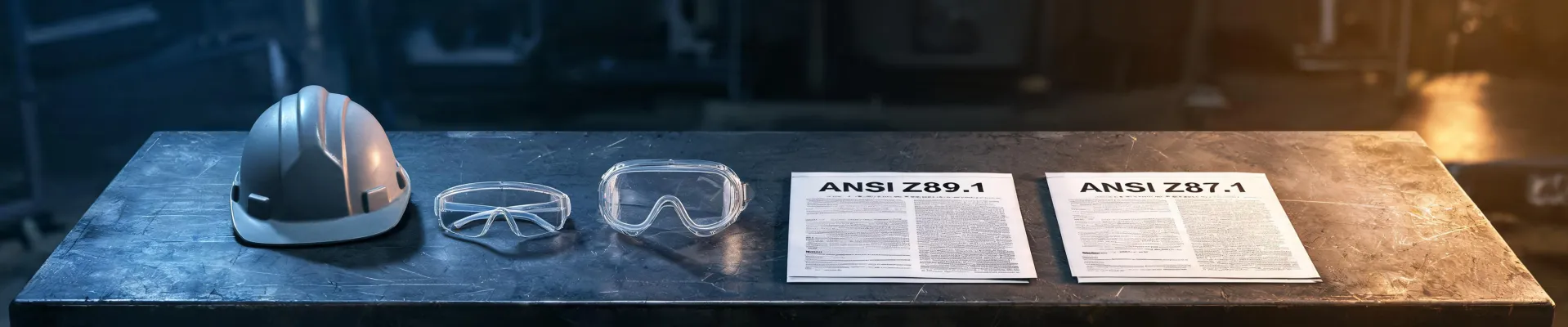
Certification—like ANSI Z87.1 for eye and face protection—tells you the lens passed an impact test. It doesn't tell you it will work with everything else you've already issued. Take a Pyramex face shield, for example. It's a solid product—lightweight, clear visor, decent price. But whether it's actually useful depends on whether it mounts to your hard hat, how it interacts with your hearing protection, and whether it stays in place while someone is bent over in a trench.
I once ordered 50 Pyramex face shields and assumed they'd fit the hard hats we issued. Half of them did. The other half didn't. Same bracket? No. I didn't verify the attachment style across two different hard hat models. The crew discovered this in about four minutes on the morning of the job.
Worse than the wasted money was the message it sent. "Here's your new face shield." "It doesn't fit." "We'll get you another." Not ideal. It undermines confidence in the whole safety program.
Deep Cause #2: Fit Ain't a Size Chart
The second gap is fit, and this is where I had to admit I'm not a biomechanics expert. I can't speak to all the anthropometric data. What I can tell you from a procurement perspective is this: you cannot order your way around geometry.
When I first ordered leather gloves for women on a crew, I filtered by "leather gloves women" and picked a smaller men's glove. That's the classic mistake. A smaller men's glove has shorter fingers and a wider palm. It doesn't match the shape of many women's hands. The women wearing them had to keep pulling them off to do anything that required precision, which defeated the point of wearing gloves.
Same thing with boots. Keen work boots are a good example, and not because there's anything wrong with them—they're a popular brand on our crews and the toe protection holds up. But a woman who wears a size 7 street shoe doesn't necessarily need a size 7 men's boot. She needs a boot built on a women's last. I learned this after a worker told me her feet were aching by mid-morning. The boot was technically the right length. It wasn't the right boot.
OSHA's PPE standard (29 CFR 1910.132(d)) requires employers to select PPE that properly fits each employee. That's not a bureaucratic decoration. Most people think "properly fits" means "not falling off." It also means "won't be ditched in a tool bag after lunch."
Deep Cause #3: What Is Net PPE, Really?
Okay, let's answer the phrase directly. What is net PPE?
If you're in finance, "net PPE" is property, plant, and equipment, net of accumulated depreciation. I'm not an accountant, so I can't help you with the depreciation schedules. But in the safety world, "net PPE" should mean something else: the amount of protection that's actually left after you subtract everything that keeps people from wearing the gear.
Three things: fit. Compatibility. Adoption. In that order.
Gross PPE is what shows up on the purchase order. Net PPE is what's still being worn correctly at 3 p.m. on a Tuesday. The difference is sometimes scary.
Net PPE = Ordered PPE - gear that doesn't fit - gear that doesn't work with other gear - gear that's uncomfortable enough to get abandoned.
Take safety glasses as an example. Pyramex over the glasses safety glasses are a practical option if you're trying to avoid a separate prescription insert. They're designed to fit over a regular frame. But "over the glasses" doesn't automatically mean they'll fit over every pair of glasses. Wide temples, thick frames, low nose pads—all of that changes the contact points. I tried a pair once and it clamped my reading glasses so hard the lens popped out. That wasn't the product failing. It was me assuming "one size fits most" meant "one size fits this guy."
This is the confusion behind "what is net PPE" searches. People buy PPE by the model number and end up with a drawer full of expensive almost-right gear.
The Cost of a Negative Net PPE Number
Here's where it stops being theoretical.
In 2022, I approved an order for 150 pairs of over-the-glasses style safety glasses. One model, one size. It checked all the boxes on paper. We didn't check whether the temple width matched the variety of frames on the crew. When the order arrived, about 22 pairs didn't fit. The restocking fee, the return shipping, and the rush order for replacements cost $890 and a week of delay.
The price quote I keep referencing has changed since then, so don't quote me on exact market rates. The lesson hasn't changed.
But the bigger cost wasn't the invoice. The bigger cost is the worker who wears a face shield that keeps sliding down and just takes it off for "one quick cut." The bigger cost is the worker who chooses a worn-out pair of glasses over the new ones because the new ones pinch. That's when a compliant program becomes a liability.
Why I Decided to Stop Ordering Like a Mailroom Clerk
I went back and forth on how to fix this for a long time. On paper, the efficient thing was to standardize on one brand and one model and buy in bulk. My gut kept saying we'd lose the fit battle. My gut was right—more often than not.
Our fix wasn't a fancy software subscription. It's a checklist that takes about 30 minutes before a purchase order goes out. It didn't make procurement more complicated. It made it more efficient, because we stopped buying the same replacements twice.
Before any PPE order, we now answer five questions:
- Will this actually pair with our existing hard hats, respirators, and face protection? (Physical samples beat datasheets.)
- Do we have sizes and models that fit the actual body shapes on this crew—including women's-specific styles, not just smaller versions of men's?
- Can the pickiest person on the crew wear it for a full shift without complaining?
- What's the net usage rate after week two?
- Does everyone know why they're wearing it, or did it just show up in a box?
The checklist has caught 47 potential errors in the past 18 months. Some were compatibility issues. Some were size issues. A few were me about to order the same "leather gloves women" mistake again.
I still buy Pyramex and Keen and other brands that make sense for the job. The technology in modern PPE is genuinely good. But the most efficient process in the world won't protect anyone if the gear doesn't make it onto the worker's body.
What I'd Tell a New Buyer
My experience is based on roughly 200 orders in manufacturing, construction, and warehouse environments. If you're in a lab or a food facility, your gaps will be different. The underlying question is the same.
Don't ask "What's the price?" Ask "What's the net PPE?"
That's the real answer to what is net PPE: it's the protection you can count on after real life gets done with it. Not the number on the purchase order. The number that's left when someone still has the gear on, correctly, at the end of the shift.
If you don't know that number, you're probably overpaying for protection you're not getting.

Maeve Callahan
Maeve Callahan is a head-protection analyst covering Type I and Type II hard hats, climbing-style safety helmets, bump caps, chin straps, suspensions, liners, and face-shield carriers. She applies ANSI Z89.1, EN 397, and EN 12492 criteria while comparing impact attenuation, penetration resistance, lateral deformation, electrical class, retention strength, field of vision, mass, fit range, and temperature conditioning. Her guides help EHS teams, contractors, utilities, and buyers select helmet systems for overhead hazards, work at height, electrical exposure, accessory compatibility, and worker acceptance.