-
Questions I get every month
-
Are Pyramex Z87 safety glasses actually good?
-
Can I wear a Pyramex face shield over safety glasses?
-
Hard hat color meaning: is there a universal standard?
-
How much should I spend on welding gloves?
-
Latex vs nitrile gloves: which is cheaper in the long run?
-
What cost do people forget when comparing PPE prices?
I buy PPE for a 90-person metal fabrication and assembly shop. I manage a safety budget of about $30,000 a year, I've negotiated with 15-plus vendors, and I've documented every order in our cost tracking system for six years. Most people assume I buy whatever is cheapest. I don't. I calculate cost per use, not cost per box.
Here are the PPE questions I get asked most, answered the way I'd answer a coworker.
Questions I get every month
- Are Pyramex Z87 safety glasses actually good?
- Can I wear a Pyramex face shield over safety glasses?
- Hard hat color meaning: is there a universal standard?
- How much should I spend on welding gloves?
- Latex vs nitrile gloves: which is cheaper in the long run?
- What cost do people forget when comparing PPE prices?
Are Pyramex Z87 safety glasses actually good?
'Good' is relative. The real question is whether your people will wear them. I've had workers ignore $8 glasses and wear $3 ones all day. What I look for is the Z87+ mark on the lens, an anti-fog coating, and a temple shape that doesn't fight with hearing protection. Pyramex puts Z87 on a lot of models, and I've had zero lenses shatter in our shop. That's not a scientific sample, but six years of data is enough for me.
The coating is where models differ. I don't have hard data on how long the anti-fog treatment lasts on every Pyramex lens, but based on our orders, the anti-fog models hold up longer than the non-coated ones. If I could buy only one model, it would be a vented, clear-lens Pyramex with a foam brow pad. Fog complaints drop, and people stop resting them on top of their head. That's worth more than saving $2 per pair.
One more thing: Per FTC guidelines, a claim like 'meets Z87' has to be backed up. But I still check the lens marking on every case we open. People make mistakes, and I've caught a mislabeled box before.
Can I wear a Pyramex face shield over safety glasses?
Depends on the headgear and the size of your glasses. A face shield protects your face from splashes, sparks, and chips, but it doesn't seal around your eyes. So no, I don't let anyone use a face shield alone when there's a splash or impact risk. It's 'over glasses,' not 'instead of glasses'.
A Pyramex face shield with ratchet headgear usually has room for Z87 glasses underneath. But 'usually' isn't a spec. When I rolled out our first face shields, a guy with thick prescription frames couldn't get the brow guard to sit flat. Looking back, I should have ordered a wider headgear option before committing to a full case. We fixed it, but the extra shipping cost was my fault, not the equipment's.
If you're buying face shields for a crew, buy one sample, test it with your actual eyewear, and then order the rest. That's a cheap insurance policy.
Hard hat color meaning: is there a universal standard?
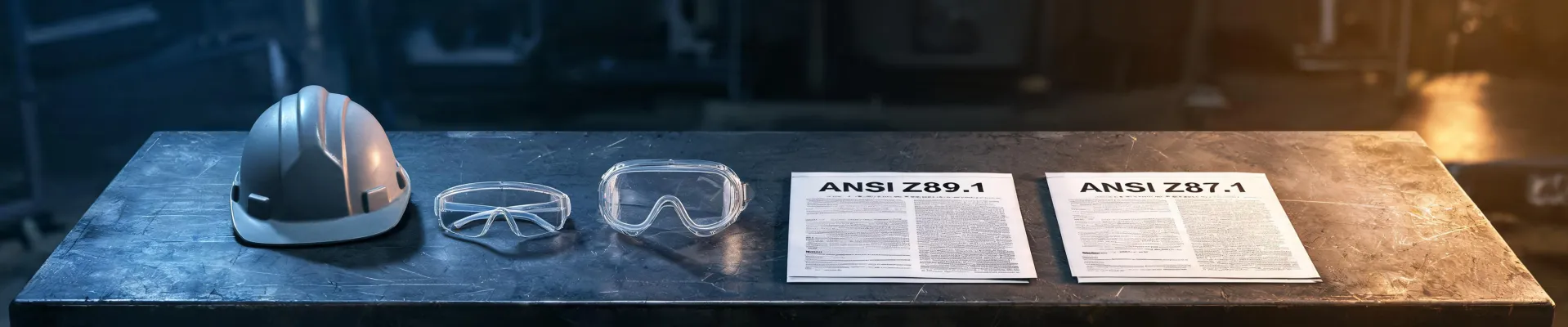
Short answer: whatever your site says. There is no national hard hat color law. OSHA requires hard hats that meet ANSI Z89.1, and that standard covers impact, penetration, and electrical resistance—not color. Colors are a site communication system, not a universal code.
Common conventions I've seen:
- White: supervisors, managers, engineers
- Yellow: general labor and earth-moving operators
- Blue: electricians, carpenters, some technical trades
- Green: safety officers, sometimes new workers
- Orange: road crews or visitors
- Red: fire safety or emergency response
But I've also seen sites swap blue and green. If you're ordering Pyramex hard hats, choose colors to match your internal chart. And if heat is the bigger complaint, seriously, pay attention to Type 2 vented hats before color. Color helps people find the right person; a vented shell helps that person get through the afternoon.
How much should I spend on welding gloves?
More than the cheapest pair, less than the most expensive. That sounds like a non-answer, but I've made both mistakes.
Once I bought a bulk box of thin leather gloves because the per-pair price was unbeatable. The first overhead weld shredded a thumb. The 'cheap' option resulted in a $1,200 redo when quality failed. It wasn't the glove's fault alone, but my cost-per-use calculation didn't look so smart on the job report.
For light MIG and torch work, a medium-weight split cowhide glove with a reinforced thumb is usually enough. For heavy stick welding, spend more on thicker leather, longer cuffs, and no exposed interior seams. There's no universal test that tells you exactly when a glove should be retired. If leather is stiff, cracked, or heat comes through, replace it.
Pyramex's glove line includes leather work gloves that handle a lot of light and medium duty work. For production stick welding, I'd still budget for a dedicated welding gauntlet and treat it as a separate line item.
Latex vs nitrile gloves: which is cheaper in the long run?
Nitrile, for us. Latex boxes are usually cheaper, but nitrile wins on total cost because we don't burn through as many.
Latex has weak chemical resistance to a lot of oils and solvents, and it triggers contact allergies in a decent number of employees. When people get itchy, they change gloves more often, and that's waste you don't see on the unit price. Nitrile costs more per box but resists oil, punctures, and most chemicals better.
For jobs that are only about keeping hands clean, latex can be fine. But once you add oils or solvents, it's false economy. I wish I had tracked skin complaints more carefully in the first two years. What I can say anecdotally is that switching to nitrile cut glove-related complaints by a noticeable margin.
If you're ordering Pyramex nitrile, the 6-mil version is a good middle ground. 4-mil is too thin for metal shop work; 8-mil starts to feel clumsy.
What cost do people forget when comparing PPE prices?
I've learned to ask 'what's NOT included' before I ask 'what's the price.' A quote for $3.20 per pair of safety glasses can become $3.85 after shipping, handling, and a minimum order premium. One vendor quoted us a lower unit price, then added a $75 pallet handling fee. That difference was 18% hidden in fine print.
Transparent pricing matters. The vendor who lists all fees upfront—even if the total looks higher—usually costs less in the end. I'd rather see a total on page one than get a surprise charge on an invoice.
I also had two hours once to approve a rush order before a plant shutdown. Normally I'd get three quotes, but there was no time. I went with the vendor whose quote had line-item shipping and no 'miscellaneous'. That was the safest call I could make under pressure.
So when you compare PPE pricing, compare the full landed cost. Unit price is the starting line, not the finish line.

Maeve Callahan
Maeve Callahan is a head-protection analyst covering Type I and Type II hard hats, climbing-style safety helmets, bump caps, chin straps, suspensions, liners, and face-shield carriers. She applies ANSI Z89.1, EN 397, and EN 12492 criteria while comparing impact attenuation, penetration resistance, lateral deformation, electrical class, retention strength, field of vision, mass, fit range, and temperature conditioning. Her guides help EHS teams, contractors, utilities, and buyers select helmet systems for overhead hazards, work at height, electrical exposure, accessory compatibility, and worker acceptance.