How a Vented Helmet Forced Me to Redo My Whole PPE Budget
In February 2024, I was sitting in a windowless conference room with a spreadsheet open, trying to decide what 142 shop floor employees would wear for the next two years. I manage procurement for a metal fabrication company. For four years I have tracked every order we place, and over that stretch we have spent roughly $180,000 on personal protective equipment.
The trigger was simple. Our incumbent supplier wanted a 9% price increase on the next contract. So I did what any cost controller should do: I sent the same product list to four distributors and asked for quotes. The low quote came in 11% below what we were currently paying. It looked like a win.
I almost signed it in the first week. Then I remembered last year’s “free setup” that ended up costing us $450 in hidden fees. That memory is why I built a total-cost-of-ownership spreadsheet in the first place. The question wasn’t which vendor had the cheapest sticker price. The question was which vendor gets the same safety outcome for less when you count the entire cost of owning that gear.
The Quote That Looked Too Good
The cheap quote wasn’t exactly fake. It was just built on assumptions that didn’t match our ordering patterns. The unit price was real—but the shipping line was quoted as “estimate to follow.” The minimum order quantity was listed as 50 units per SKU, even though some of our low-use items only need 10 at a time. The restocking fee for returns was 15%. None of those were in the headline number.
From the outside, $2 less per hard hat looks like pure savings. The reality is that a lower unit price becomes a higher total cost if you replace the item twice as often, or if you pay freight on four separate rush orders.
Why does this matter? Because safety gear is not a one-time purchase. Hard hats get sun-baked. Lenses get scratched. Welding gloves wear out at the fingers. The cost of PPE is a recurring expense, not an initial purchase.
So I added a column for cost per worker-day instead of cost per product. That changed the conversation. It’s one thing to argue over $0.60 per pair of gloves. It’s another to compare $0.04 per worker-day versus $0.07 per worker-day. The second number is the one that matters.
The Helmet Decision
The first product category to fall into the spreadsheet was head protection. In a metal shop, hard hats are the baseline. We had been using standard Type 1 hats, which protect against impacts from above. But workers kept complaining about heat. We have an overhead crane and finishing stations, and while nobody loved wearing a hard hat in August, the heat made the compliant option even harder to keep on.
I read a lot of Pyramex SL T2 safety helmet Type 2 vented reviews before asking for samples. The reviews kept mentioning airflow, and after one week of wearing them in the grinding area, I understood. The vented SL T2 flows enough air that employees stopped taking it off every time they stopped for a drink. That compliance point is part of the value—a hard hat that sits on a hook isn’t protecting anyone.
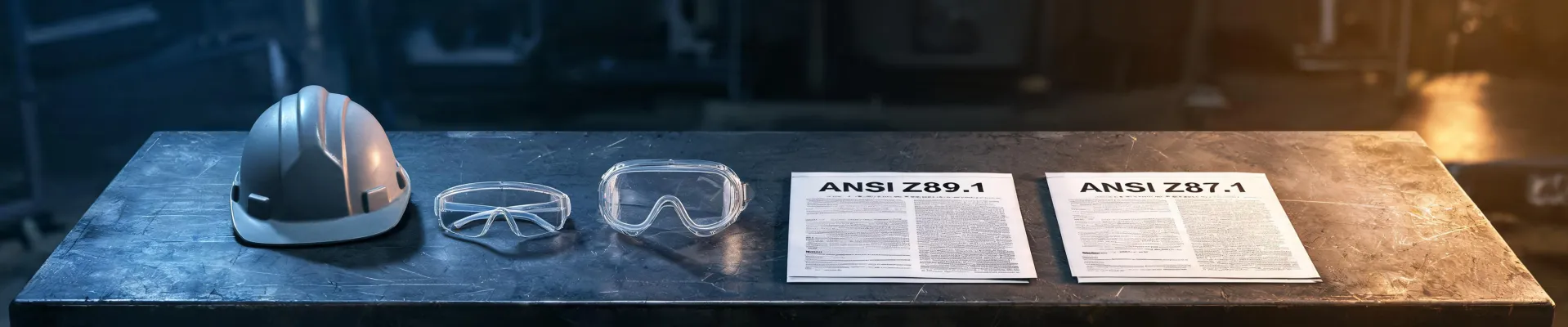
In ANSI Z89.1 terms, Type 2 helmets protect against top and lateral impacts. Our old hats were Type 1 only. That wasn’t the main reason we switched, but it gave the safety committee an easy way to justify the change beyond comfort.
We also looked at Pyramex Ridgeline hard hats, which are full brim style. The Ridgeline has a more classic shape and a wider brim for outdoor sun. In the end, we didn’t have to pick one. That is one of the advantages of the Pyramex line: we could outfit the plant floor with the SL T2 and the yard crew with Ridgeline, with the same distributor, same billing terms, and one invoice.
Beyond the Helmet: Eyewear, Gloves, and Hearing
Head protection was the most visible change, but the total cost math applied everywhere. For example, we have Uvex safety glasses in our maintenance area. The workers like the coverage. I was not about to swap a product that people voluntarily wear, no matter what the price spread showed. But when I priced our grinding station, the variable was anti-fog coatings, not the frame color. In some conditions, the cheap lens fogs after a few weeks. A lens that gets cleaned, laid down, and replaced early is not a bargain.
For eyewear, the relevant mark in the U.S. is ANSI Z87.1. If a pair doesn’t have the Z87+ high-impact mark, I’m not buying it for grinding. That is a hard stop in our spec sheet.
Welding gloves were a similar category. We tested two pairs side by side: a $5 pair and a $9 pair. The cheap pair lasted about two weeks before the thumb seam failed. The other pair lasted almost seven weeks. For four welders, the extra $4 per pair reduced annual replacement orders enough to cover the difference. Unit price vs replacement cycle. That’s where the real money lives.
Then there was earplugs. One of our supervisors asked, “How does Loop earplugs work?” We weren’t going to hand out $30 consumer earplugs on the line, but the question stayed in my head. Loop-style earplugs use an acoustic channel to lower the overall volume while still letting speech through. It’s a different philosophy from foam plugs, which block essentially everything. For workers who say “I can’t hear when I put these in,” the willingness-to-wear problem is a safety problem. If a hearing protector is uncomfortable or isolating, workers leave it in the locker. And every missed day of wearing it raises exposure.
Per OSHA, once the eight-hour time-weighted average hits 85 dBA, a hearing conservation program is required. Our noise mapping showed we’re right around that threshold in the press and finishing areas. The exact earplug decision is still being discussed, but the TCO thinking changed the conversation: it’s not just decibel rating, it’s compliance rate.
The Result
When I finished the cost model, the “cheap” quote was no longer cheap. It had about 18% higher TCO once I included order splitting, rush shipping, restocking fees, and the estimated cost of reordering replacements earlier than expected. We ended up signing with a different distributor who offered a smaller per-unit discount but a bundled contract with predictable quarterly freight and a 90-day warranty on defects.
We cut our PPE SKUs from 27 to 9. We consolidated hard hats, eyewear, gloves, and hi-vis apparel into one order. The annual savings came to about $8,400—a little under 18% of the safety supplies budget—but the bigger win was the administrative time. Three things changed: fewer invoices, fewer stockouts, and fewer “why didn’t this order arrive” emails. In that order.
What I’d Do Differently
I wish I had tracked replacement cycles by job role sooner. I don’t have hard data on injury prevention savings from this switch, and I won’t pretend the spreadsheet measured that. What I can say anecdotally is that when we stopped forcing one generic product on every work area, the complaints dropped noticeably.
This approach worked for us, but our situation was specific: a 142-person shop, quarterly ordering, and a safety committee that is actually willing to meet. If you’re a decentralized construction site with dozens of foremen ordering independently, your TCO factors could be completely different.
My advice? Before you compare vendor prices, build the cost model. Include the hidden line items: freight, minimums, restocking, replacement rate, downtime. And if someone asks why you’re not taking the lowest bid, tell them TCO is not acronym theater—it’s how you avoid paying for the same hard hat twice.

Maeve Callahan
Maeve Callahan is a head-protection analyst covering Type I and Type II hard hats, climbing-style safety helmets, bump caps, chin straps, suspensions, liners, and face-shield carriers. She applies ANSI Z89.1, EN 397, and EN 12492 criteria while comparing impact attenuation, penetration resistance, lateral deformation, electrical class, retention strength, field of vision, mass, fit range, and temperature conditioning. Her guides help EHS teams, contractors, utilities, and buyers select helmet systems for overhead hazards, work at height, electrical exposure, accessory compatibility, and worker acceptance.