-
Does 'Pyramex Z87 Safety Glasses' Mean They're Certified?
-
Why Does the Pyramex Logo Look Different on Different Products?
-
How Do I Pick a Hard Hat Sun Shade That Fits Pyramex Hard Hats?
-
Do Doc Martens Work Boots Count as Safety Footwear?
-
Are Loop Earplugs Worth It?
-
Why Do Workers Stop Wearing Their Safety Glasses? (The Question Nobody Asks)
I'm the office administrator for a 140-person light manufacturing company. I handle PPE ordering—roughly $40,000 a year across six vendors—and I've placed more Pyramex orders than I can count: hard hats, safety glasses, bump caps, gloves, hi-vis, and accessories. This is the FAQ I wish someone had handed me when I first took over purchasing. No hype, just what I've learned ordering and troubleshooting this stuff.
Does 'Pyramex Z87 Safety Glasses' Mean They're Certified?
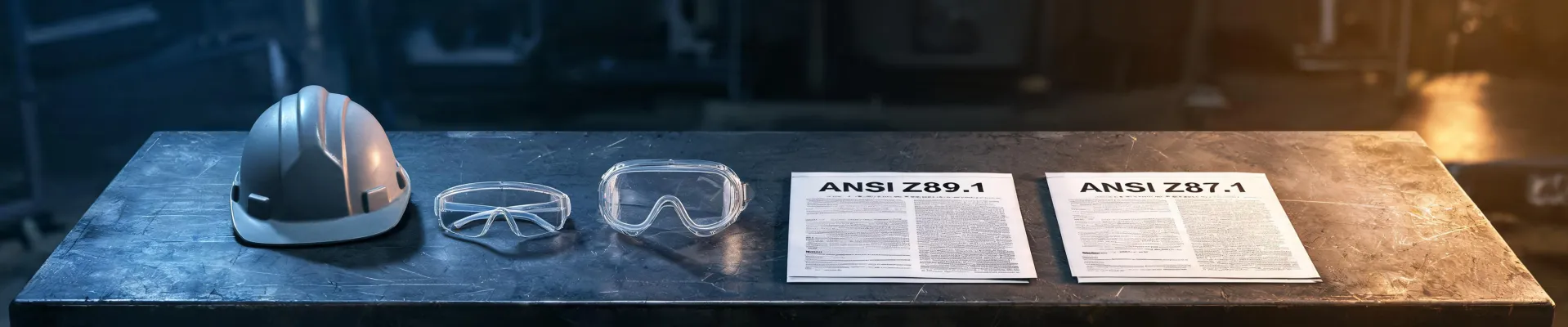
A lot of products list Z87 right in the title. It's easy to assume that means they all meet the same standard. The reality is the mark on the lens or frame matters more than the marketing copy. According to ANSI/ISEA Z87.1, a Z87 lens meets basic impact and optical requirements; a Z87+ lens also passes high-velocity and high-mass impact tests. When I order Pyramex Z87 safety glasses, I check the temple or lens for the mark—not just the product name.
Their product line covers clear, tinted, mirrored, anti-fog, and readers, so 'Z87' is a starting point, not the whole story. If the task involves welding, you might need a shade lens. If it's a humid warehouse, anti-fog matters more than tint. I've also learned that cost is not the main difference between glasses. The real issue is fit and coating. A $4 pair that fits is safer than a $15 pair that gets stuffed in a drawer.
Why Does the Pyramex Logo Look Different on Different Products?
I've had employees ask this after opening a new box. The short answer: don't buy based on the logo. Pyramex uses different branding across product lines—some glasses have a subtle Pyramex logo on the temple, some packaging has the full word mark, and some accessories just carry a model number. If you're verifying authenticity, the model number and the safety marks are more reliable than the icon in the corner.
In 2024 I nearly rejected an order because the logo looked smaller than the previous batch. Turns out it was just a packaging refresh from the distributor. (Thankfully I checked before making a fuss.) If you need exact branding for inventory or reimbursable orders, ask your distributor for the official spec sheet. Don't rely on a product photo that may be older than the current stock.
How Do I Pick a Hard Hat Sun Shade That Fits Pyramex Hard Hats?
A hard hat sun shade is an afterthought—until summer. Then it's the thing people ask for most. There are a few styles: clip-on brim shades, foldable fabric drapes, and wrap-around neck capes. Some are universal; some are designed specifically for cap-style or full-brim hard hats. Pyramex carries both hard hats and accessories, so I usually order the matching brand unless the worker has an unusual head size.
Here's where I made my mistake. I ordered 40 'universal' sun shades from a secondary vendor. We tried to fit them on full-brim Pyramex hard hats, and they didn't clip on securely. We had 40 shades in the supply closet and a crew that was still hot. The vendor's universal design was really aimed at cap-style shells. That was a communication failure, not a product-quality failure. Now I verify the hard hat model before ordering, and if I'm not sure, I get a shade that is listed as compatible with full-brim Type 2 shells. 'Universal' is a marketing word, not a guarantee (surprise, surprise).
Do Doc Martens Work Boots Count as Safety Footwear?
I don't buy footwear, but employees ask me about it. (They ask everyone.) The honest answer is: the label matters more than the brand. Some Doc Martens work boots may be safety-rated, but if a style isn't marked with the right standard, the word 'work' in the name doesn't make it appropriate for tasks that require safety toes or puncture-resistant soles. Look for an ASTM F2413 mark on the boot or on the spec sheet.
In 2023, an employee showed up in a very expensive pair of work boots that didn't pass our workplace hazard assessment. It wasn't the brand's fault—they were built for light duty, not material handling. But the standard cleared up the disagreement before anyone got hurt. If your job site requires footwear, approve by standard, not by logo. That's true for boots and it's true for glasses too.
Are Loop Earplugs Worth It?
I have mixed feelings about Loop earplugs. For concerts, flights, and shared bedrooms, sure—they're small, reusable, and look nicer than foam plugs. If you're asking about them for everyday noise sensitivity, they can be worth it. But for occupational hearing protection, I'd be careful. Workplace hearing protection is often tied to OSHA's hearing conservation standard (29 CFR 1910.95). That system depends on labeled noise reduction ratings and proper fit.
Loop products list attenuation in different ways; some use European SNR values. A US employer's hearing protection program usually looks for an NRR on the label. I'm not 100% sure if Loop has added an NRR in recent years, so check the package before relying on them at work. For our press area, I stick with earplugs that show an NRR and fit-test properly.
Why Do Workers Stop Wearing Their Safety Glasses? (The Question Nobody Asks)
People assume the problem is laziness or comfort. Actually, the reason I hear most is fogging. You put on a pair of Z87 glasses, walk into a warm area, and the lenses fog. Suddenly the glasses are off. The solution is usually anti-fog coating or a model with venting. Many Pyramex Z87 safety glasses have anti-fog options, and upgrading from plain clear lenses cut our replacement requests more than any sign or policy.
This is one of those cases where cheap is expensive. We saved a dollar or two per pair with basic lenses, but workers kept taking them off. Switch to anti-fog lenses and you keep the glasses on faces—which is the whole point. Just don't buy random generic glasses online; check for the model number and the Pyramex logo so you know what you're actually getting. I learned that from an ordering mistake too.

Maeve Callahan
Maeve Callahan is a head-protection analyst covering Type I and Type II hard hats, climbing-style safety helmets, bump caps, chin straps, suspensions, liners, and face-shield carriers. She applies ANSI Z89.1, EN 397, and EN 12492 criteria while comparing impact attenuation, penetration resistance, lateral deformation, electrical class, retention strength, field of vision, mass, fit range, and temperature conditioning. Her guides help EHS teams, contractors, utilities, and buyers select helmet systems for overhead hazards, work at height, electrical exposure, accessory compatibility, and worker acceptance.