-
I Almost Specified the Wrong Hard Hat for 400 Workers
-
Four PPE Scenarios. Find Yours.
- Scenario 1: Hot Weather and Sun Exposure
- Scenario 2: Type 2 Hard Hat Compliance
- Scenario 3: Liquid Chemical Exposure
-
Scenario 4: Budget-Only Basics That Don't Get You Sued
-
How to Know Which Scenario You're In
-
The Bottom Line: Verify First, Buy Second
I Almost Specified the Wrong Hard Hat for 400 Workers
Back in Q2 2024, I sat in my office with two sample helmets on my desk. A client renewal was on the line: 400 units of Type 2 head protection, six figures, and a crew that had already filed 11 heat-related comfort complaints the summer before. I was leaning toward the premium European brand because of its reputation. Turned out, I almost spent 70% more for features our crew didn't notice, wouldn't use, and couldn't get replacement parts for.
After six years of managing PPE procurement—about $180,000 in cumulative spending tracked in our system—I've stopped asking "what's the best PPE?" There's no universal answer. There's only what fits your crew, your real hazards, and your price point.
So instead of telling you to buy one thing, I'm going to help you find your scenario and make the call with your eyes open.
Four PPE Scenarios. Find Yours.
Every buying decision I've witnessed—good or bad—falls into one of these four buckets:
- Outdoor heat exposure: Crews in direct sun, complaining about heavy gear, and taking hats off when they shouldn't.
- Lateral impact compliance: Type 2 hard hats required on paper, confusion about what that actually means.
- Liquid chemical splash: Workers handling acids, solvents, or caustics with a mixed bag of gloves and glasses.
- Budget-only basics: You just need compliant, durable gear that doesn't blow the quarterly budget.
Your answer changes everything. Here's my breakdown of each scenario.
Scenario 1: Hot Weather and Sun Exposure
If your crew works outside in summer—roofing, road construction, utilities—you know the drill. The hard hat gets hot, the sweat runs down, and the hat comes off. Then someone gets hurt.
This is where the Pyramex Ridgeline full brim hard hat earns its keep. The cooling liner sold me during our trial. I was the skeptic at the table when the rep first showed us one of these—figured it was the same shell as anything else. But we put 20 units on a road crew in July. Heat-related complaints dropped by half compared to the previous standard-issue helmets.
The full brim does double duty. It gives shade for the neck and ears, and it channels rain away from the face instead of straight down your collar. That sounds minor until you watch a crew get caught in an afternoon thunderstorm and keep working because their eyes aren't streaming water.
Pair It with Heatwave Safety Glasses
The Heatwave safety glasses earned a spot in our rotation for a specific reason: the anti-fog coating. Our welders would transition from the hot shop floor into the cooler morning air and their old lenses fogged up instantly. Complaints fell almost to zero after we switched to the Heatwave line. The wraparound coverage is decent for impact protection, and they pass the ANSI Z87.1 high-impact test.
Are they the most advanced eye protection on the market? No. Are they good enough for 90% of the tasks our guys do? Absolutely. And workers actually wear them—which is the whole point.
One warning: don't confuse a bump cap with a hard hat for this scenario. Bump caps handle bumps against overhead obstructions. They are not rated for falling objects. Subbing one in for a Type 1 or Type 2 helmet when there's any falling-object risk is the kind of shortcut that gets people hurt and procurement managers fired.
Scenario 2: Type 2 Hard Hat Compliance
Now the question I get asked most: Pyramex vs. Kask—which is better? I've been on both sides of that decision.
What "Type 2" Actually Means
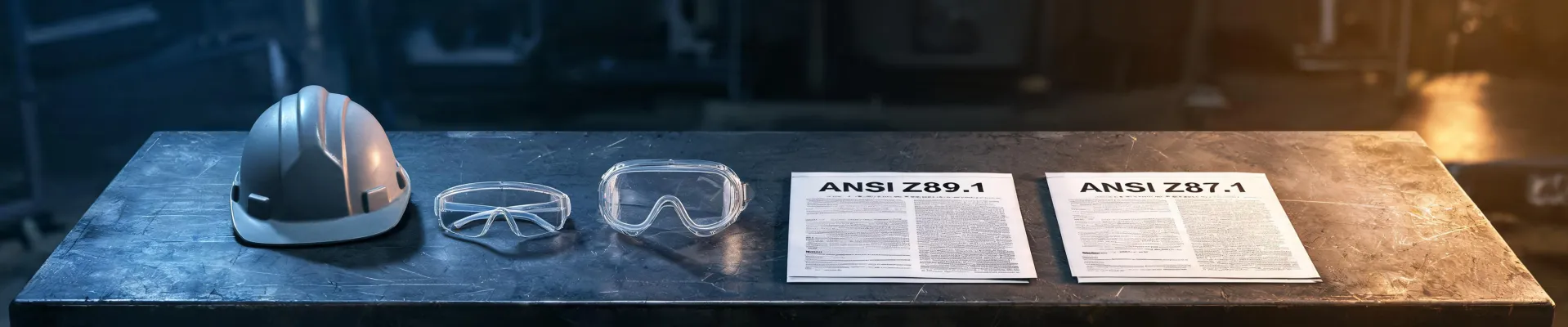
A Type 2 hard hat protects against both top impact and lateral impact. Per ANSI Z89.1-2014, Type 1 only covers a blow to the top of the head. If your risk assessment identifies lateral impact hazards—working around swings, moving loads, tight confined spaces—then Type 2 is a requirement, not a nice-to-have.
The Pyramex Ridgeline is a Type 2 full-brim helmet. Kask also makes Type 2 options (the Kask Super Plasma is their most well-known). Both meet the standard. That's where the similarity ends.
Pyramex Ridgeline vs. Kask Super Plasma: My Honest Take
I went back and forth between these two for two weeks. The Kask is noticeably lighter and, on paper, the premium option. Some of our supervisors loved the way it felt. The Ridgeline is heavier, but it's also 40–50% cheaper per unit, and replacement suspension kits cost a fraction of the Kask equivalent.
What tipped me? I ordered samples of both and handed them to the crew—not just the safety committee. The Ridgeline's ratchet adjustment mechanism felt more robust after six weeks of daily use. One of our senior guys put it best: "The Kask feels nicer in the break room. The Ridgeline feels like it'll survive getting thrown in the truck bed."
That's not a knock on Kask. It's a genuinely well-engineered helmet. If you have the budget and your workers ask for it, you're not making a mistake choosing Kask. But if you're equipping dozens—or hundreds—of workers, and you're tracking total cost per year of service, the Ridgeline delivers the same certification at a price that lets you reinvest the savings into other PPE gaps.
One lesson I learned the hard way: verify accessory availability before you commit to a model. I assumed "same specifications" meant identical accessory ecosystems across vendors. Didn't verify. Turns out the premium brand's chin straps and face shield mounts were back-ordered for months. A compliance deadline doesn't care about your aesthetic preference.
Scenario 3: Liquid Chemical Exposure
The most common safety question I hear—and probably why you're here too—is: "Which PPE can protect you from liquid chemicals?"
The honest answer: it depends on the chemical. If any supplier tells you one product solves all splash hazards, they're selling, not solving.
Here's what I mean. Your Safety Data Sheet (SDS) specifies the required protective equipment for each chemical on your site. Different chemicals attack different materials. Nitrile gloves resist many solvents but not all. PVC aprons handle many acids but not every concentration. Nothing handles all of it.
The Three-Layer Approach That Actually Works
For splash risks, the right composition is:
- Primary layer — Chemical splash goggles with indirect ventilation. Ordinary safety glasses—even good ones like the Heatwave—leave gaps around the edges. A splash from overhead or from a pressurized line gets in. You need goggles that meet ANSI Z87.1 for chemical protection specifically.
- Secondary layer — Face shield for high-risk tasks. Decanting, opening lines, anything where a face-level splash is plausible. A face shield over goggles, not instead of them.
- Supporting layer — Gloves and aprons matched to the SDS. Check the chemical compatibility chart on the glove manufacturer's website. I've seen crews assume "chemical gloves" means anything from the bin. That assumption led to a hand injury last year on a neighboring site. Not on mine. I made sure of that.
And here's the prevention rule I live by: verify compatibility before anyone gets it on their skin. Five minutes checking the SDS and the chemical resistance chart is the cheapest insurance in the industry. I don't care if it's a $4 pair of gloves or a $40 face shield—if it's not compatible with the specific chemical, it's decoration.
Scenario 4: Budget-Only Basics That Don't Get You Sued
I fully respect the position where you just need compliant PPE without bells and whistles. Not every operation needs a premium Type 2 helmet.
For basic top-impact protection, Pyramex's standard cap-style hard hats meet ANSI Z89.1 Type 1 requirements at a price point that doesn't wreck your quarterly numbers. No, they don't have the cooling liner or the lateral impact rating. But if your hazard assessment says top-impact only, paying 3x more for protection you don't need is inefficient spending—and a cost controller will always tell you to place money where the real risk lives.
Pair that with a no-frills spectacle like the Heatwave safety glasses, and you have a compliant, wearable kit at a defensible cost. That's not sexy. It's procurement.
How to Know Which Scenario You're In
Here's the self-audit I run before every PPE decision:
- Pull your last three incident reports or near-miss notes. What's the actual hazard pattern? Falling objects, splash exposure, or heat-related incidents?
- Check the contract spec. Does the job site require Type 2-rated protection? If not, you have room to choose by cost and comfort.
- Ask the crew. I can't overstate this one. The most expensive PPE is the PPE people won't wear. We trial anything that affects comfort.
- Calculate TCO, not unit price. Shell price, replacement suspension kits, accessory availability, and expected service life. Two helmets with identical upfront costs can differ by a factor of two over a three-year lifecycle.
And if you're still stuck after that audit, order samples. For the cost of one or two lunches per worker, you can verify fit, comfort, and compatibility before making a five-figure commitment. I built a cost calculator after getting burned on hidden fees twice. A sample order is the cheapest insurance available.
The Bottom Line: Verify First, Buy Second
Whether you're choosing between the Pyramex Ridgeline and Kask for Type 2 protection, deciding if Heatwave safety glasses fit your eye hazard profile, or figuring out which PPE stops liquid chemicals, the process is the same. Five minutes of verification beats five days of correction.
That's the lesson I carried from auditing our 2023 spending—nearly 18% of our budget overruns came from rush orders and emergency replacements after improper PPE failed. We now operate a simple policy: anything new gets a sample order, anything dangerous gets a pre-task compatibility check. Our overruns dropped by a third.
Use the questions above to find your scenario. Test the gear with the people who'll wear it. And if you get it wrong the first time, don't repeat it. That's the only real mistake I've seen in six years of buying safety equipment: buying in bulk before verifying what works.

Maeve Callahan
Maeve Callahan is a head-protection analyst covering Type I and Type II hard hats, climbing-style safety helmets, bump caps, chin straps, suspensions, liners, and face-shield carriers. She applies ANSI Z89.1, EN 397, and EN 12492 criteria while comparing impact attenuation, penetration resistance, lateral deformation, electrical class, retention strength, field of vision, mass, fit range, and temperature conditioning. Her guides help EHS teams, contractors, utilities, and buyers select helmet systems for overhead hazards, work at height, electrical exposure, accessory compatibility, and worker acceptance.