-
The Three Mistakes That Broke My Default Settings
-
Zone II and Trulock: Two Pyramex Models, Two Different Jobs
-
Photochromic Safety Glasses: The Truth Nobody Tells You
-
Smoke Detector vs Carbon Monoxide Detector: The Same Pattern
-
What Boots Taught Me About Compliance
-
What Vendors Won't Tell You
-
When I'm Wrong (and When This Advice Doesn't Apply)
Six years ago I placed my first bulk PPE order as safety coordinator for a 140-person manufacturing crew. It was $3,600 of safety glasses, and roughly half of them ended up in storage because I thought "safety glasses" was one category and my job was just to find the best price. The most expensive safety glasses I've ever bought were also the cheapest ones I could find.
Here's the conclusion up front: stop choosing eyewear by price, by looks, or by whatever the distributor is pushing that month. Choose by how the lens behaves on a real face in a real environment — fogging, fit, tint — and verify the compliance mark on every unit before you accept delivery. Get that right and the rest of the program runs cleaner. Get it wrong and you're not saving money; you're building a pile of unused gear.
Why should you trust that? I've handled PPE ordering for the same plant since 2019. I've personally made and documented eleven significant procurement mistakes, totaling roughly $4,700 in wasted budget. That doesn't count the near-miss caused by one of them. I now maintain our team's PPE selection checklist, and in the past 18 months we've caught 47 potential gear mismatches before they hit the floor.
The Three Mistakes That Broke My Default Settings
In 2019, I ordered 240 pairs of basic safety glasses without anti-fog coating. The plant runs a concrete grinding line, and the humidity is brutal. Within 45 minutes of the shift start, people were pulling the glasses off to wipe them. By the second week, most of the crew was carrying them on their hard hats like a badge of intent. Then a near-miss happened: a wire brush kicked debris toward a guy who was clearing his lenses at exactly the wrong moment. Nobody got badly hurt, but the plant manager went red, and my $1,100 order turned into a $2,300 panic reorder with anti-fog lenses plus a mandatory tool-box talk.
The takeaway should've been obvious: fogging is a safety issue, not a comfort issue. But I repeated the pattern.
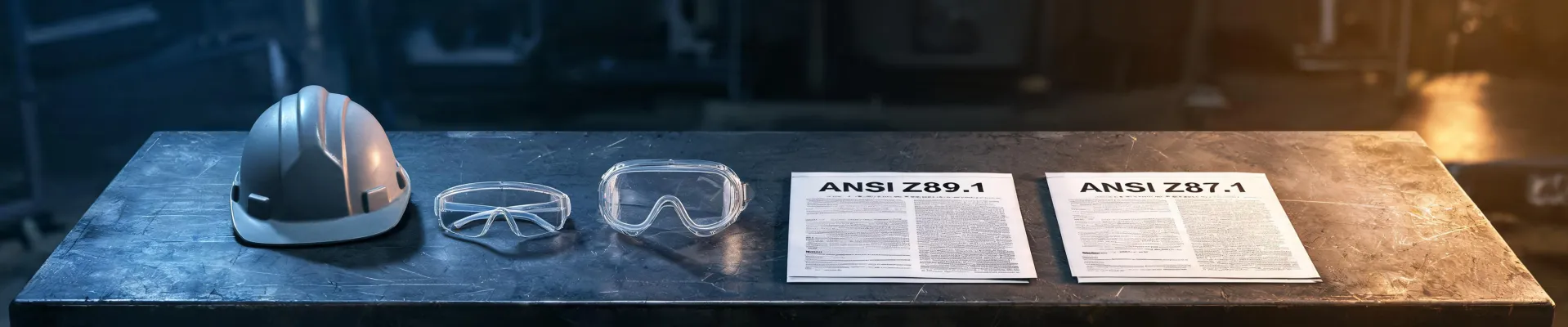
In 2021, I switched suppliers to save eighteen cents a pair. The website said the glasses met ANSI Z87.1. I had two days to place the order because the previous supplier was out of stock — no time for samples. I approved it. When the boxes arrived, I did a random check and found no Z87 marking on the lenses or the frame. The supplier said the model line generally passed but couldn't explain why this batch lacked the mark. I returned them, paid a 15% restocking fee, and lost a week of lead time. The lesson stuck: the only compliance evidence that counts is the mark on the item in your hand. In the U.S., OSHA 29 CFR 1910.133 makes the employer responsible for ensuring eye protection matches the hazard assessment — a vendor can't do that for you.
And in 2022, I bought glasses that looked tough — heavy, fully framed, dominating the face. The crew hated them. They wore them when I was on the floor and took them off when I walked away. That's when I learned the counter-intuitive rule of PPE: a pair that nobody wears protects nobody, no matter what rating is printed on the frame.
Zone II and Trulock: Two Pyramex Models, Two Different Jobs
After that, I stopped buying on paper specs and started testing with the crew. The two models I kept in rotation were the Pyramex Zone II safety glasses and the Pyramex Trulock safety glasses. Both arrive with the Z87+ high-impact marking — I check that on every shipment now — but they solve different problems.
The Zone II is the workhorse. It wraps further around the face, which makes it a solid choice for overhead work and anything with dust drifting in from the side. Guys with wider faces tend to prefer it. It feels substantial when you're bending down and reaching up. If I hand one to a new worker without thinking, that's usually the one they keep.
The Trulock is the pair people forget they're wearing. The frame is lighter on the temples and sits closer to the face. It looks closer to normal eyewear, which sounds cosmetic but isn't. In my experience, the guy who complains about a heavy frame all day will wear the Trulock through a full shift without touching them. And that's exactly why it prevents more injuries than the "safer-looking" model: it stays on faces. If the glasses are sitting in a locker, the Z87+ mark is just optimistic coloring on plastic.
Photochromic Safety Glasses: The Truth Nobody Tells You
I added photochromic safety glasses to our list after three dock workers told me they couldn't see properly moving between the bright yard and the dim warehouse with clear lenses. Automatic tinting sounded like the perfect fix. It is — until you know its limits.
First, photochromic lenses do not darken inside a vehicle. The windshield blocks the UV light that triggers them. So a worker driving between sites steps out of the truck and waits — sometimes fifteen to twenty seconds — for the lenses to catch up. Not a safety failure, but a surprise if you didn't know.
Second, the un-darkening process gets slower in cold weather. Walk into an unheated warehouse in January, and the lenses take longer to clear. That's normal lens chemistry, not a defect. But for someone moving rapidly between light conditions, it matters.
Does that mean photochromic isn't worth it? Not at all. For the indoor/outdoor crew, it's genuinely useful. I'd just stop expecting one lens to be perfect for every task. It's the same pattern as the smoke detector thing — full explanation in a second.
Smoke Detector vs Carbon Monoxide Detector: The Same Pattern
Last year I ran a short safety quiz at new-hire orientation. One question asked for the difference between a smoke detector and a carbon monoxide detector. About 60% of the crew couldn't answer.
The answer matters: a smoke detector senses particles of fire. A carbon monoxide detector senses CO gas. They solve different problems, and having one doesn't cover the other. You can install smoke detectors in every room and still be unprotected against carbon monoxide.
I see the same confusion in PPE purchasing. A compliant pair of safety glasses covers the hazards you verified — but it doesn't cover fogging, doesn't automatically handle bright-to-dim transitions, and doesn't help if the worker won't keep it on. Thinking one gear item covers all eye hazards is like thinking a smoke detector covers gas. Different hazards need different tools.
What Boots Taught Me About Compliance
I'm not a footwear specialist, but I've watched a lot of workers step out of cheap, stiff company-issued boots into something they chose themselves. The difference is obvious.
A couple of our dock guys swear by Brunt work boots. They bought them out of their own pocket, because the boots fit comfortably on day one and didn't cost a fortune. That says a lot: these are people who walk on concrete all day and will happily spend their own money on the pair that doesn't punish them. Nobody goes back to the blister boot.
Why do we happily let people choose their own boots but buy their safety glasses from a spreadsheet? Looking back, I should have ordered a $60 sample pack of three or four eyewear models before every bulk order. Sending those around the crew for a week sounds like a slowdown, but it's the fastest way to find the pair they'll actually wear. It would have saved me thousands in reorders and restocking fees.
What Vendors Won't Tell You
Here's something most buyers don't realize: PPE suppliers will process a bulk order without ever asking what the glasses are for. They'll take the PO, route the boxes, and move on. If the order doesn't match your hazard assessment, that's not their problem. The "one-size-fits-all safety glasses" idea comes from an era when polycarbonate was the only practical option and everything looked like industrial utility. That era is gone — anti-fog coatings, tint levels, side-shield designs, photochromic chemistry — and the buying decision is more specific because of it. But compliance verification is still your signature, not theirs.
Also, don't sleep on the efficiency side. The fix that straightened out our process wasn't a fancy platform. I moved our hazard assessment, PPE matrix, and order form into one shared document, so when a foreman requests new glasses, the lens behavior and rating required for that task are visible before the approval goes through. That one digital change cut our reorder rate and turned a multi-day email chain into a two-minute lookup. Fewer manual checks, fewer mistakes. That's the kind of efficiency I'd argue for: not automation for its own sake, but removing the step where I kept proving I was too rushed to be reliable.
When I'm Wrong (and When This Advice Doesn't Apply)
I don't want to oversell my checklist. If your crew is welding, photochromic lenses are the wrong answer entirely — you need shade-rated filter lenses for arc radiation, not automatic tinting. If your crew works in a clean, low-impact environment, a basic Z87 lens might be plenty, and I'd be over-engineering your problem.
I also haven't tested every brand out there. MSA, 3M, Honeywell, Lincoln Electric — I've seen workers wearing their gear, and good products exist beyond Pyramex. I keep coming back to Zone II and Trulock because I've seen them perform at scale, not because other manufacturers can't make a solid pair of glasses. If another brand fits your people better and carries the right markings, that's a reasonable choice.
To be fair to the cheap glasses in that first order: they weren't junk. They were the wrong tool for a hot, humid, grinding environment. In a dry office with no impact hazard, they might have been fine. But I'd still want the Z87 mark on whatever I buy.
The pattern that finally worked for me: start with the hazard assessment. Pick the lens behavior that matches the job. Verify the mark on the physical item. Hand a sample to a worker and listen when they say it fogs, pinches, or feels heavy. That's not pampering them — it's the difference between gear in the hands and gear in the locker.

Maeve Callahan
Maeve Callahan is a head-protection analyst covering Type I and Type II hard hats, climbing-style safety helmets, bump caps, chin straps, suspensions, liners, and face-shield carriers. She applies ANSI Z89.1, EN 397, and EN 12492 criteria while comparing impact attenuation, penetration resistance, lateral deformation, electrical class, retention strength, field of vision, mass, fit range, and temperature conditioning. Her guides help EHS teams, contractors, utilities, and buyers select helmet systems for overhead hazards, work at height, electrical exposure, accessory compatibility, and worker acceptance.